Department of Ophthalmology, Seongnam Citizens Medical Center, Seongnam, Republic of Korea.
Department of Ophthalmology, Samsung Medical Center, Sungkyunkwan University School of Medicine, Seoul, Republic of Korea.
PLoS One. 2021 Mar 4;16(3):e0246245. doi: 10.1371/journal.pone.0246245. eCollection 2021.
To investigate the comparative efficacy of intense pulsed light (IPL) therapy alone with that of IPL plus meibomian gland expression (MGX) for meibomian gland dysfunction (MGD).
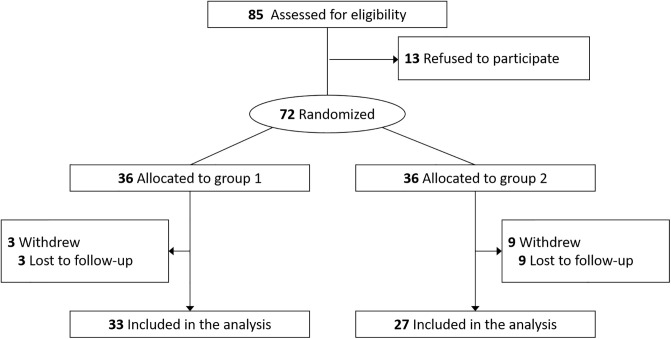
This is a prospective randomized crossover clinical trial. Sixty patients were enrolled and randomly assigned to two groups. All of patients underwent four treatment sessions in total, which were two weeks apart. Group 1 underwent two sessions of IPL therapy with MGX, as well as two sessions of IPL alone. Group 2 received two sessions of IPL therapy alone, and two sessions of IPL therapy with MGX. The following parameters were measured at baseline (BL), 2 weeks after the second treatment session (FU1), and 2 weeks after the fourth treatment session (FU2): tearfilm break-up time (BUT), Oxford grade for corneal staining, meibomian gland expressibility (MGE), meibum quality (MQ), and ocular surface disease index (OSDI). The separate effect of MGX on improvement of MGD parameters was evaluated using generalized estimating equation (GEE).
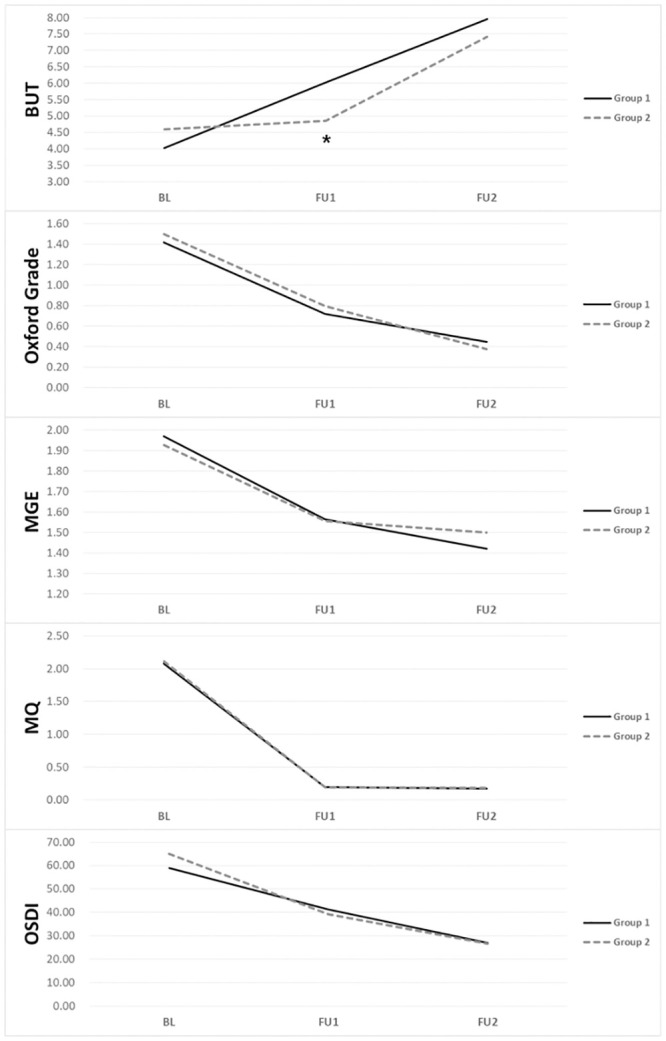
The mean age of the participants was 57.52 ± 10.50 years. The BUT, Oxford grade, MGE, MQ, and OSDI of both groups improved significantly (from baseline) by the end of four treatment sessions (FU2 compared to BL; all p-values <0.05). The MGE and MQ significantly improved after the first and second treatment sessions (FU1 compare to BL; all p-values < 0.001). However, the improvement was not statistically significant after the third and fourth treatment sessions (FU2 compared to FU1; p-value of 0.388 for MGE and 0.645 for MQ in group 1, 0.333 for MGE and 0.333 for MQ in group 2). The IPL plus MGX therapy produced greater improvements in the BUT scores than did IPL therapy alone (p = 0.003 by GEE). In contrast, the Oxford grade, MGE, MQ, and OSDI were not influenced by the addition of MGX to IPL (p = 0.642, 0.663, 0.731, and 0.840, respectively by GEE).
IPL therapy effectively improves the subjective symptoms and objective ocular findings of MGD. MGX enhanced the improvement of BUT driven by IPL therapy. The meibomian gland function (MGE and MQ) recovers faster in response to IPL therapy than did the other parameters.
研究强脉冲光(IPL)治疗单独应用与 IPL 联合睑板腺按摩(MGX)治疗对睑板腺功能障碍(MGD)的疗效比较。
这是一项前瞻性随机交叉临床试验。共纳入 60 名患者,并随机分为两组。所有患者均接受 4 次治疗,每次治疗间隔 2 周。第 1 组接受 2 次 IPL 联合 MGX 治疗,2 次 IPL 单独治疗;第 2 组接受 2 次 IPL 单独治疗,2 次 IPL 联合 MGX 治疗。在基线(BL)、第 2 次治疗后 2 周(FU1)和第 4 次治疗后 2 周(FU2)测量以下参数:泪膜破裂时间(BUT)、角膜染色牛津分级、睑板腺分泌功能(MGE)、睑脂质量(MQ)和眼表疾病指数(OSDI)。采用广义估计方程(GEE)评估 MGX 对改善 MGD 参数的单独作用。
参与者的平均年龄为 57.52±10.50 岁。两组的 BUT、牛津分级、MGE、MQ 和 OSDI 在 4 次治疗结束时(FU2 与 BL 相比;所有 p 值均<0.05)均显著改善。第 1 次和第 2 次治疗后 MGE 和 MQ 均明显改善(FU1 与 BL 相比;所有 p 值均<0.001)。然而,第 3 次和第 4 次治疗后改善不具有统计学意义(FU2 与 FU1 相比;第 1 组的 MGE 和 MQ 的 p 值分别为 0.388 和 0.645,第 2 组的 MGE 和 MQ 的 p 值分别为 0.333 和 0.333)。与 IPL 治疗相比,IPL 联合 MGX 治疗可显著提高 BUT 评分(p=0.003 采用 GEE)。相比之下,MGX 对 IPL 联合 MGX 治疗的牛津分级、MGE、MQ 和 OSDI 无影响(p=0.642、0.663、0.731 和 0.840,分别采用 GEE)。
IPL 治疗可有效改善 MGD 的主观症状和客观眼部发现。MGX 增强了 IPL 治疗对 BUT 的改善作用。MGX 联合 IPL 治疗对睑板腺功能(MGE 和 MQ)的恢复速度快于其他参数。