Department of Clinical and Molecular Medicine, Norwegian University of Science and Technology, Trondheim, Norway
Clinic of Clinical Services, St. Olavs Hospital, Trondheim University Hospital, Trondheim, Norway.
BMJ Open. 2021 Mar 4;11(3):e042147. doi: 10.1136/bmjopen-2020-042147.
To determine whether videos taken by parents of their infants' spontaneous movements were in accordance with required standards in the In-Motion-App, and whether the videos could be remotely scored by a trained General Movement Assessment (GMA) observer. Additionally, to assess the feasibility of using home-based video recordings for automated tracking of spontaneous movements, and to examine parents' perceptions and experiences of taking videos in their homes.
The study was a multi-centre prospective observational study.
Parents/families of high-risk infants in tertiary care follow-up programmes in Norway, Denmark and Belgium.
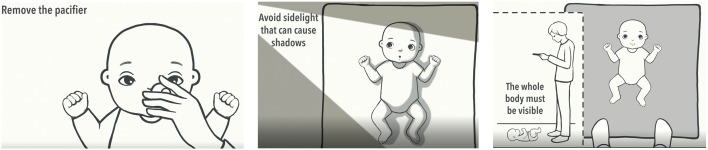
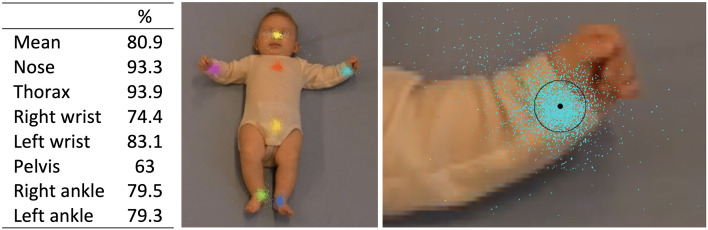
Parents/families were asked to video record their baby in accordance with the In-Motion standards which were based on published GMA criteria and criteria covering lighting and stability of smartphone. Videos were evaluated as GMA 'scorable' or 'non-scorable' based on predefined criteria. The accuracy of a 7-point body tracker software was compared with manually annotated body key points. Parents were surveyed about the In-Motion-App information and clarity.
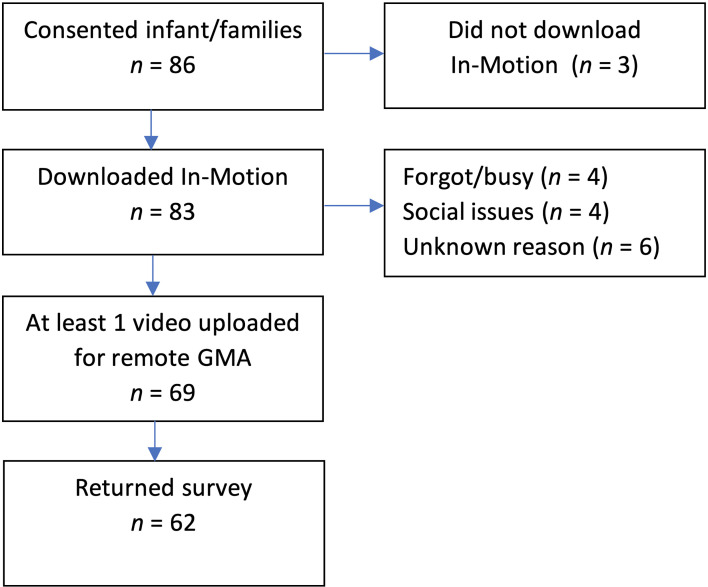
The sample comprised 86 parents/families of high-risk infants.
The 86 parent/families returned 130 videos, and 121 (96%) of them were in accordance with the requirements for GMA assessment. The 7-point body tracker software detected more than 80% of body key point positions correctly. Most families found the instructions for filming their baby easy to follow, and more than 90% reported that they did not become more worried about their child's development through using the instructions.
This study reveals that a short instructional video enabled parents to video record their infant's spontaneous movements in compliance with the standards required for remote GMA. Further, an accurate automated body point software detecting infant body landmarks in smartphone videos will facilitate clinical and research use soon. Home-based video recordings could be performed without worrying parents about their child's development.
NCT03409978.
确定父母拍摄婴儿自发运动的视频是否符合“In-Motion-App”的要求标准,以及经过培训的 GMAT 观察者是否可以远程对视频进行评分。此外,评估使用基于家庭的视频记录进行自发运动自动跟踪的可行性,并检查父母对在家中拍摄视频的看法和经验。
该研究为多中心前瞻性观察研究。
挪威、丹麦和比利时的三级保健随访计划中的高危婴儿的父母/家庭。
要求父母/家庭按照“In-Motion”标准拍摄婴儿的视频,该标准基于已发表的 GMAT 标准和涵盖智能手机照明和稳定性的标准。根据预设标准,将视频评估为 GMAT“可评分”或“不可评分”。比较了 7 点身体跟踪软件与手动注释身体关键点的准确性。向父母调查“In-Motion-App”信息和清晰度。
该样本包括 86 名高危婴儿的父母/家庭。
86 位父母/家庭共返回了 130 个视频,其中 121 个(96%)符合 GMAT 评估要求。7 点身体跟踪软件正确检测到超过 80%的身体关键点位置。大多数家庭发现拍摄婴儿的说明很容易遵循,超过 90%的家庭报告说,他们在使用说明时并没有对孩子的发育感到更加担忧。
这项研究表明,一段简短的教学视频使父母能够按照远程 GMAT 所需的标准录制婴儿的自发运动视频。此外,一种准确的自动身体点软件可以在智能手机视频中检测到婴儿的身体地标,这将有助于临床和研究使用。基于家庭的视频记录可以在不使父母担心孩子发育的情况下进行。
NCT03409978。