Li Shanshan, Liu Yize, Qiu Guanzhen, Luo Yinzhou, Luan Lan, Xu Tiance, Wang Yong, Xia Shuyue
Respiratory Department, Central Hospital Affiliated to Shenyang Medical College, Shenyang, Liaoning, 110024, People's Republic of China.
4th Department of Orthopedics, Central Hospital Affiliated to Shenyang Medical College, Shenyang, Liaoning, 110024, People's Republic of China.
Cancer Manag Res. 2021 Feb 25;13:1967-1979. doi: 10.2147/CMAR.S287386. eCollection 2021.
Non-coding RNAs, including long non-coding (lnc)RNAs and microRNAs (miRs), play crucial roles in numerous malignant tumors, including non-small cell lung cancer (NSCLC).
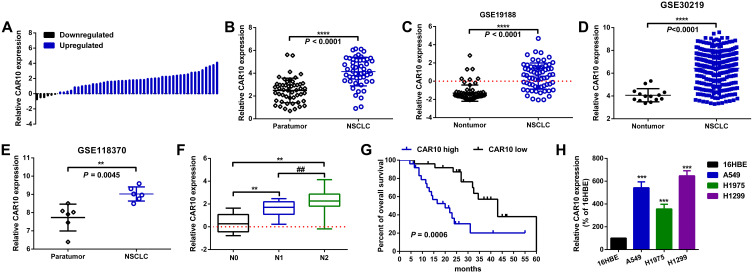
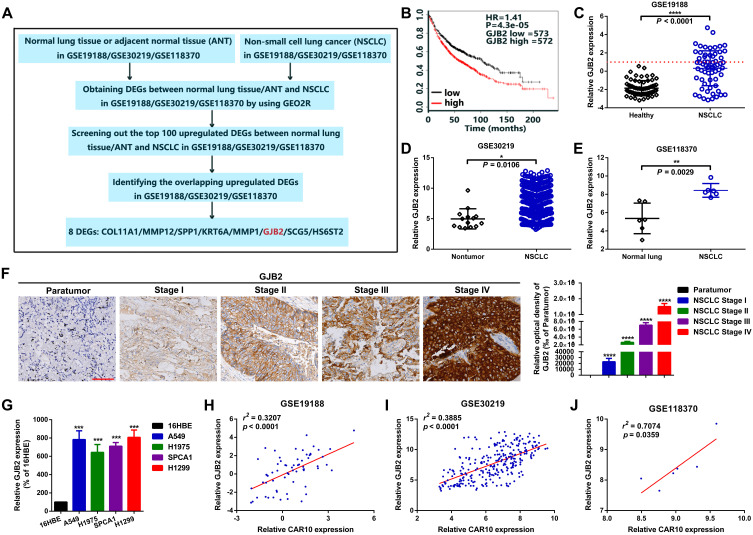
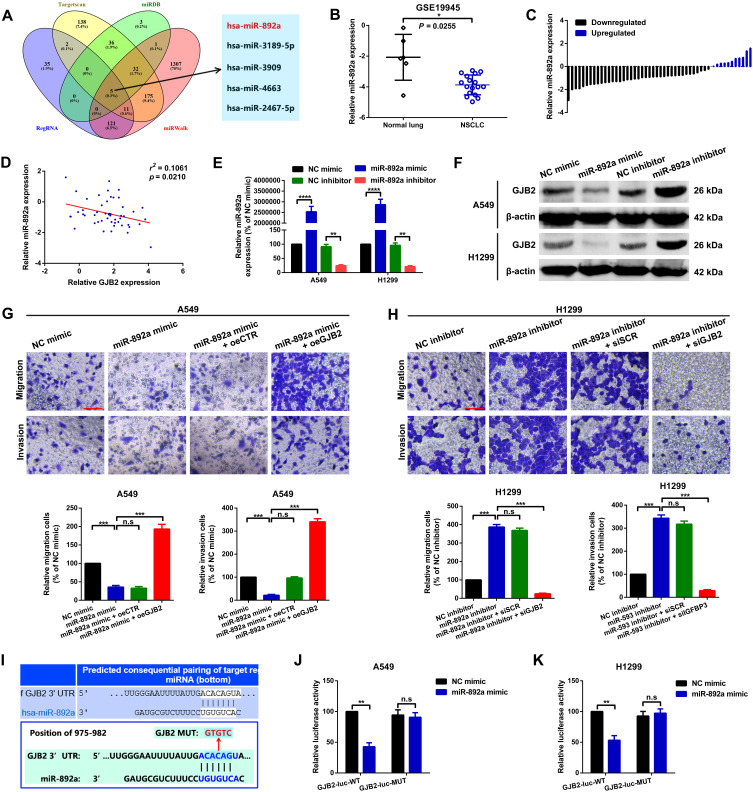
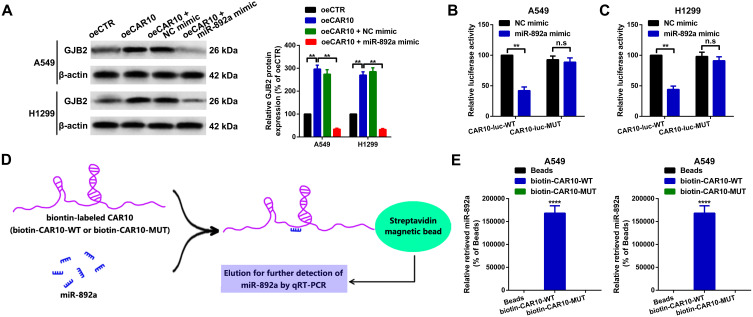
The expression levels of chromatin-associated RNA Intergenic 10 (CAR10), gap junction protein beta 2 (GJB2) and miR-892a in NSCLC were evaluated by reanalyzing three Gene Expression Omnibus (GEO) datasets, and performing reverse transcription-quantitative PCR, immunohistochemistry staining and Western blot analysis, accordingly. Functionally, Transwell and Matrigel assays were performed to measure changes in the migration and invasion abilities of the A549 and H1299 cell lines. The targeted binding effects between CAR10 and miR-892a, as well as between miR-892a and GJB2 were confirmed by conducting dual-luciferase reporter and RNA pull-down assays, respectively.
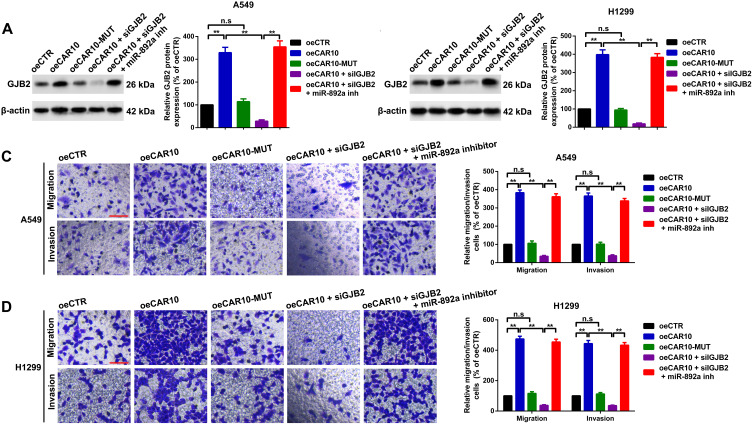
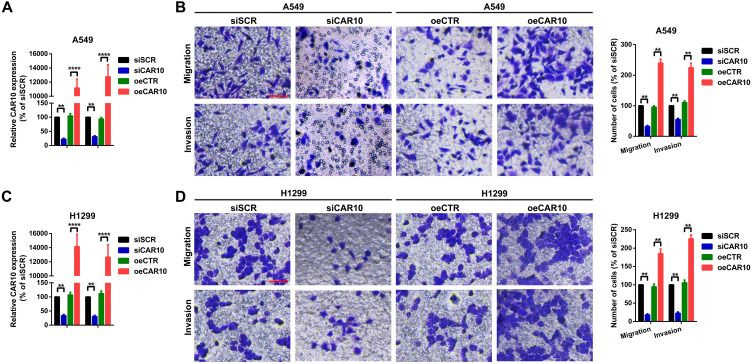
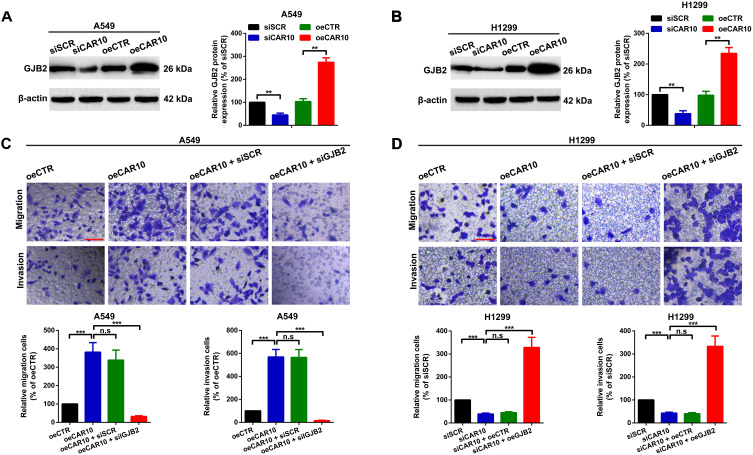
The present study demonstrated that CAR10 was upregulated in patients with NSCLC, which was also associated with a poor prognosis. Functionally, CAR10 was confirmed to be oncogenic and promoted NSCLC cell migration and invasion, using overexpression and knockdown Transwell assays. Furthermore, GJB2 expression was revealed to be upregulated and was positively correlated with CAR10 expression in NSCLC. A further mechanistic study revealed that GJB2 was a downstream target of CAR10, which induced the migration and invasive potential of the A549 and H1299 cell lines. More specifically, miR-892a was found to serve as a bridge between CAR10 and GJB2, via similar miRNA response elements. The RNA pull-down and luciferase assays indicated that miR-892a directly binds both CAR10 and GJB2.
CAR10 promoted NSCLC cell migration and invasion by upregulating GJB2 and sponging miR-892a. These findings illustrated that the CAR10/miR-892a/GJB2 axis may be a novel molecular target for the treatment of NSCLC.
非编码RNA,包括长链非编码(lnc)RNA和微小RNA(miR),在包括非小细胞肺癌(NSCLC)在内的众多恶性肿瘤中发挥着关键作用。
通过重新分析三个基因表达综合数据库(GEO)数据集,并相应地进行逆转录定量PCR、免疫组织化学染色和蛋白质印迹分析,评估NSCLC中染色质相关RNA基因间10(CAR10)、间隙连接蛋白β2(GJB2)和miR-892a的表达水平。在功能上,进行Transwell和基质胶实验以检测A549和H1299细胞系迁移和侵袭能力的变化。分别通过双荧光素酶报告基因实验和RNA下拉实验证实了CAR10与miR-892a之间以及miR-892a与GJB2之间的靶向结合作用。
本研究表明,NSCLC患者中CAR10表达上调,这也与预后不良相关。在功能上,通过过表达和敲低Transwell实验证实CAR10具有致癌性并促进NSCLC细胞迁移和侵袭。此外,NSCLC中GJB2表达上调且与CAR10表达呈正相关。进一步的机制研究表明,GJB2是CAR10的下游靶点,可诱导A549和H1299细胞系的迁移和侵袭潜能。更具体地说,发现miR-892a通过相似的微小RNA反应元件在CAR10和GJB2之间起桥梁作用。RNA下拉实验和荧光素酶实验表明,miR-892a直接与CAR10和GJB2结合。
CAR10通过上调GJB2和结合miR-892a促进NSCLC细胞迁移和侵袭。这些发现表明,CAR10/miR-892a/GJB2轴可能是治疗NSCLC的新分子靶点。