Wölk Ellen, Stengel Andreas, Schaper Selina Johanna, Rose Matthias, Hofmann Tobias
Department for Psychosomatic Medicine, Charité Center for Internal Medicine and Dermatology, Corporate Member of Freie Universität Berlin, Berlin Institute of Health, Charité - Universitätsmedizin Berlin, Humboldt-Universität zu Berlin, Berlin, Germany.
Department of Psychosomatic Medicine and Psychotherapy, University Hospital Tübingen, Tübingen, Germany.
Front Behav Neurosci. 2021 Feb 16;15:629729. doi: 10.3389/fnbeh.2021.629729. eCollection 2021.
Neurotensin and xenin are two closely related anorexigenic neuropeptides synthesized in the small intestine that exert diverse peripheral and central functions. Both act via the neurotensin-1-receptor. In animal models of obesity reduced central concentrations of these peptides have been found. Dysregulations of the acute and chronic stress response are associated with development and maintenance of obesity. Until now, associations of both peptides with stress, anxiety, depressiveness, and eating disorder symptoms have not been investigated. The aim of the present study was to examine associations of neurotensin and xenin with these psychological characteristics under conditions of obesity.
From 2010 to 2016 we consecutively enrolled 160 inpatients (63 men and 97 women), admitted due to obesity and its mental and somatic comorbidities. Blood withdrawal und psychometric tests (PSQ-20, GAD-7, PHQ-9, and EDI-2) occurred within one week after admission. We measured levels of neurotensin and xenin in plasma by ELISA.
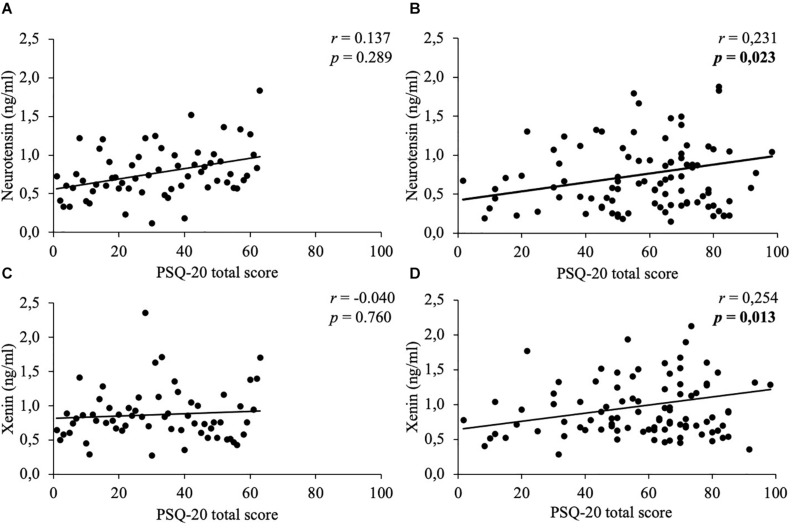
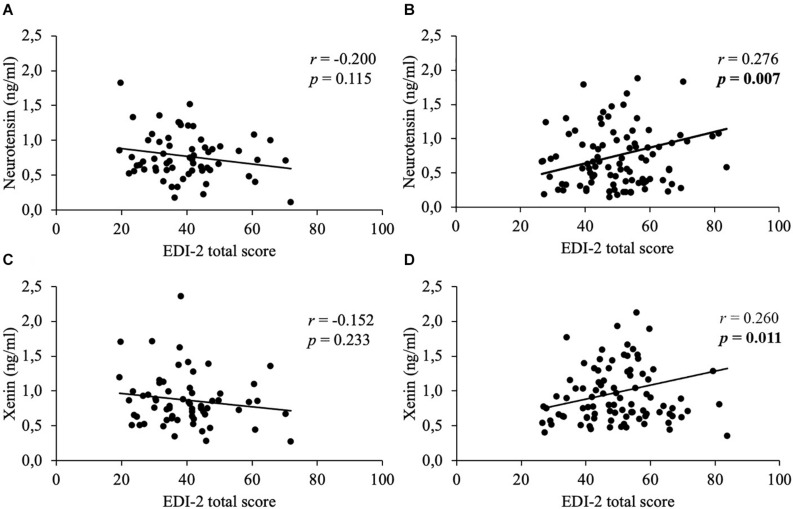
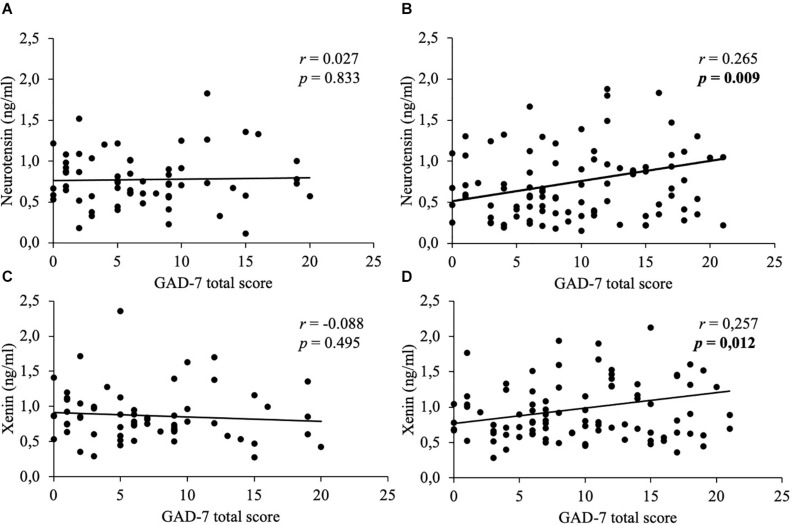
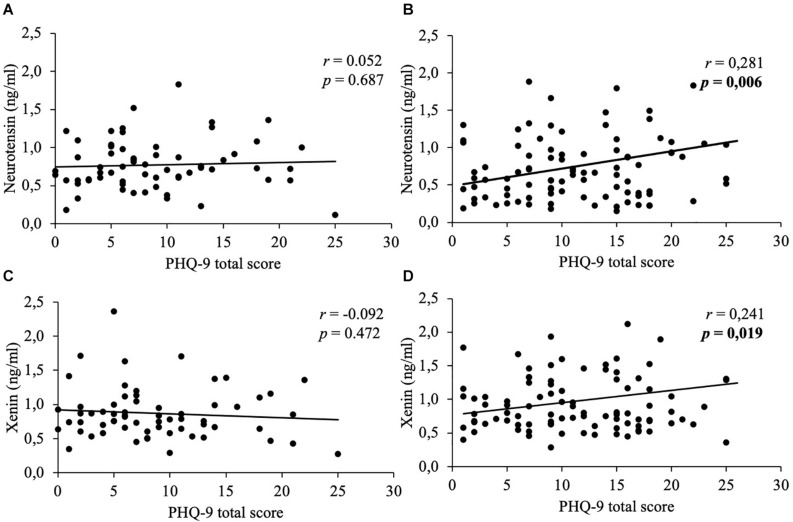
Mean body mass index was 47.2 ± 9.5 kg/m. Concentrations of neurotensin and xenin positively correlated with each other (women: = 0.788, < 0.001; men: = 0.731, < 0.001) and did not significantly differ between sexes ( > 0.05). Women generally displayed higher psychometric values than men (PSQ-20: 58.2 ± 21.7 vs. 47.0 ± 20.8, = 0.002; GAD-7: 9.7 ± 5.8 vs. 7.1 ± 5.3, = 0.004; PHQ-9: 11.6 ± 6.6 vs. 8.8 ± 5.9, = 0.008; EDI-2: 50.5 ± 12.8 vs. 39.7 ± 11.9, < 0.001). Only women showed positive correlations of both neuropeptides with stress (neurotensin: = 0.231, = 0.023; xenin: = 0.254, = 0.013), anxiety (neurotensin: = 0.265, = 0.009; xenin: = 0.257, = 0.012), depressiveness (neurotensin: = 0.281, = 0.006; xenin: = 0.241, = 0.019) and eating disorder symptoms (neurotensin: = 0.276, = 0.007; xenin: = 0.26, = 0.011), whereas, men did not ( > 0.05).
Neurotensin and xenin plasma levels of female obese patients are positively correlated with perceived stress, anxiety, depressiveness, and eating disorder symptoms. These associations could be influenced by higher prevalence of mental disorders in women and by sex hormones. In men, no correlations were observed, which points toward a sex-dependent regulation.
神经降压素和 Xenin 是两种在小肠中合成的密切相关的厌食性神经肽,具有多种外周和中枢功能。二者均通过神经降压素 -1- 受体发挥作用。在肥胖动物模型中,已发现这些肽的中枢浓度降低。急性和慢性应激反应失调与肥胖的发生和维持有关。迄今为止,尚未研究这两种肽与应激、焦虑、抑郁和饮食失调症状之间的关联。本研究的目的是在肥胖条件下,研究神经降压素和 Xenin 与这些心理特征之间的关联。
2010 年至 2016 年,我们连续招募了 160 名因肥胖及其身心合并症入院的住院患者(63 名男性和 97 名女性)。入院后一周内进行采血和心理测量测试(PSQ - 20、GAD - 7、PHQ - 9 和 EDI - 2)。我们通过 ELISA 法测量血浆中神经降压素和 Xenin 的水平。
平均体重指数为 47.2±9.5kg/m。神经降压素和 Xenin 的浓度彼此呈正相关(女性:r = 0.788,P < 0.001;男性:r = 0.731,P < 0.001),且性别之间无显著差异(P > 0.05)。女性的心理测量值总体上高于男性(PSQ - 20:58.2±21.7 对 47.0±20.8,P = 0.002;GAD - 7:9.7±5.8 对 7.1±5.3,P = 0.004;PHQ - 9:11.6±6.6 对 8.8±5.9,P = 0.008;EDI - 2:50.5±12.8 对 39.7±11.9,P < 0.001)。仅女性的两种神经肽与应激(神经降压素:r = 0.231,P = 0.023;Xenin:r = 0.254,P = 0.013)、焦虑(神经降压素:r = 0.265,P = 0.009;Xenin:r = 0.257,P = 0.012)、抑郁(神经降压素:r = 0.281,P = 0.006;Xenin:r = 0.241,P = 0.019)和饮食失调症状(神经降压素:r = 0.276,P = 0.007;Xenin:r = 0.26,P = 0.011)呈正相关,而男性则无(P > 0.05)。
女性肥胖患者的神经降压素和 Xenin 血浆水平与感知到的应激、焦虑、抑郁和饮食失调症状呈正相关。这些关联可能受女性精神障碍患病率较高和性激素的影响。在男性中未观察到相关性,这表明存在性别依赖性调节。