Dutta Anik, Croll Daniel, McDonald Bruce A, Barrett Luke G
Plant Pathology Institute of Integrative Biology ETH Zurich Zurich Switzerland.
Laboratory of Evolutionary Genetics Institute of Biology University of Neuchâtel Neuchâtel Switzerland.
Evol Appl. 2020 Sep 24;14(2):335-347. doi: 10.1111/eva.13117. eCollection 2021 Feb.
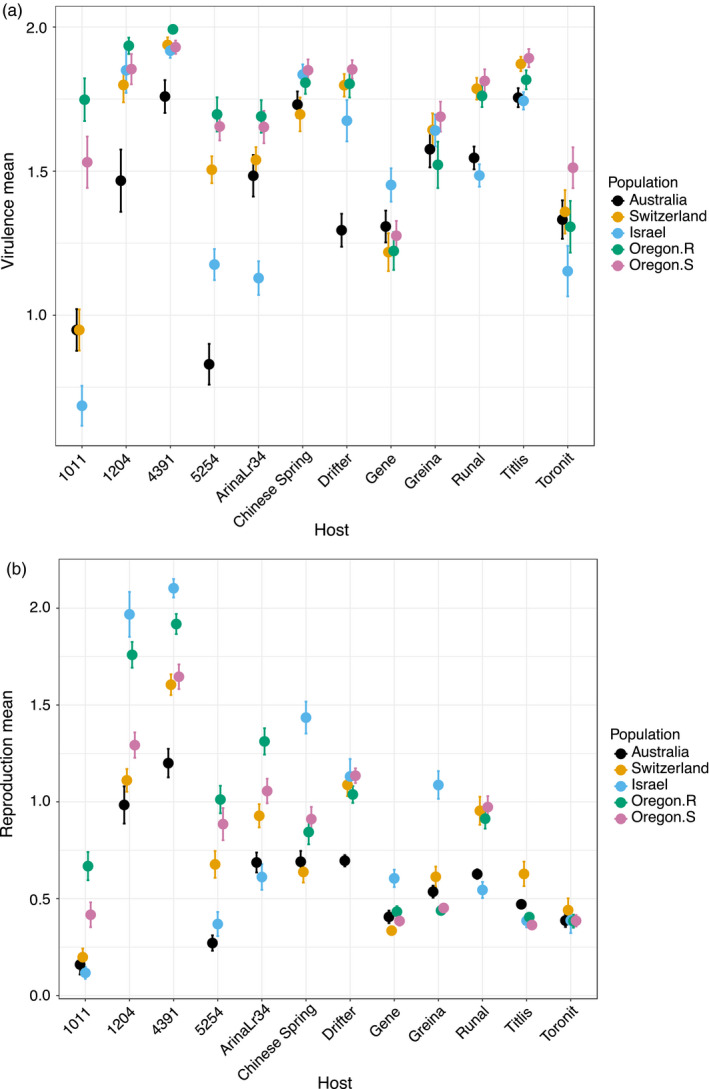
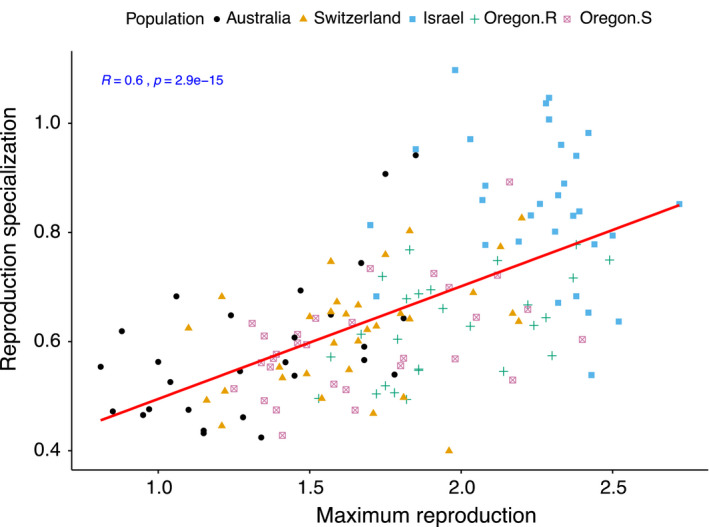
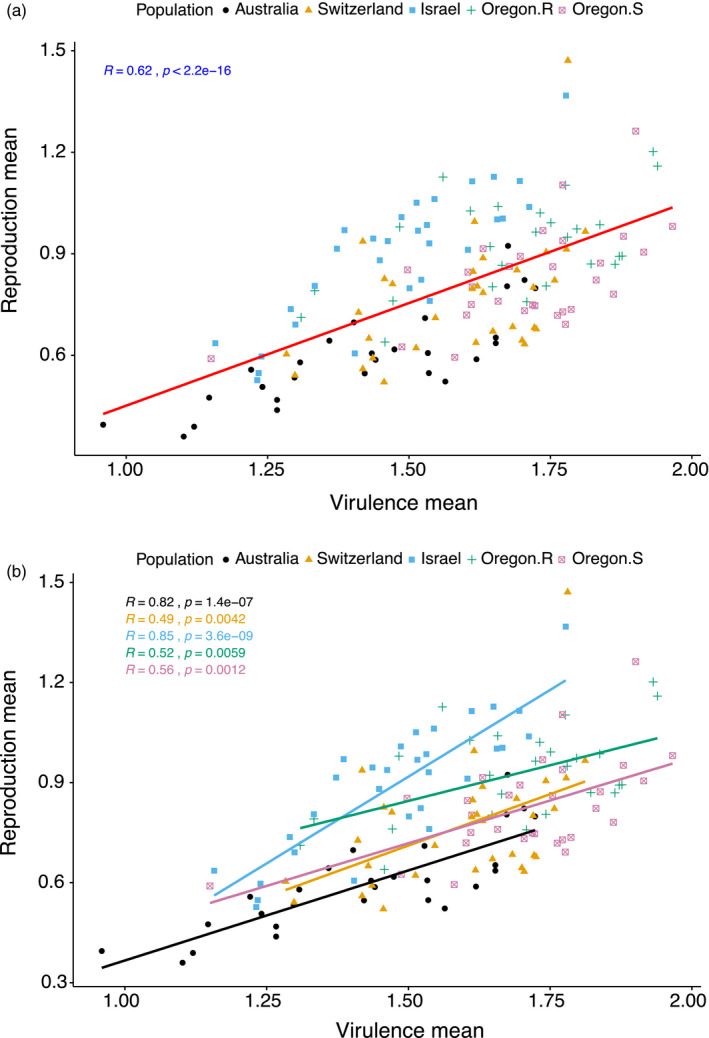
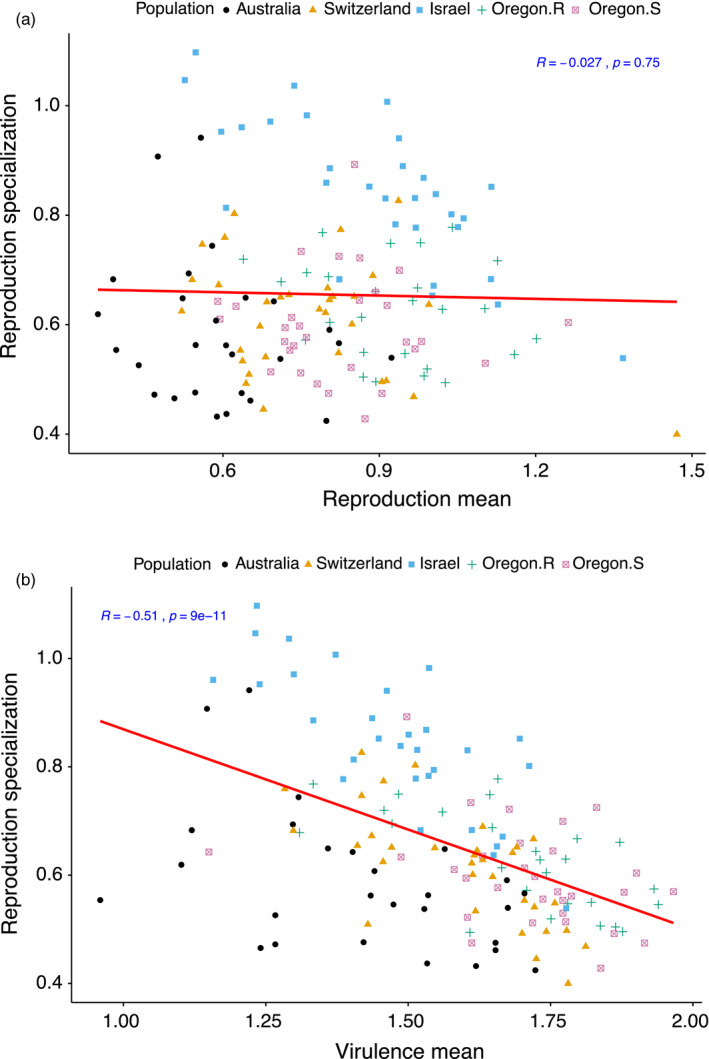
Genetic diversity within pathogen populations is critically important for predicting pathogen evolution, disease outcomes and prevalence. However, we lack a good understanding of the processes maintaining genetic variation and constraints on pathogen life-history evolution. Here, we analysed interactions between 12 wheat host genotypes and 145 strains of from five global populations to investigate the evolution and maintenance of variation in pathogen virulence and reproduction. We found a strong positive correlation between virulence (amount of leaf necrosis) and reproduction (pycnidia density within lesions), with substantial variation in both traits maintained within populations. On average, highly virulent isolates exhibited higher reproduction, which might increase transmission potential in agricultural fields planted to homogeneous hosts at a high density. We further showed that pathogen strains with a narrow host range (i.e. specialists) for reproduction were on average less virulent, and those with a broader host range (i.e. generalists) were on average less fecund on a given specific host. These costs associated with adaptation to different host genotypes might constrain the emergence of generalists by disrupting the directional evolution of virulence and fecundity. We conclude that selection favouring pathogen strains that are virulent across diverse hosts, coupled with selection that maximizes fecundity on specific hosts, may explain the maintenance of these pathogenicity traits within and among populations.
病原体群体内的遗传多样性对于预测病原体进化、疾病结果和流行情况至关重要。然而,我们对维持遗传变异的过程以及病原体生活史进化的限制因素缺乏充分的了解。在这里,我们分析了12种小麦宿主基因型与来自五个全球群体的145个菌株之间的相互作用,以研究病原体毒力和繁殖变异的进化与维持。我们发现毒力(叶片坏死量)与繁殖(病斑内分生孢子器密度)之间存在很强的正相关,且这两个性状在群体内均存在显著变异。平均而言,高毒力分离株表现出更高的繁殖能力,这可能会增加在高密度种植单一宿主的农田中的传播潜力。我们进一步表明,繁殖宿主范围狭窄的病原体菌株(即专性寄生物)平均毒力较低,而宿主范围较广的菌株(即兼性寄生物)在特定宿主上的繁殖力平均较低。与适应不同宿主基因型相关联的这些代价可能会通过扰乱毒力和繁殖力的定向进化来限制兼性寄生物的出现。我们得出结论,有利于在不同宿主上具有毒力的病原体菌株的选择,以及使特定宿主上的繁殖力最大化的选择,可能解释了这些致病性性状在群体内和群体间的维持。