Mida Liana Arielle, Della Zazzera Vincent, Fontaine-Bisson Bénédicte
Interdisciplinary School of Health Sciences, University of Ottawa, 25 University Private, Ottawa, Canada.
The Ottawa Hospital, 501 Smyth Road, Ottawa, Canada.
Prev Med Rep. 2021 Feb 6;22:101327. doi: 10.1016/j.pmedr.2021.101327. eCollection 2021 Jun.
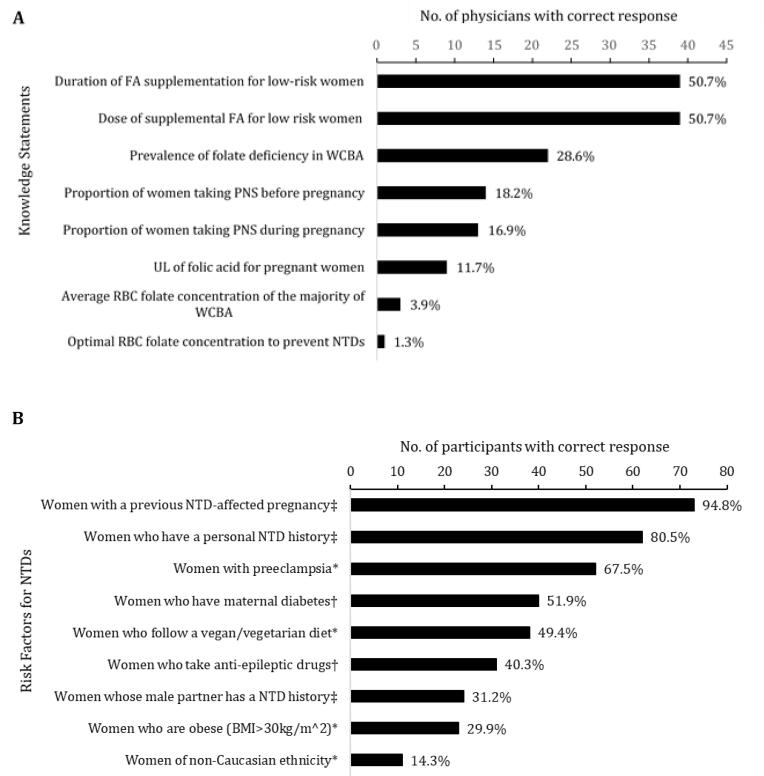
Canadian expert guidelines recommend low-risk women to consume a daily multivitamin supplement containing 400 µg of folic acid (FA) to prevent neural tube defects. Mandatory food fortification coupled with intake of prenatal vitamin/mineral supplements (PVS), most of which contain ≥ 1000 µg-FA, has resulted in an unprecedented shift in Canadian pregnant women folate status. This study assessed the knowledge, attitude and practice (KAP) of physicians regarding periconceptional FA recommendations, intake and health related outcomes, since they play an essential role in promoting appropriate FA intake. Seventy-seven physicians answered the self-administered KAP survey. Only half of physicians knew the correct dose and duration of FA for low-risk women. Approximately 70% were unsure of, or unfamiliar with the most recent guidelines and 60% of physicians most often recommend a ≥ 1000 µg-FA supplement. Knowledge score 1 (KS1), which related to low-risk women, was associated with physicians' attitude toward believing that most PVS contain the recommended amount of FA (p = 0.004). Significant correlations were also found between KS1 and the total practice score (TPS) (r = 0.45, 0.0001) as well as between the total knowledge score and TPS (r = 0.38, = 0.0007). Our findings show that physicians lacking knowledge regarding periconceptional FA is associated with their attitude and practice. Despite a vast majority of physicians being unsure or uncomfortable recommending PVS that are not in line with recommendations, a lack of knowledge and a widely accessible 400 µg-FA PVS, enables a contradictory practice in reality.
加拿大专家指南建议低风险女性每日服用含400微克叶酸(FA)的多种维生素补充剂,以预防神经管缺陷。强制性食品强化加上产前维生素/矿物质补充剂(PVS)的摄入,其中大多数含有≥1000微克FA,导致加拿大孕妇的叶酸状况发生了前所未有的转变。本研究评估了医生关于围孕期FA建议、摄入量及健康相关结果的知识、态度和实践(KAP),因为他们在促进适当的FA摄入方面起着至关重要的作用。77名医生回答了自行填写的KAP调查问卷。只有一半的医生知道低风险女性服用FA的正确剂量和持续时间。约70%的医生不确定或不熟悉最新指南,60%的医生最常推荐≥1000微克FA的补充剂。与低风险女性相关的知识得分1(KS1)与医生认为大多数PVS含有推荐量FA的态度相关(p = 0.004)。KS1与总实践得分(TPS)之间也发现了显著相关性(r = 0.45,p = 0.0001),总知识得分与TPS之间也有显著相关性(r = 0.38,p = 0.0007)。我们的研究结果表明,医生缺乏围孕期FA知识与其态度和实践相关。尽管绝大多数医生不确定或不愿意推荐不符合建议的PVS,但知识的缺乏和广泛可得的400微克FA的PVS,在现实中导致了一种矛盾的做法。