Fouad Shahd, Hauton David, D'Angiolella Vincenzo
Department of Oncology, Medical Research Council Oxford Institute for Radiation Oncology, University of Oxford, Oxford, United Kingdom.
Front Mol Biosci. 2021 Feb 16;7:599332. doi: 10.3389/fmolb.2020.599332. eCollection 2020.
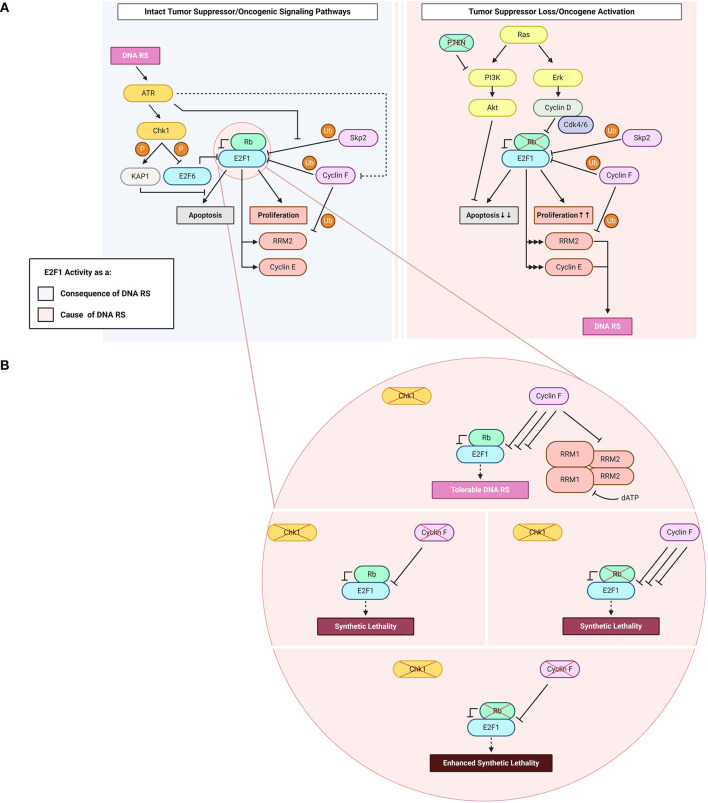
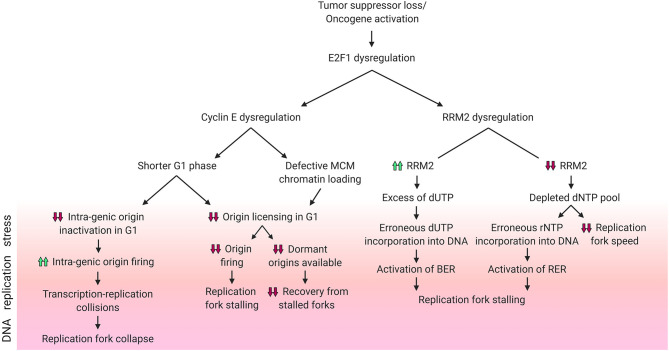
In mammalian cells, cell cycle entry occurs in response to the correct stimuli and is promoted by the transcriptional activity of E2F family members. E2F proteins regulate the transcription of S phase cyclins and genes required for DNA replication, DNA repair, and apoptosis. The activity of E2F1, the archetypal and most heavily studied E2F family member, is tightly controlled by the DNA damage checkpoints to modulate cell cycle progression and initiate programmed cell death, when required. Altered tumor suppressor and oncogenic signaling pathways often result in direct or indirect interference with E2F1 regulation to ensure higher rates of cell proliferation independently of external cues. Despite a clear link between dysregulated E2F1 activity and cancer progression, literature on the contribution of E2F1 to DNA replication stress phenotypes is somewhat scarce. This review discusses how dysfunctional tumor suppressor and oncogenic signaling pathways promote the disruption of E2F1 transcription and hence of its transcriptional targets, and how such events have the potential to drive DNA replication stress. In addition to the involvement of E2F1 upstream of DNA replication stress, this manuscript also considers the role of E2F1 as a downstream effector of the response to this type of cellular stress. Lastly, the review introduces some reflections on how E2F1 activity is integrated with checkpoint control through post-translational regulation, and proposes an exploitable tumor weakness based on this axis.
在哺乳动物细胞中,细胞周期进入是对正确刺激的反应,并由E2F家族成员的转录活性促进。E2F蛋白调节S期细胞周期蛋白的转录以及DNA复制、DNA修复和细胞凋亡所需的基因。E2F1是典型且研究最多的E2F家族成员,其活性受到DNA损伤检查点的严格控制,以调节细胞周期进程,并在需要时启动程序性细胞死亡。改变的肿瘤抑制和致癌信号通路通常会直接或间接干扰E2F1的调节,以确保更高的细胞增殖速率,而不依赖外部信号。尽管E2F1活性失调与癌症进展之间存在明确联系,但关于E2F1对DNA复制应激表型贡献的文献却较为稀少。本综述讨论了功能失调的肿瘤抑制和致癌信号通路如何促进E2F1转录及其转录靶点的破坏,以及这些事件如何有可能导致DNA复制应激。除了E2F1在DNA复制应激上游的作用外,本文还考虑了E2F1作为对这种细胞应激反应的下游效应器的作用。最后,综述对E2F1活性如何通过翻译后调节与检查点控制整合进行了一些思考,并基于此轴提出了一个可利用的肿瘤弱点。