Hoogmartens Julie, Cacace Rita, Van Broeckhoven Christine
Neurodegenerative Brain Diseases VIB Center for Molecular Neurology Antwerp Belgium.
Department of Biomedical Sciences University of Antwerp Antwerp Belgium.
Alzheimers Dement (Amst). 2021 Feb 20;13(1):e12155. doi: 10.1002/dad2.12155. eCollection 2021.
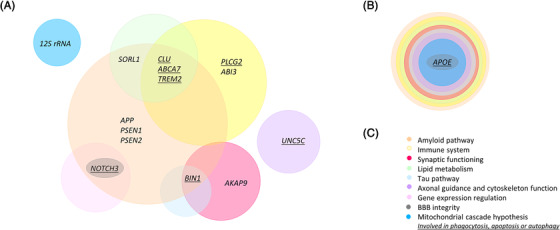
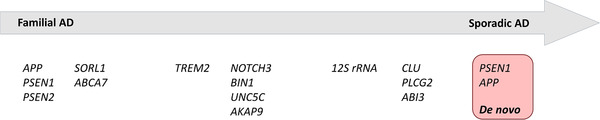
Early-onset Alzheimer's disease (EOAD) is generally known as a dominant disease due to highly penetrant pathogenic mutations in the amyloid precursor protein, presenilin 1 and 2. However, they explain only a fraction of EOAD patients (5% to 10%). Furthermore, only 10% to 15% of EOAD families present with clear autosomal dominant inheritance. Studies showed that only 35% to 60% of EOAD patients have at least one affected first-degree relative. Parent-offspring concordance in EOAD was estimated to be <10%, indicating that full penetrant dominant alleles are not the sole players in EOAD. We aim to summarize current knowledge of rare variants underlying familial and seemingly sporadic Alzheimer's disease (AD) patients. Genetic findings indicate that in addition to the amyloid beta pathway, other pathways are of importance in AD pathophysiology. We discuss the difficulties in interpreting the influence of rare variants on disease onset and we underline the value of carefully selected ethnicity-matched cohorts in AD genetic research.
早发性阿尔茨海默病(EOAD)通常被认为是一种显性疾病,这是由于淀粉样前体蛋白、早老素1和2中存在高外显率的致病突变。然而,这些突变仅能解释一小部分EOAD患者(5%至10%)。此外,只有10%至15%的EOAD家族呈现明显的常染色体显性遗传。研究表明,只有35%至60%的EOAD患者至少有一位患病的一级亲属。EOAD患者的亲子一致性估计低于10%,这表明完全外显的显性等位基因并非EOAD的唯一病因。我们旨在总结关于家族性及看似散发性阿尔茨海默病(AD)患者潜在罕见变异的现有知识。遗传学研究结果表明,除了淀粉样β蛋白途径外,其他途径在AD病理生理学中也很重要。我们讨论了解释罕见变异对疾病发病影响的困难,并强调了在AD遗传学研究中精心挑选种族匹配队列的价值。