Cincinnati Children's Hospital Medical Center, University of Cincinnati, 3333 Burnet Avenue, MLC 7037, Cincinnati, OH, 45229-3026, USA.
Curr Allergy Asthma Rep. 2021 Mar 5;21(3):15. doi: 10.1007/s11882-021-00993-1.
Since the coronavirus SARS-CoV-2 outbreak in China in late 2019 turned into a global pandemic, numerous studies have reported associations between environmental factors, such as weather conditions and a range of air pollutants (particulate matter, nitrogen dioxide, ozone, etc.) and the first wave of COVID-19 cases. This review aims to offer a critical assessment of the role of environmental exposure risk factors on SARS-CoV-2 infections and COVID-19 disease severity.
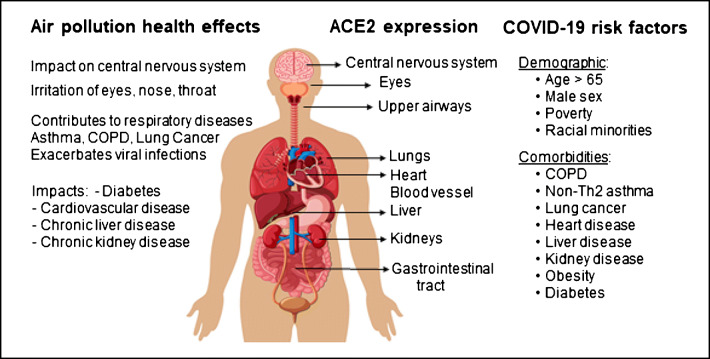
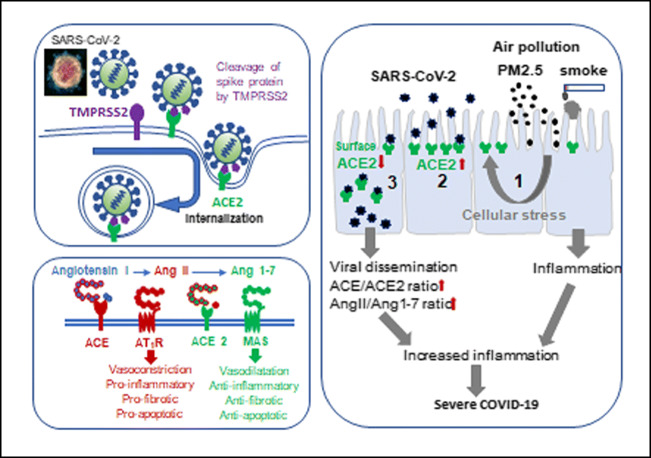
In this review, we provide a critical assessment of COVID-19 risk factors, identify gaps in our knowledge (e.g., indoor air pollution), and discuss methodological challenges of association and causation and the impact lockdowns had on air quality. In addition, we will draw attention to ethnic and socioeconomic factors driving viral transmission related to COVID-19. The complex role angiotensin-converting enzyme 2 (ACE2) plays in COVID-19 and future promising avenues of research are discussed. To demonstrate causality, we stress the need for future epidemiologic studies integrating personal air pollution exposures, detailed clinical COVID-19 data, and a range of socioeconomic factors, as well as in vitro and in vivo mechanistic studies.
自 2019 年末中国爆发冠状病毒 SARS-CoV-2 以来,许多研究报告了环境因素(如天气条件和一系列空气污染物(颗粒物、二氧化氮、臭氧等))与 COVID-19 首例病例之间的关联。本综述旨在批判性评估环境暴露风险因素对 SARS-CoV-2 感染和 COVID-19 疾病严重程度的影响。
在这篇综述中,我们对 COVID-19 的风险因素进行了批判性评估,确定了我们知识中的空白(例如,室内空气污染),并讨论了关联和因果关系的方法学挑战,以及封锁对空气质量的影响。此外,我们将提请注意与 COVID-19 相关的导致病毒传播的种族和社会经济因素。讨论了血管紧张素转换酶 2(ACE2)在 COVID-19 中的复杂作用以及未来有前途的研究途径。为了证明因果关系,我们强调需要未来的流行病学研究将个人空气污染暴露、详细的 COVID-19 临床数据和一系列社会经济因素以及体外和体内机制研究整合在一起。