Section of Islet Cell and Regenerative Biology, Department of Medicine, Joslin Diabetes Center, Brigham and Women's Hospital, Harvard Medical School, and Harvard Stem Cell Institute, Boston, Massachusetts, USA; Stem Cells and Diabetes Laboratory, Institute of Molecular and Cell Biology, Proteos, Singapore, Singapore; Department of Biochemistry and Department of Medicine, Yong Loo Lin School of Medicine, National University of Singapore, Singapore, Singapore.
Stem Cells and Diabetes Laboratory, Institute of Molecular and Cell Biology, Proteos, Singapore, Singapore; Department of Biochemistry and Department of Medicine, Yong Loo Lin School of Medicine, National University of Singapore, Singapore, Singapore.
J Biol Chem. 2021 Jan-Jun;296:100495. doi: 10.1016/j.jbc.2021.100495. Epub 2021 Mar 3.
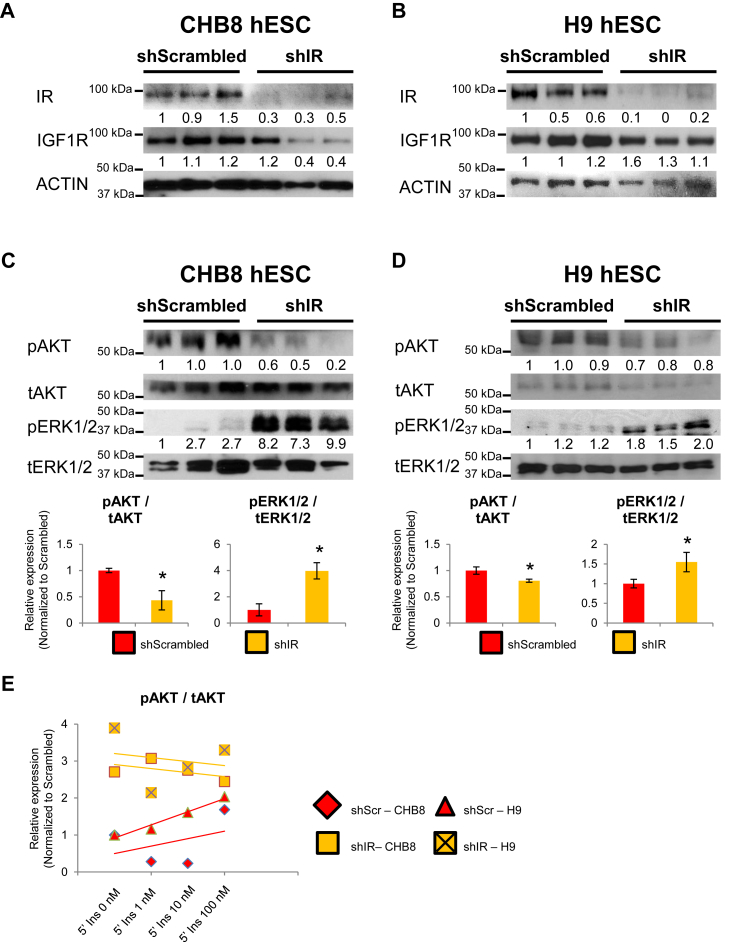
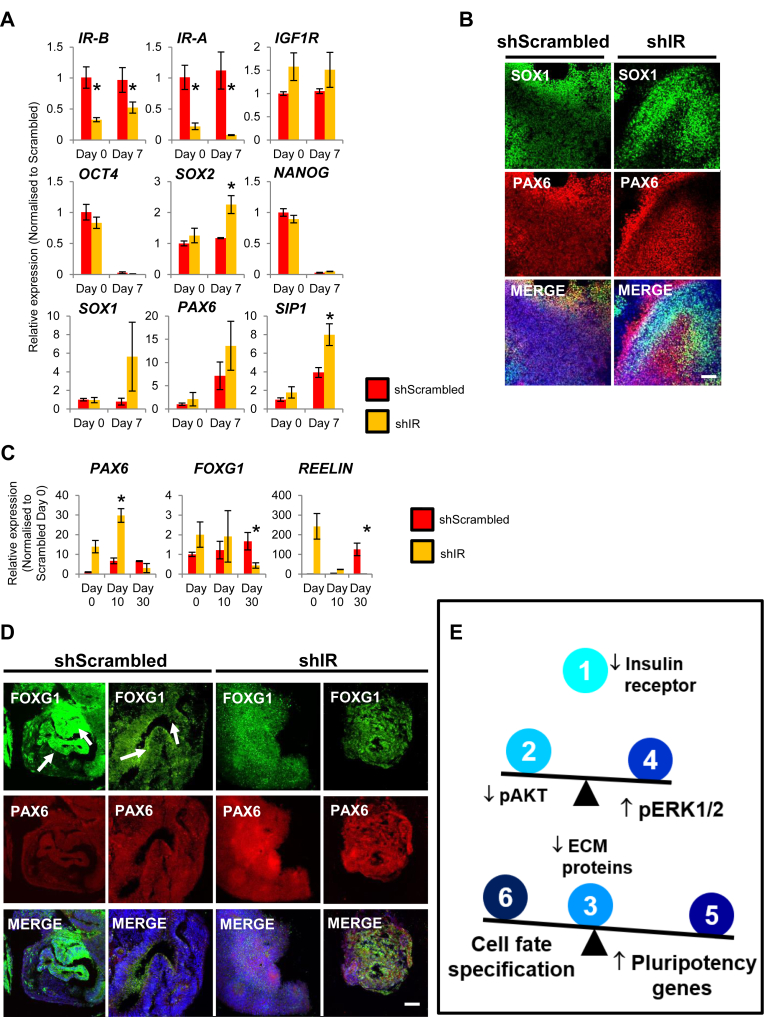
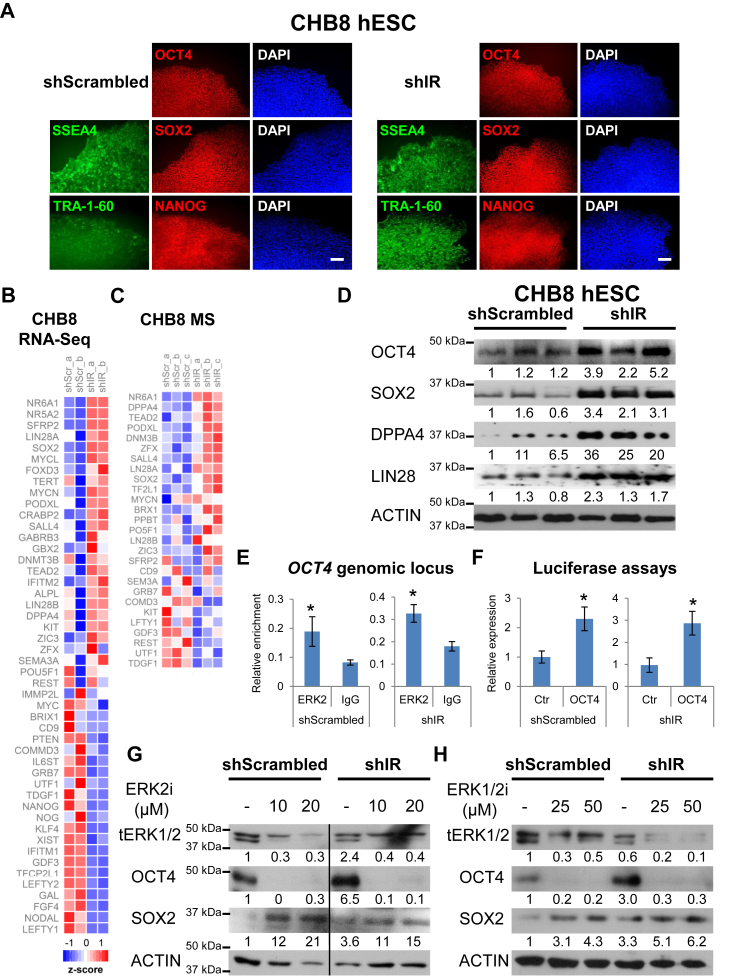
Human embryonic stem cells are a type of pluripotent stem cells (hPSCs) that are used to investigate their differentiation into diverse mature cell types for molecular studies. The mechanisms underlying insulin receptor (IR)-mediated signaling in the maintenance of human pluripotent stem cell (hPSC) identity and cell fate specification are not fully understood. Here, we used two independent shRNAs to stably knock down IRs in two hPSC lines that represent pluripotent stem cells and explored the consequences on expression of key proteins in pathways linked to proliferation and differentiation. We consistently observed lowered pAKT in contrast to increased pERK1/2 and a concordant elevation in pluripotency gene expression. ERK2 chromatin immunoprecipitation, luciferase assays, and ERK1/2 inhibitors established direct causality between ERK1/2 and OCT4 expression. Of importance, RNA sequencing analyses indicated a dysregulation of genes involved in cell differentiation and organismal development. Mass spectrometry-based proteomic analyses further confirmed a global downregulation of extracellular matrix proteins. Subsequent differentiation toward the neural lineage reflected alterations in SOX1PAX6 neuroectoderm and FOXG1 cortical neuron marker expression and protein localization. Collectively, our data underscore the role of IR-mediated signaling in maintaining pluripotency, the extracellular matrix necessary for the stem cell niche, and regulating cell fate specification including the neural lineage.
人胚胎干细胞是一种多能干细胞(hPSCs),用于研究其分化为不同的成熟细胞类型,以进行分子研究。胰岛素受体(IR)介导的信号在维持人多能干细胞(hPSC)特性和细胞命运特化中的作用机制尚不完全清楚。在这里,我们使用两种独立的 shRNA 稳定敲低了两种代表多能干细胞的 hPSC 系中的 IRs,并探讨了对与增殖和分化相关的途径中的关键蛋白表达的影响。我们一致观察到 pAKT 降低,而 pERK1/2 增加,并且多能性基因表达一致升高。ERK2 染色质免疫沉淀、荧光素酶测定和 ERK1/2 抑制剂确立了 ERK1/2 和 OCT4 表达之间的直接因果关系。重要的是,RNA 测序分析表明,参与细胞分化和生物体发育的基因失调。基于质谱的蛋白质组学分析进一步证实了细胞外基质蛋白的全面下调。随后向神经谱系分化反映了 SOX1PAX6 神经外胚层和 FOXG1 皮质神经元标记物表达和蛋白定位的改变。总的来说,我们的数据强调了 IR 介导的信号在维持多能性、干细胞巢所需的细胞外基质以及调节包括神经谱系在内的细胞命运特化中的作用。