de Jong Daan J, Veldhuis Wouter B, Wessels Frank J, de Vos Bob, Moeskops Pim, Kok Madeleine
Department of Radiology, University Medical Center Utrecht, Heilberglaan 100, 3584 CX Utrecht, The Netherlands.
Quantib-U, Padualaan 8, 3584 CH Utrecht, The Netherlands.
J Pers Med. 2021 Feb 24;11(3):159. doi: 10.3390/jpm11030159.
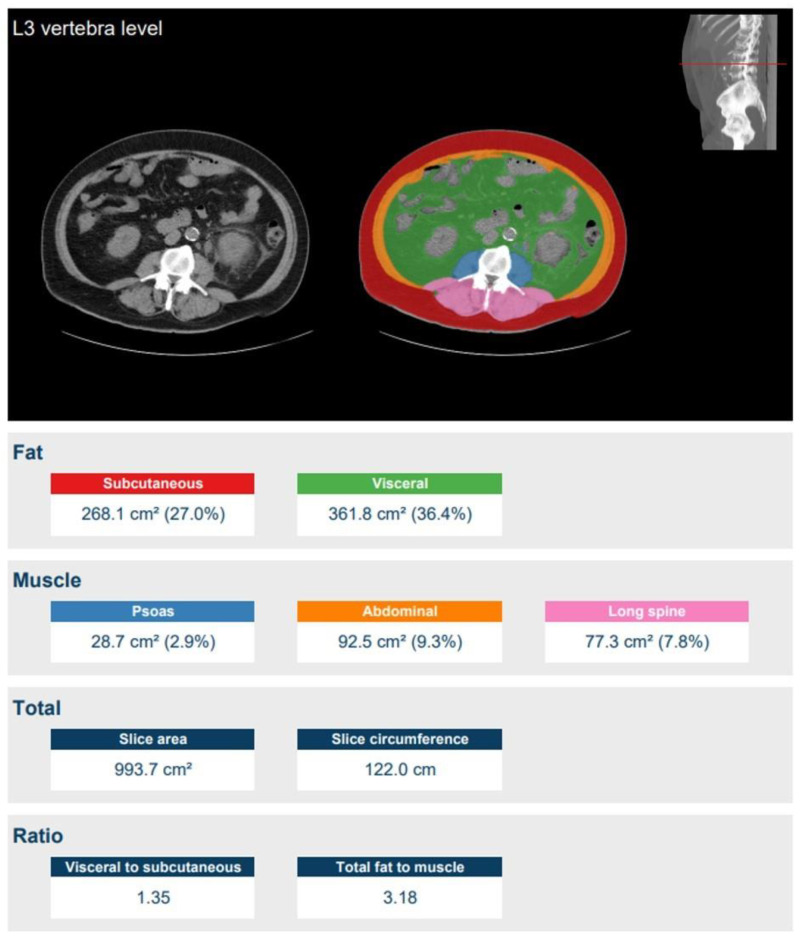
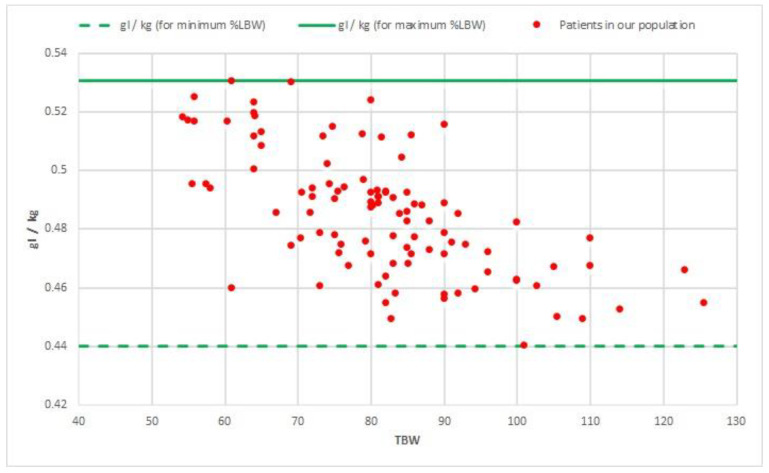
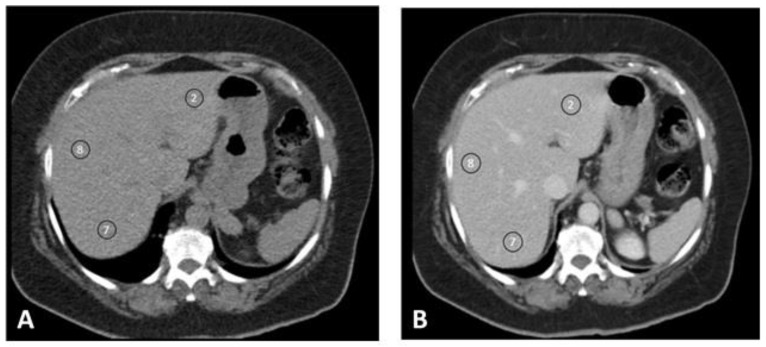
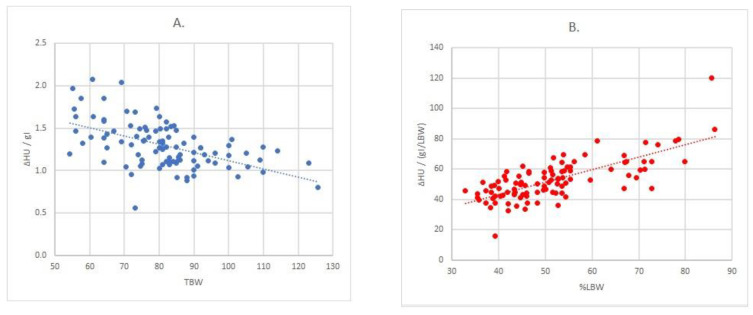
In contrast-enhanced computed tomography, total body weight adapted contrast injection protocols have proven successful in achieving a homogeneous enhancement of vascular structures and liver parenchyma. However, because solid organs have greater perfusion than adipose tissue, the lean body weight (fat-free mass) rather than the total body weight is theorised to cause even more homogeneous enhancement. We included 102 consecutive patients who underwent a multiphase abdominal computed tomography between March 2016 and October 2019. Patients received contrast media (300 mgI/mL) according to bodyweight categories. Using regions of interest, we measured the Hounsfield unit (HU) increase in liver attenuation from unenhanced to contrast-enhanced computed tomography. Furthermore, subjective image quality was graded using a four-point Likert scale. An artificial intelligence algorithm automatically segmented and determined the body compositions and calculated the percentages of lean body weight. The hepatic enhancements were adjusted for iodine dose and iodine dose per total body weight, as well as percentage lean body weight. The associations between enhancement and total body weight, body mass index, and lean body weight were analysed using linear regression. Patients had a median age of 68 years (IQR: 58-74), a total body weight of 81 kg (IQR: 73 - 90), a body mass index of 26 kg/m (SD: ±4.2), and a lean body weight percentage of 50% (IQR: 36 - 55). Mean liver enhancements in the portal venous phase were 61 ± 12 HU (≤ 70 kg), 53 ± 10 HU (70 - 90 kg), and 53 ± 7 HU (≥ 90 kg). The majority (93%) of scans were rated as good or excellent. Regression analysis showed significant correlations between liver enhancement corrected for injected total iodine and total body weight ( = 0.53; < 0.001) and between liver enhancement corrected for lean body weight and the percentage of lean body weight ( = 0.73; < 0.001). Most benefits from personalising iodine injection using %LBW additive to total body weight would be achieved in patients under 90 kg. Liver enhancement is more strongly associated with the percentage of lean body weight than with the total body weight or body mass index. The observed variation in liver enhancement might be reduced by a personalised injection based on the artificial-intelligence-determined percentage of lean body weight.
在增强计算机断层扫描中,根据总体重调整的造影剂注射方案已被证明能成功实现血管结构和肝实质的均匀强化。然而,由于实体器官的灌注比脂肪组织更强,理论上瘦体重(去脂体重)而非总体重会带来更均匀的强化效果。我们纳入了2016年3月至2019年10月期间连续接受多期腹部计算机断层扫描的102例患者。患者根据体重类别接受造影剂(300 mgI/mL)。我们使用感兴趣区域测量了从平扫计算机断层扫描到增强计算机断层扫描时肝脏衰减的亨氏单位(HU)增加值。此外,使用四点李克特量表对主观图像质量进行评分。一种人工智能算法自动分割并确定身体成分,并计算瘦体重的百分比。对肝脏强化进行了碘剂量、每总体重碘剂量以及瘦体重百分比的校正。使用线性回归分析强化与总体重、体重指数和瘦体重之间的关联。患者的中位年龄为68岁(四分位间距:58 - 74岁),总体重为81 kg(四分位间距:73 - 90 kg),体重指数为26 kg/m(标准差:±4.2),瘦体重百分比为50%(四分位间距:3 = 0.53;P < 0.001)以及校正瘦体重后的肝脏强化与瘦体重百分比之间(r = 0.73;P < 0.001)。在体重低于90 kg的患者中,使用基于瘦体重百分比添加到总体重的方法来个性化碘注射能获得最大益处。肝脏强化与瘦体重百分比的关联比与总体重或体重指数的关联更强。基于人工智能确定的瘦体重百分比进行个性化注射可能会减少观察到的肝脏强化差异。 6 - 55)。门静脉期肝脏的平均强化值在体重≤70 kg的患者中为61 ± 12 HU,在体重70 - 90 kg的患者中为53 ± 10 HU,在体重≥90 kg的患者中为53 ± 7 HU。大多数(93%)扫描被评为良好或优秀。回归分析显示校正注射总碘后的肝脏强化与总体重之间(r