Department of Biotechnology, Chonnam National University, Gwangju 61186, Korea.
School of Food Science and Biotechnology, Kyungpook National University, Daegu 41566, Korea.
Molecules. 2021 Feb 24;26(5):1211. doi: 10.3390/molecules26051211.
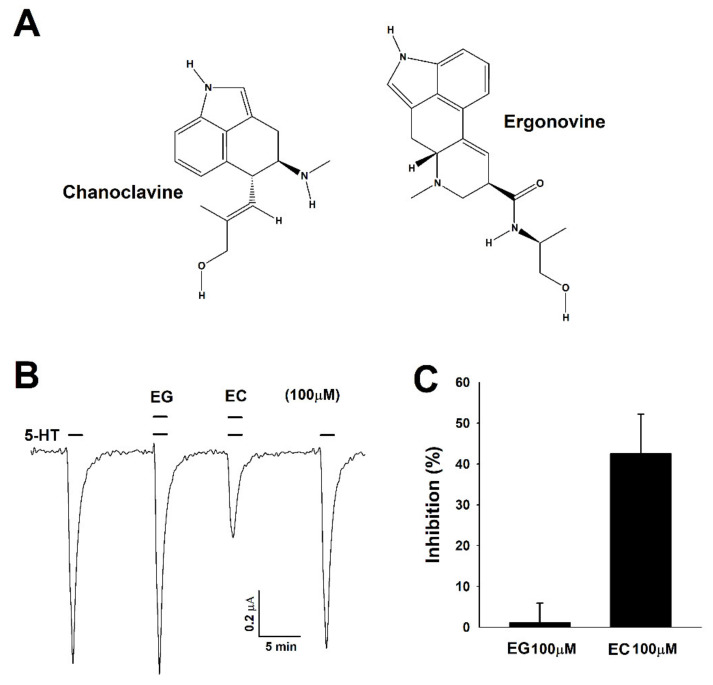
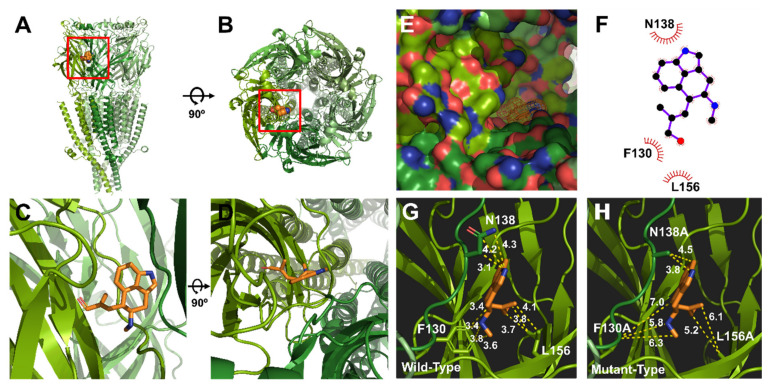
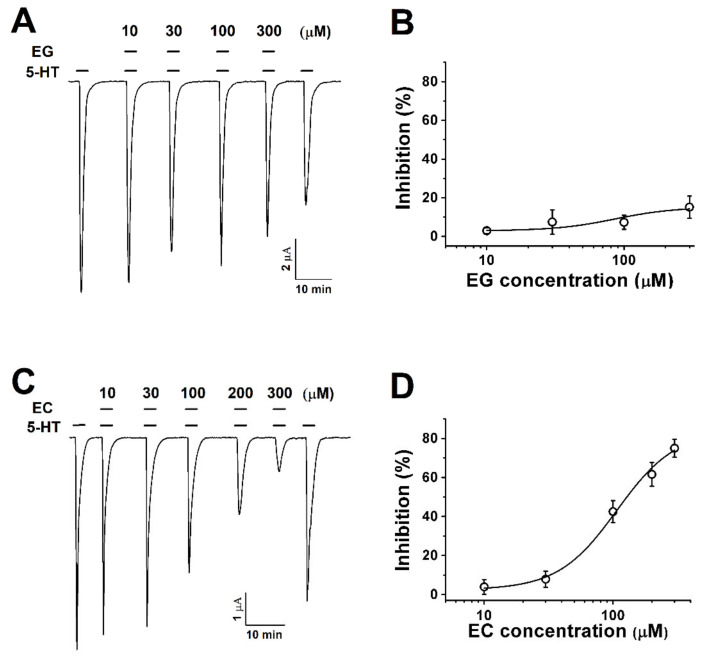
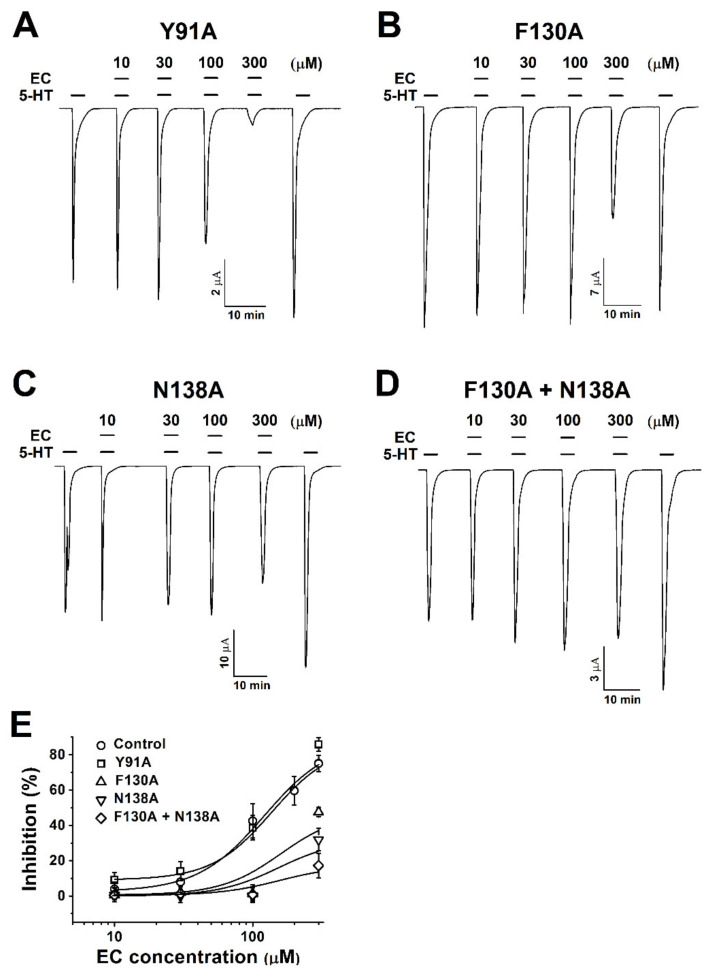
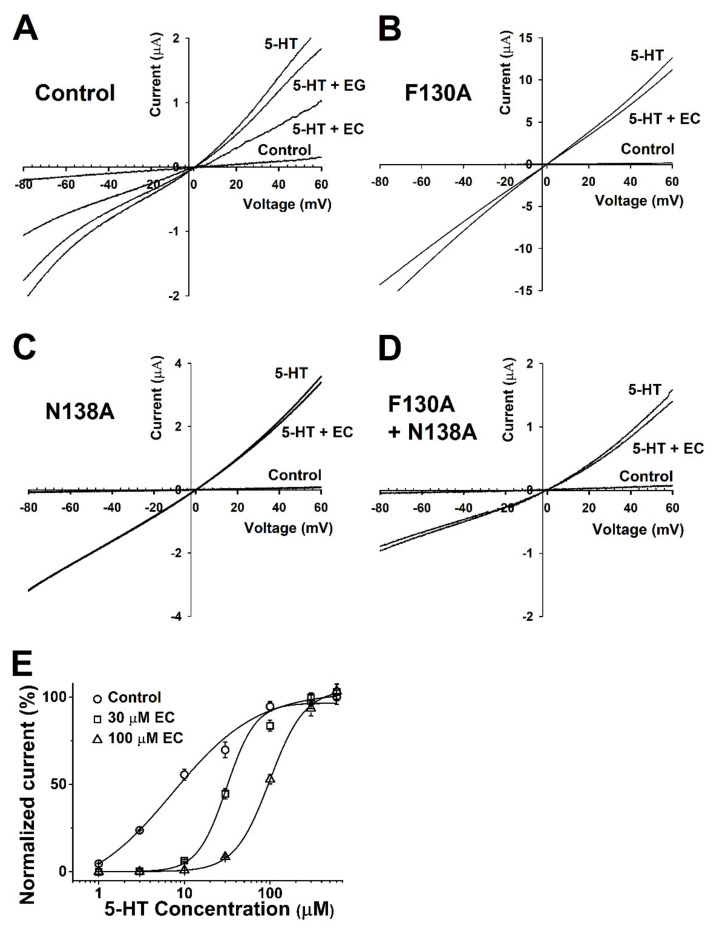
Irritable bowel syndrome (IBS) is a chronic disease that causes abdominal pain and an imbalance of defecation patterns due to gastrointestinal dysfunction. The cause of IBS remains unclear, but intestinal-brain axis problems and neurotransmitters have been suggested as factors. In this study, chanoclavine, which has a ring structure similar to 5-hydroxytryptamine (5-HT), showed an interaction with the 5-HT receptor to regulate IBS. Although its derivatives are known to be involved in neurotransmitter receptors, the molecular physiological mechanism of the interaction between chanoclavine and the 5-HT receptor is unknown. Electrophysiological experiments were conducted using a two-electrode voltage-clamp analysis to observe the inhibitory effects of chanoclavine on oocytes in which the h5-HT receptor was expressed. The co-application of chanoclavine and 5-HT resulted in concentration-dependent, reversible, voltage-independent, and competitive inhibition. The 5-HT response induced by 5-HT was blocked by chanoclavine with half-maximal inhibitory response concentration (IC) values of 107.2 µM. Docking studies suggested that chanoclavine was positioned close F130 and N138 in the 5-HT receptor-binding site. The double mutation of F130A and N138A significantly attenuated the interaction of chanoclavine compared to a single mutation or the wild type. These data suggest that F130 and N138 are important sites for ligand binding and activity. Chanoclavine and ergonovine have different effects. Asparagine, the 130th amino acid sequence of the 5-HT receptor, and phenylalanine, the 138th, are important in the role of binding chanoclavine, but ergonovine has no interaction with any amino acid sequence of the 5-HT receptor. The results of the electrophysiological studies and of in silico simulation showed that chanoclavine has the potential to inhibit the hypergastric stimulation of the gut by inhibiting the stimulation of signal transduction through 5-HT receptor stimulation. These findings suggest chanoclavine as a potential antiemetic agent for excessive gut stimulation and offer insight into the mechanisms of 5-HT receptor inhibition.
肠易激综合征(IBS)是一种慢性疾病,由于胃肠道功能障碍,会导致腹痛和排便模式失衡。IBS 的病因尚不清楚,但肠道-大脑轴问题和神经递质已被认为是其中的一些因素。在这项研究中,具有与 5-羟色胺(5-HT)相似的环结构的金雀花堿与 5-HT 受体相互作用,以调节 IBS。虽然其衍生物已知与神经递质受体有关,但金雀花堿与 5-HT 受体相互作用的分子生理机制尚不清楚。使用双电极电压钳分析进行电生理学实验,以观察金雀花堿对表达 h5-HT 受体的卵母细胞的抑制作用。金雀花堿与 5-HT 的共同应用导致浓度依赖性、可逆性、电压独立性和竞争性抑制。金雀花堿以半最大抑制反应浓度(IC)值 107.2µM 阻断 5-HT 诱导的 5-HT 反应。对接研究表明,金雀花堿位于 5-HT 受体结合位点的 F130 和 N138 附近。与单个突变或野生型相比,F130A 和 N138A 的双突变显着减弱了金雀花堿的相互作用。这些数据表明 F130 和 N138 是配体结合和活性的重要部位。金雀花堿和麦角新碱的作用不同。天门冬酰胺,5-HT 受体的第 130 个氨基酸序列,和苯丙氨酸,第 138 个,在结合金雀花堿的作用中很重要,但麦角新碱与 5-HT 受体的任何氨基酸序列都没有相互作用。电生理学研究和计算机模拟的结果表明,金雀花堿通过抑制 5-HT 受体刺激的信号转导,有可能抑制肠道对高胃刺激的反应。这些发现表明金雀花堿可能成为抑制过度肠道刺激的止吐剂,并为 5-HT 受体抑制机制提供了新的见解。