Yu Yidong, Wolf Ann-Katrin, Thusek Sina, Heinekamp Thorsten, Bromley Michael, Krappmann Sven, Terpitz Ulrich, Voigt Kerstin, Brakhage Axel A, Beilhack Andreas
Interdisciplinary Center for Clinical Research Laboratory, Department of Internal Medicine II, Würzburg University Hospital, 97080 Würzburg, Germany.
Research Center for Infectious Diseases, 97080 Würzburg, Germany.
J Fungi (Basel). 2021 Feb 13;7(2):136. doi: 10.3390/jof7020136.
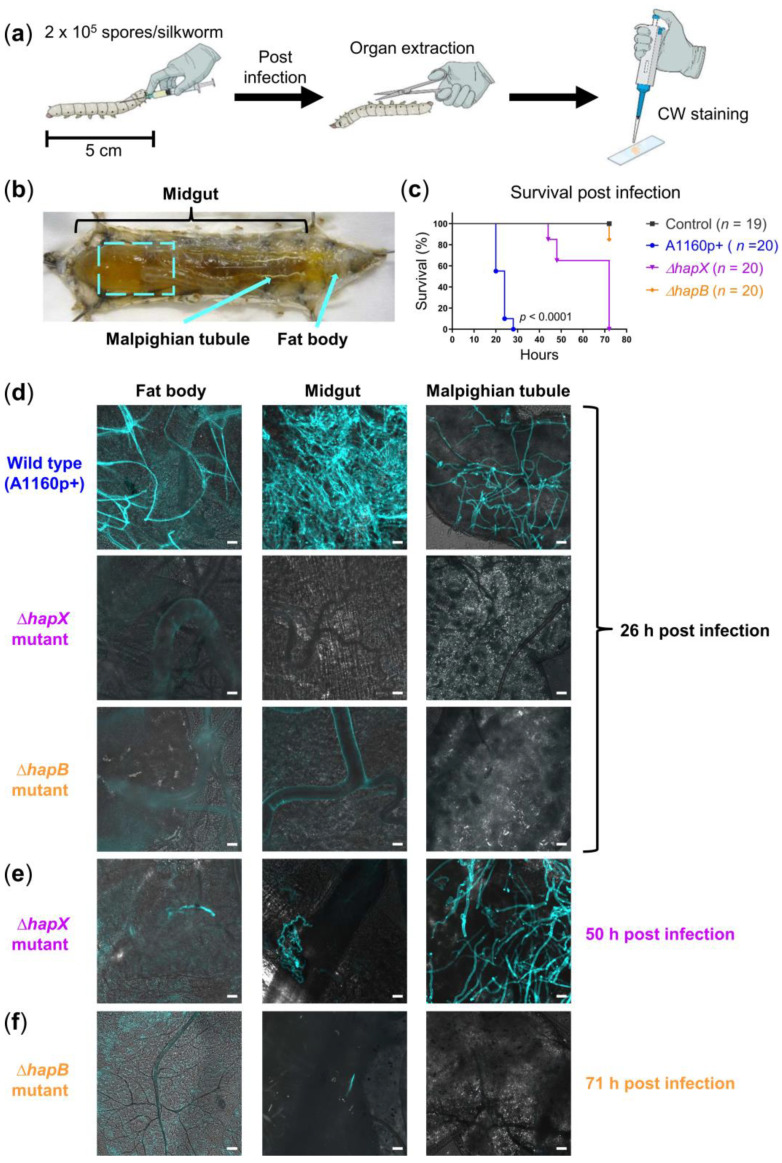
Invasive fungal infections (IFIs) are difficult to diagnose and to treat and, despite several available antifungal drugs, cause high mortality rates. In the past decades, the incidence of IFIs has continuously increased. More recently, SARS-CoV-2-associated lethal IFIs have been reported worldwide in critically ill patients. Combating IFIs requires a more profound understanding of fungal pathogenicity to facilitate the development of novel antifungal strategies. Animal models are indispensable for studying fungal infections and to develop new antifungals. However, using mammalian animal models faces various hurdles including ethical issues and high costs, which makes large-scale infection experiments extremely challenging. To overcome these limitations, we optimized an invertebrate model and introduced a simple calcofluor white (CW) staining protocol to macroscopically and microscopically monitor disease progression in silkworms () infected with the human pathogenic filamentous fungi and . This advanced silkworm infection model could validate knockout mutants with either attenuated, strongly attenuated or unchanged virulence. Finally, CW staining allowed us to efficiently visualize antifungal treatment outcomes in infected silkworms. Conclusively, we here present a powerful animal model combined with a straightforward staining protocol to expedite large-scale in vivo research of fungal pathogenicity and to investigate novel antifungal candidates.
侵袭性真菌感染(IFI)难以诊断和治疗,尽管有几种可用的抗真菌药物,但死亡率仍然很高。在过去几十年中,IFI的发病率持续上升。最近,全球范围内报道了重症患者中与严重急性呼吸综合征冠状病毒2(SARS-CoV-2)相关的致命IFI。对抗IFI需要更深入地了解真菌致病性,以促进新型抗真菌策略的开发。动物模型对于研究真菌感染和开发新的抗真菌药物不可或缺。然而,使用哺乳动物动物模型面临各种障碍,包括伦理问题和高成本,这使得大规模感染实验极具挑战性。为了克服这些限制,我们优化了一种无脊椎动物模型,并引入了一种简单的荧光增白剂(CW)染色方案,以宏观和微观方式监测感染人类致病丝状真菌和的家蚕体内的疾病进展。这种先进的家蚕感染模型可以验证毒力减弱、显著减弱或不变的基因敲除突变体。最后,CW染色使我们能够有效地观察感染家蚕的抗真菌治疗效果。总之,我们在此展示了一个强大的动物模型,并结合了一种简单的染色方案,以加快对真菌致病性的大规模体内研究,并研究新型抗真菌候选药物。