Herrero-Herrero María, Gómez-Tejedor José Antonio, Vallés-Lluch Ana
Centre for Biomaterials and Tissue Engineering (CBIT), Universitat Politècnica de València, Camino de Vera s/n, 46022 Valencia, Spain.
Biomedical Research Networking Centre in Bioengineering, Biomaterials and Nanomedicine (CIBER-BBN), 46022 Valencia, Spain.
Polymers (Basel). 2021 Feb 25;13(5):695. doi: 10.3390/polym13050695.
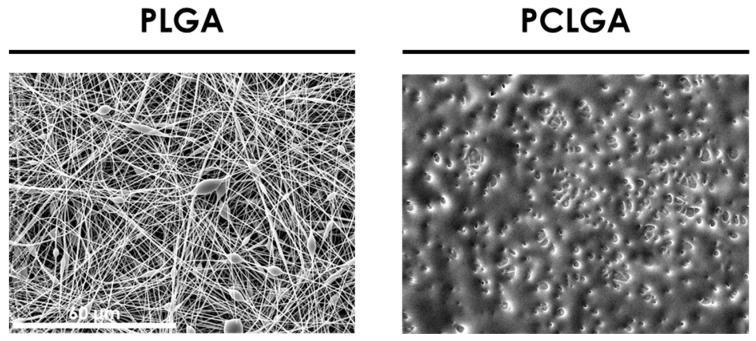
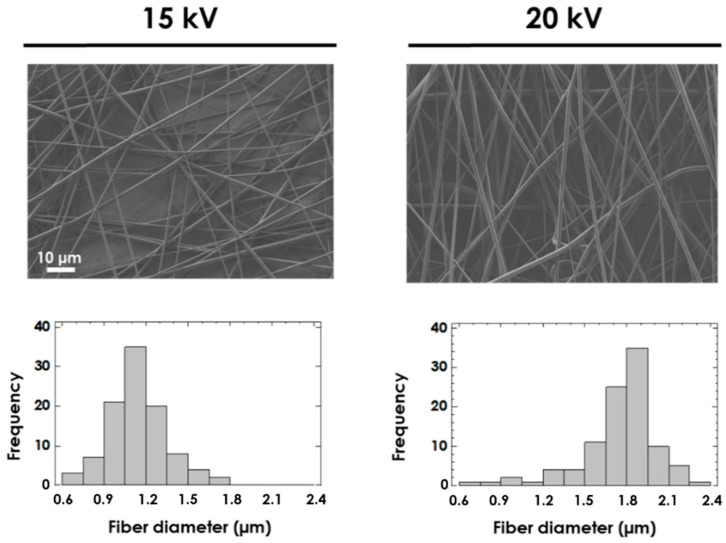
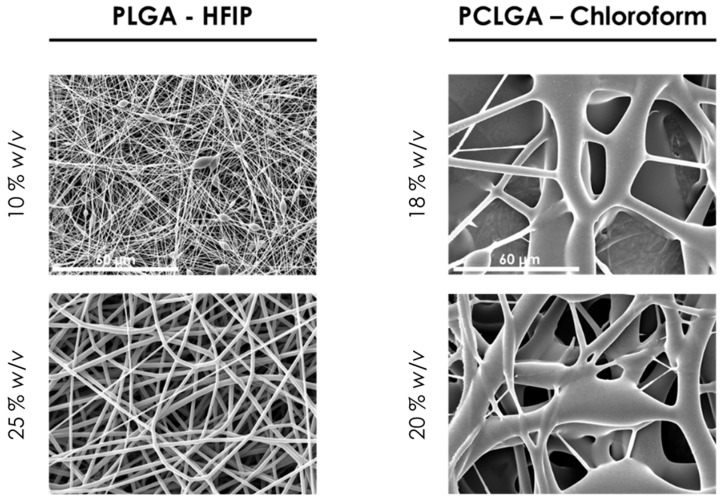
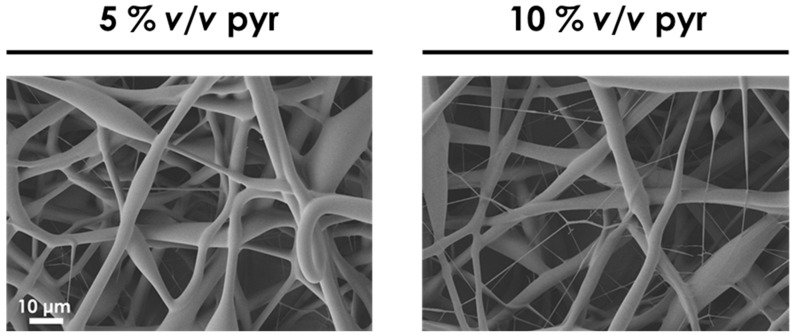
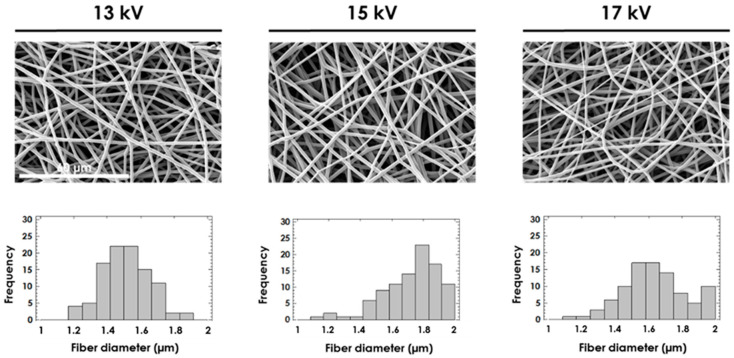
Poly(lactic-co-glycolic acid) (PLGA) and poly(caprolactone-co-glycolic acid) (PCLGA) solutions were electrospun into membranes with tailored fiber diameter of 1.8 μm. This particular fiber diameter was tuned depending on the used co-polymer by adjusting the electrospinning parameters that mainly influence the fiber diameter. The greatest setting of the fiber diameter was achieved by varying the polymer solution parameters (polymer concentration, solvents and solvents ratio). PLGA was adequately electrospun with 1,1,1,3,3,3-hexafluoro-2-propanol (HFIP), whereas PCLGA required a polar solvent (such as chloroform) with a lower dielectric constant. Moreover, due to the amorphous morphology of PCLGA, pyridine as salt had to be added to the starting solution to increase its conductivity and make it electrospinnable. Indeed, the electrospinning of this co-polymer presents notable difficulties due to its amorphous structure. Interestingly, PCLGA, having a higher glycolic acid molar fraction than commonly electrospun co-polymers (caprolactone:glycolic acid ratio of 45:55 instead of 90:10), could be successfully electrospun, which has not been reported to date. To an accurate setting of fiber diameter, the voltage and the distance from needle to collector were varied. Finally, the study of the surface tension, conductivity and viscosity of the polymer solutions allowed to correlate these particular characteristics of the solutions with the electrospinning variables so that prior knowledge of them enables predicting the required processing conditions.
将聚乳酸-乙醇酸共聚物(PLGA)和聚己内酯-乙醇酸共聚物(PCLGA)溶液进行静电纺丝,制成纤维直径定制为1.8μm的膜。根据所使用的共聚物,通过调整主要影响纤维直径的静电纺丝参数来调节这种特定的纤维直径。通过改变聚合物溶液参数(聚合物浓度、溶剂和溶剂比例)实现了纤维直径的最大设定。PLGA用1,1,1,3,3,3-六氟-2-丙醇(HFIP)可充分进行静电纺丝,而PCLGA需要一种介电常数较低的极性溶剂(如氯仿)。此外,由于PCLGA的无定形形态,必须向起始溶液中添加吡啶作为盐以提高其导电性并使其可静电纺丝。实际上,这种共聚物的静电纺丝由于其无定形结构而存在显著困难。有趣的是,PCLGA的乙醇酸摩尔分数高于通常静电纺丝的共聚物(己内酯:乙醇酸比例为45:55而非90:10),但仍能成功进行静电纺丝,这在迄今为止尚未见报道。为了精确设定纤维直径,改变了电压和针头到收集器的距离。最后,对聚合物溶液的表面张力、导电性和粘度的研究使这些溶液的特定特性与静电纺丝变量相关联,因此对它们的先验知识能够预测所需的加工条件。