Immunological Diagnosis, Juntendo University, School of Medicine, 2-1-1 Hongo, Bunkyo-Ku, Tokyo 113-8421, Japan.
An-Najah Center for Cancer and Stem Cell Research, Faculty of Medicine and Health Sciences, An-Najah National University, Nablus P.O. Box 7, Palestine.
Int J Mol Sci. 2021 Feb 25;22(5):2304. doi: 10.3390/ijms22052304.
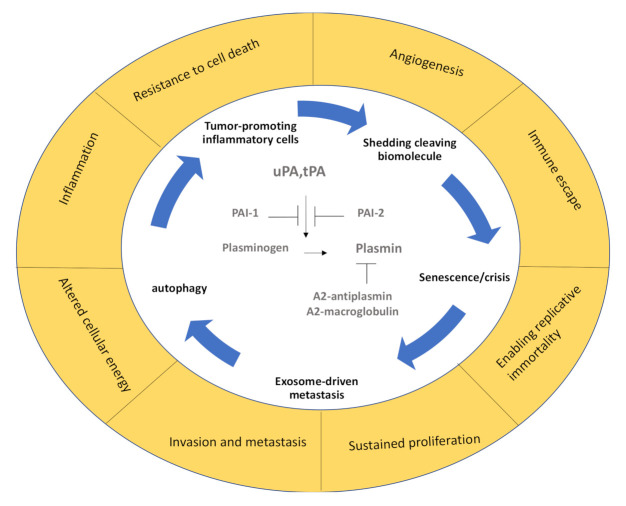
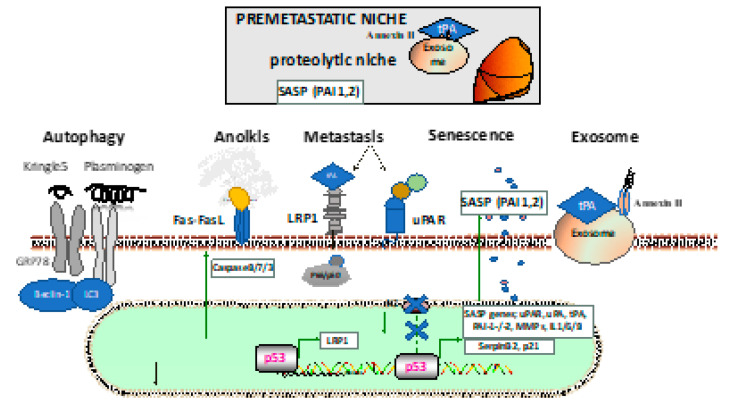
Fibrinolytic factors like plasminogen, tissue-type plasminogen activator (tPA), and urokinase plasminogen activator (uPA) dissolve clots. Though mere extracellular-matrix-degrading enzymes, fibrinolytic factors interfere with many processes during primary cancer growth and metastasis. Their many receptors give them access to cellular functions that tumor cells have widely exploited to promote tumor cell survival, growth, and metastatic abilities. They give cancer cells tools to ensure their own survival by interfering with the signaling pathways involved in senescence, anoikis, and autophagy. They can also directly promote primary tumor growth and metastasis, and endow tumor cells with mechanisms to evade myelosuppression, thus acquiring drug resistance. In this review, recent studies on the role fibrinolytic factors play in metastasis and controlling cell-death-associated processes are presented, along with studies that describe how cancer cells have exploited plasminogen receptors to escape myelosuppression.
纤维蛋白溶解因子,如纤溶酶原、组织型纤溶酶原激活剂(tPA)和尿激酶纤溶酶原激活剂(uPA),可溶解血栓。尽管它们只是细胞外基质降解酶,但纤维蛋白溶解因子会干扰原发性癌症生长和转移过程中的许多过程。它们的许多受体使它们能够参与细胞功能,肿瘤细胞广泛利用这些功能来促进肿瘤细胞的存活、生长和转移能力。它们为癌细胞提供了工具,通过干扰涉及衰老、失巢凋亡和自噬的信号通路来确保自身的存活。它们还可以直接促进原发性肿瘤的生长和转移,并赋予肿瘤细胞逃避骨髓抑制的机制,从而获得耐药性。在这篇综述中,介绍了纤维蛋白溶解因子在转移和控制细胞死亡相关过程中的作用的最新研究,以及描述癌细胞如何利用纤溶酶原受体逃避骨髓抑制的研究。