Riso Vittorio, Rossi Salvatore, Nicoletti Tommaso F, Tessa Alessandra, Travaglini Lorena, Zanni Ginevra, Aiello Chiara, Perna Alessia, Barghigiani Melissa, Pomponi Maria Grazia, Santorelli Filippo M, Silvestri Gabriella
UOC Neurologia, Fondazione Policlinico Universitario 'A. Gemelli' IRCCS, 00168 Rome, Italy.
Department of Neurosciences, Università Cattolica del Sacro Cuore, 00168 Rome, Italy.
Brain Sci. 2021 Feb 16;11(2):246. doi: 10.3390/brainsci11020246.
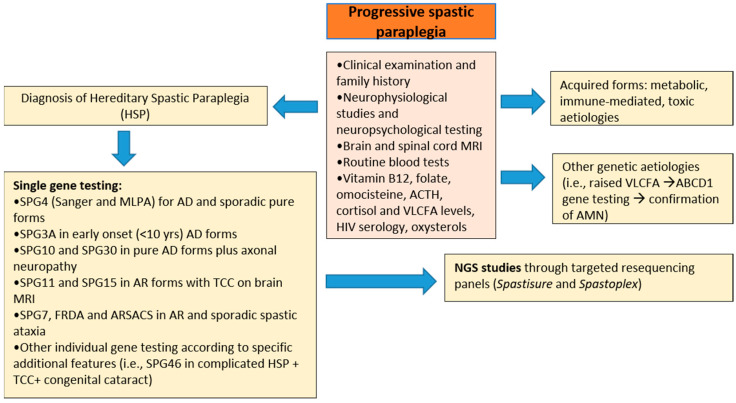
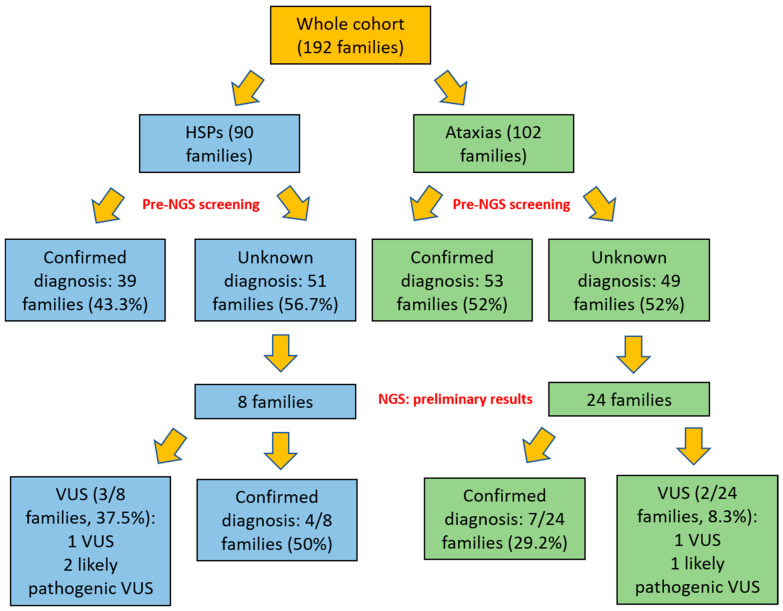
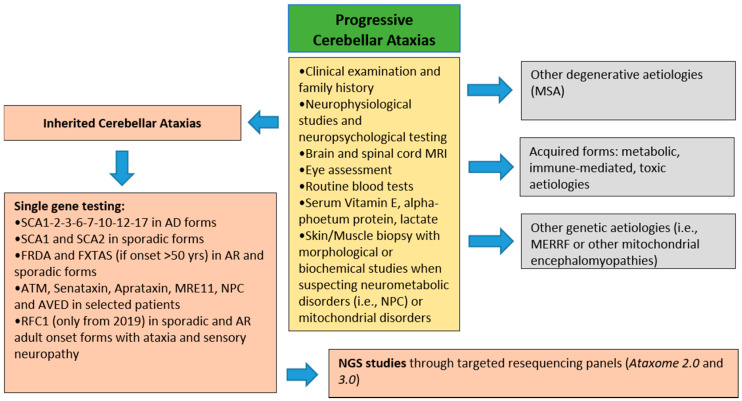
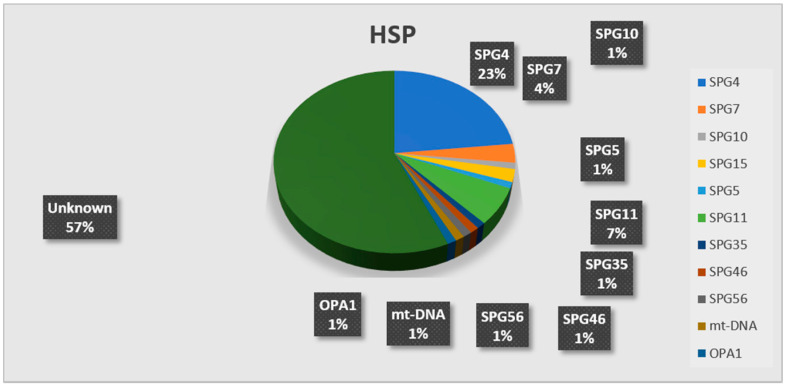
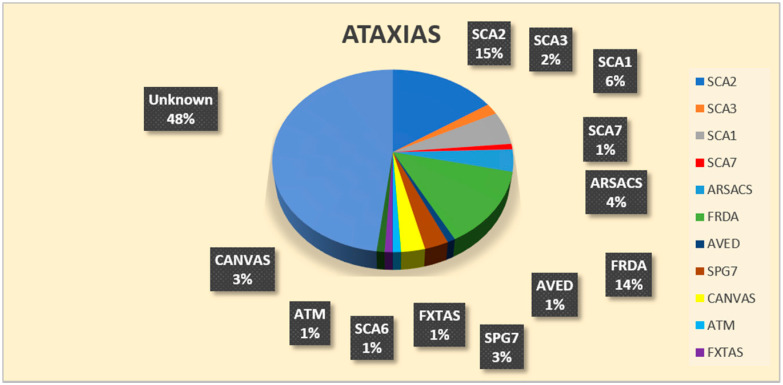
The molecular characterization of Hereditary Spastic Paraplegias (HSP) and inherited cerebellar ataxias (CA) is challenged by their clinical and molecular heterogeneity. The recent application of Next Generation Sequencing (NGS) technologies is increasing the diagnostic rate, which can be influenced by patients' selection. To assess if a clinical diagnosis of CA/HSP received in a third-level reference center might impact the molecular diagnostic yield, we retrospectively evaluated the molecular diagnostic rate reached in our center on 192 unrelated families (90 HSP and 102 CA) (i) before NGS and (ii) with the use of NGS gene panels. Overall, 46.3% of families received a genetic diagnosis by first-tier individual gene screening: 43.3% HSP and 50% spinocerebellar ataxias (SCA). The diagnostic rate was 56.7% in AD-HSP, 55.5% in AR-HSP, and 21.2% in sporadic HSP. On the other hand, 75% AD-, 52% AR- and 33% sporadic CA were diagnosed. So far, 32 patients (24 CA and 8 HSP) were further assessed by NGS gene panels, and 34.4% were diagnosed, including 29.2% CA and 50% HSP patients. Eleven novel gene variants classified as (likely) pathogenic were identified. Our results support the role of experienced clinicians in the diagnostic assessment and the clinical research of CA and HSP even in the next generation era.
遗传性痉挛性截瘫(HSP)和遗传性小脑共济失调(CA)的分子特征因其临床和分子异质性而面临挑战。新一代测序(NGS)技术的近期应用提高了诊断率,而这可能受到患者选择的影响。为了评估在三级参考中心做出的CA/HSP临床诊断是否会影响分子诊断率,我们回顾性评估了我们中心对192个无关家族(90个HSP家族和102个CA家族)在(i)NGS之前以及(ii)使用NGS基因panel时所达到的分子诊断率。总体而言,46.3%的家族通过一级单基因筛查获得了基因诊断:43.3%的HSP家族和50%的脊髓小脑共济失调(SCA)家族。常染色体显性遗传HSP(AD-HSP)的诊断率为56.7%,常染色体隐性遗传HSP(AR-HSP)为55.5%,散发性HSP为21.2%。另一方面,常染色体显性遗传CA(AD-CA)的诊断率为75%,常染色体隐性遗传CA(AR-CA)为52%,散发性CA为33%。到目前为止,32例患者(24例CA和8例HSP)通过NGS基因panel进行了进一步评估,34.4%的患者得到诊断,其中包括29.2%的CA患者和50%的HSP患者。鉴定出11种被分类为(可能)致病的新基因变异。我们的结果支持经验丰富的临床医生在CA和HSP的诊断评估及临床研究中的作用,即使在下一代测序时代亦是如此。