Nassar Farah J, Msheik Zahraa S, Itani Maha M, Helou Remie El, Hadla Ruba, Kreidieh Firas, Bejjany Rachelle, Mukherji Deborah, Shamseddine Ali, Nasr Rihab R, Temraz Sally N
Department of Internal Medicine, Faculty of Medicine, American University of Beirut, Beirut 1107 2020, Lebanon.
Department of Anatomy, Cell Biology and Physiological Sciences, Faculty of Medicine, American University of Beirut, Beirut 1107 2020, Lebanon.
Diagnostics (Basel). 2021 Feb 19;11(2):341. doi: 10.3390/diagnostics11020341.
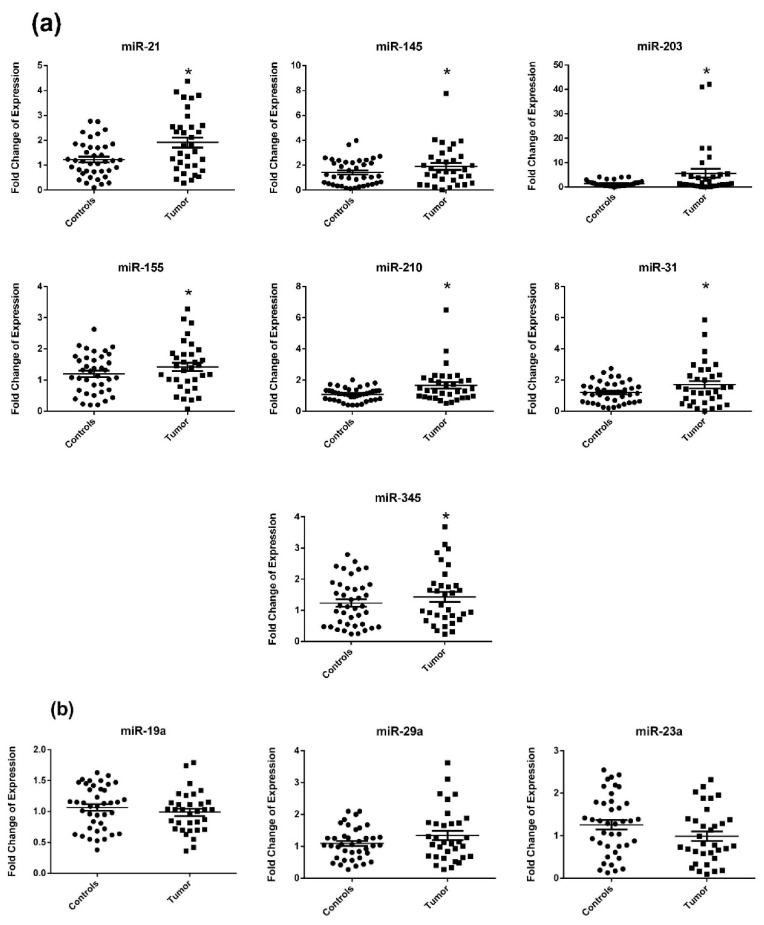
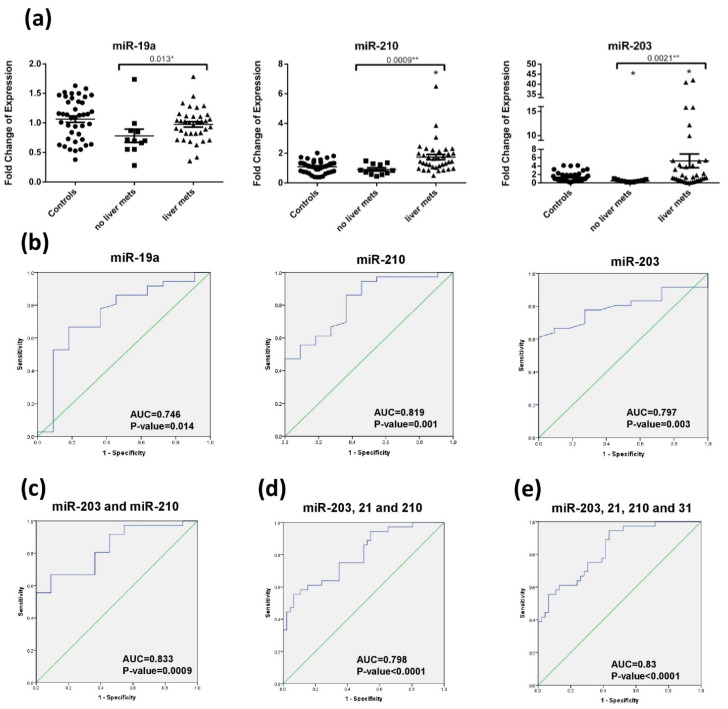
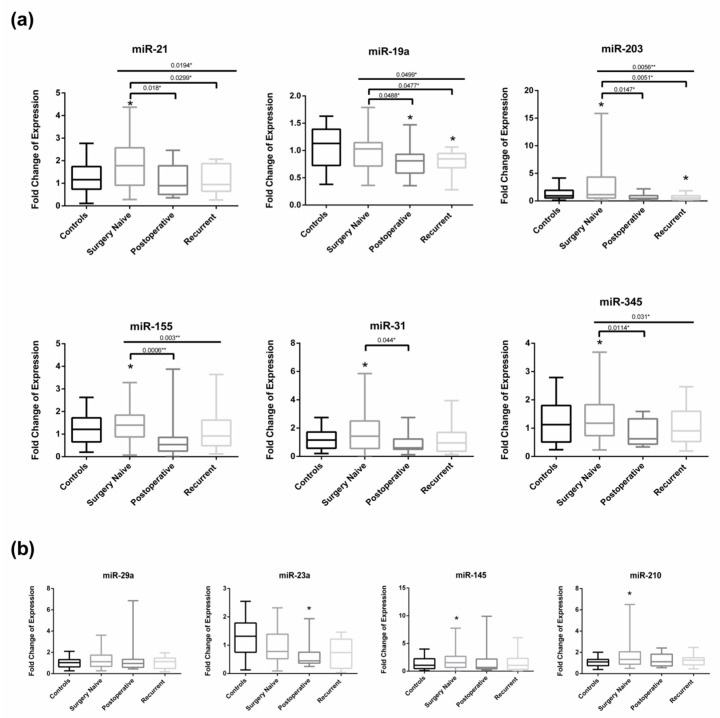
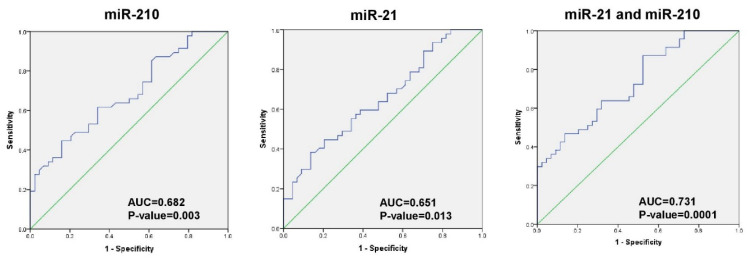
Colorectal cancer (CRC) is the second leading cause of cancer deaths worldwide. Stage IV CRC patients have poor prognosis with a five-year survival rate of 14%. Liver metastasis is the main cause of mortality in CRC patients. Since current screening tests have several drawbacks, effective stable non-invasive biomarkers such as microRNA (miRNA) are needed. We aim to investigate the expression of miRNA (miR-21, miR-19a, miR-23a, miR-29a, miR-145, miR-203, miR-155, miR-210, miR-31, and miR-345) in the plasma of 62 Lebanese Stage IV CRC patients and 44 healthy subjects using RT-qPCR, as well as to evaluate their potential for diagnosis of advanced CRC and its liver metastasis using the Receiver Operating Characteristics (ROC) curve. miR-21, miR-145, miR-203, miR-155, miR-210, miR-31, and miR-345 were significantly upregulated in the plasma of surgery naïve CRC patients when compared to healthy individuals. We identified two panels of miRNA that could be used for diagnosis of Stage IV CRC (miR-21 and miR-210) with an area under the curve (AUC) of 0.731 and diagnostic accuracy of 69% and liver metastasis (miR-210 and miR-203) with an AUC = 0.833 and diagnostic accuracy of 72%. Panels of specific circulating miRNA, which require further validation, could be potential non-invasive diagnostic biomarkers for CRC and liver metastasis.
结直肠癌(CRC)是全球癌症死亡的第二大主要原因。IV期CRC患者预后较差,五年生存率为14%。肝转移是CRC患者死亡的主要原因。由于目前的筛查测试存在若干缺点,因此需要有效的稳定非侵入性生物标志物,如微小RNA(miRNA)。我们旨在使用RT-qPCR研究62例黎巴嫩IV期CRC患者和44例健康受试者血浆中miRNA(miR-21、miR-19a、miR-23a、miR-29a、miR-145、miR-203、miR-155、miR-210、miR-31和miR-345)的表达,并使用受试者工作特征(ROC)曲线评估其诊断晚期CRC及其肝转移的潜力。与健康个体相比,初治CRC患者血浆中的miR-21、miR-145、miR-203、miR-155、miR-210、miR-31和miR-345显著上调。我们鉴定出两组可用于诊断IV期CRC(miR-21和miR-210)的miRNA,曲线下面积(AUC)为0.731,诊断准确率为69%,以及用于诊断肝转移(miR-210和miR-203)的miRNA,AUC = 0.833,诊断准确率为72%。特定循环miRNA组需要进一步验证,可能是CRC和肝转移潜在的非侵入性诊断生物标志物。