Zhang Yong, Zhou Yu-Mei, Zhang Zu-Jian, Li Xin
Department of Radiology, People's Hospital of Deyang City, Deyang City, Sichuan Province 618000, People's Republic of China.
Outpatient Department, People's Hospital of Deyang City, Deyang City, Sichuan Province, 618000, People's Republic of China.
Cancer Manag Res. 2020 Sep 25;12:9077-9085. doi: 10.2147/CMAR.S267731. eCollection 2020.
Hepatic metastasis of colon carcinoma seriously affects the prognosis of patients, and miRNA has attracted much attention in predicting hepatic metastasis of colon carcinoma (CC). This research aimed to explore the predictive role of miR-210 in serum for recurrence and prognosis of CC patients with hepatic metastasis.
Altogether, 150 patients with liver metastases of CC (research group, RG) and 130 patients with non-metastatic of CC (control group, CG) admitted to People's Hospital of Deyang City from March 2012 to March 2015 were obtained and their serum was collected. miR-210 in the RG and the CG, and miR-210 in the RG after radiofrequency ablation treatment were detected, the relationship between miR-210 and pathological parameters of CC patients with hepatic metastasis was analyzed, and patients in the RG were followed up for 5 years to analyze the recurrence, overall survival (OS) and disease-free survival (DFS). The area under the curve (AUC) of receiver operating characteristic curve (ROC) was applied to test the predictive value of miR-210. Cox regression was applied to analyze the independent prognostic factors of patients.
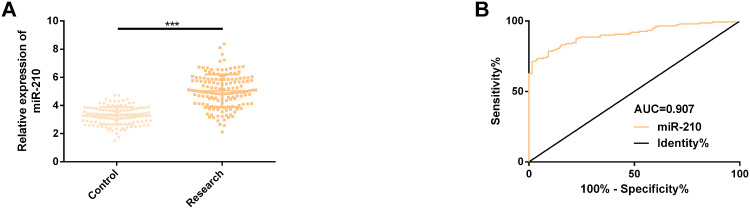
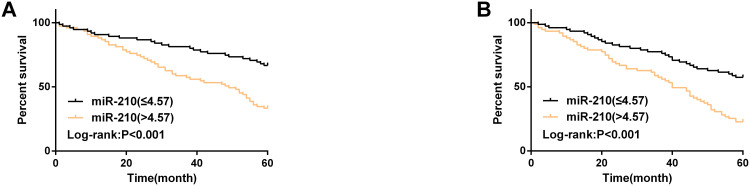
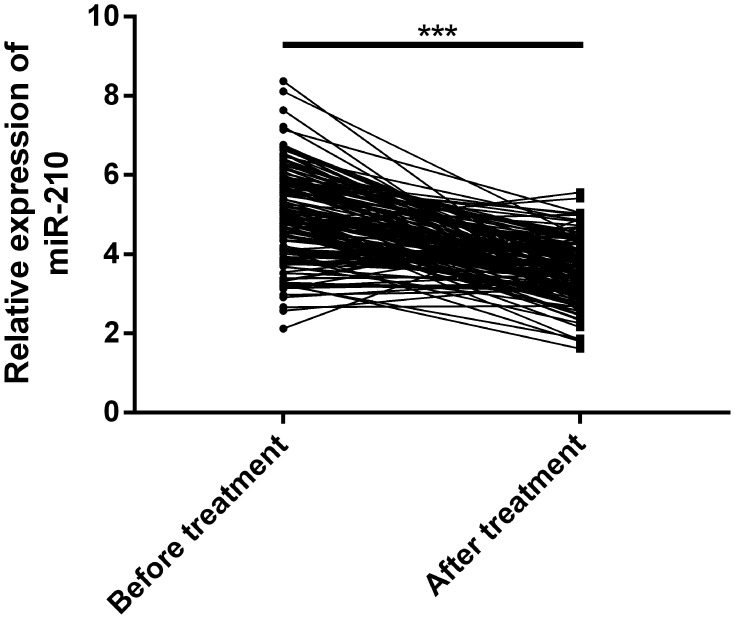
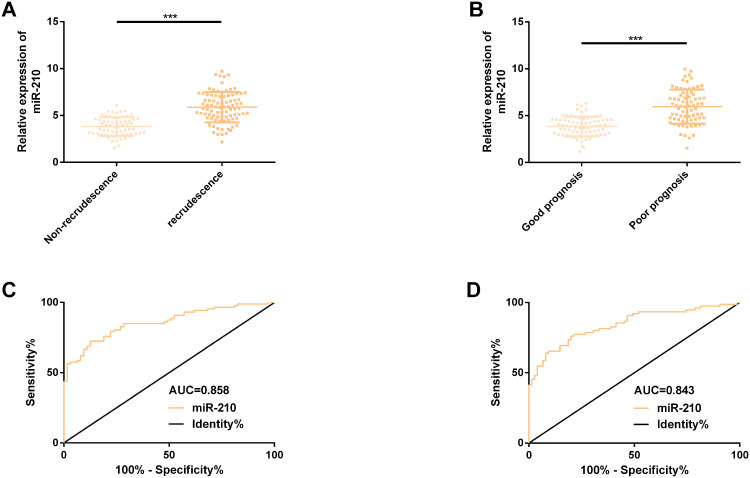
miR-210 in the RG was evidently higher than that in the CG, and AUC for distinguishing hepatic metastasis of CC was 0.907. miR-210 had a close correlation with lymph node metastasis, distant metastasis and pathological differentiation. After treatment, miR-210 in the RG was evidently reduced, and the serum was higher in patients with recurrence and with poor prognosis. AUC for predicting recurrence was 0.858, and AUC for predicting poor prognosis was 0.843. High miR-210 was closely related to lower 5-year OS and DFS and is also an independent prognostic factor affecting patients' 5-year OS.
miR-210 is enhanced in hepatic metastasis of CC, which is a serological biomarker for predicting recurrence and prognosis of patients with hepatic metastasis of CC after radiofrequency ablation, and has great clinical application value.
结肠癌肝转移严重影响患者预后,微小RNA(miRNA)在预测结肠癌(CC)肝转移方面备受关注。本研究旨在探讨血清miR-210对CC肝转移患者复发及预后的预测作用。
选取2012年3月至2015年3月在德阳市人民医院收治的150例CC肝转移患者(研究组,RG)和130例非CC转移患者(对照组,CG),采集其血清。检测RG和CG中的miR-210以及RG射频消融治疗后的miR-210,分析miR-210与CC肝转移患者病理参数的关系,并对RG患者进行5年随访,分析复发、总生存期(OS)和无病生存期(DFS)。应用受试者工作特征曲线(ROC)的曲线下面积(AUC)检验miR-210的预测价值。采用Cox回归分析患者的独立预后因素。
RG中的miR-210明显高于CG,区分CC肝转移的AUC为0.907。miR-210与淋巴结转移、远处转移及病理分化密切相关。治疗后,RG中的miR-210明显降低,复发和预后不良患者的血清miR-210较高。预测复发的AUC为0.858,预测预后不良的AUC为0.843。高miR-210与较低的5年OS和DFS密切相关,也是影响患者5年OS的独立预后因素。
miR-210在CC肝转移中升高,是预测CC肝转移患者射频消融后复发及预后的血清生物标志物,具有较大的临床应用价值。