Kang Gyumin, Lee Haelim, Shin Malsoon, Kim Jaekwan, Lee Sungki, Park Youngja
School of Bio-Medical Science, Korea University, 2511 Sejong-ro, Sejong 30019, Korea.
Department of Sports Medicine, College of Health Science, CHA University, 120 Haeryong-ro, Donggyo-dong, Pocheon 11160, Korea.
Metabolites. 2021 Feb 19;11(2):118. doi: 10.3390/metabo11020118.
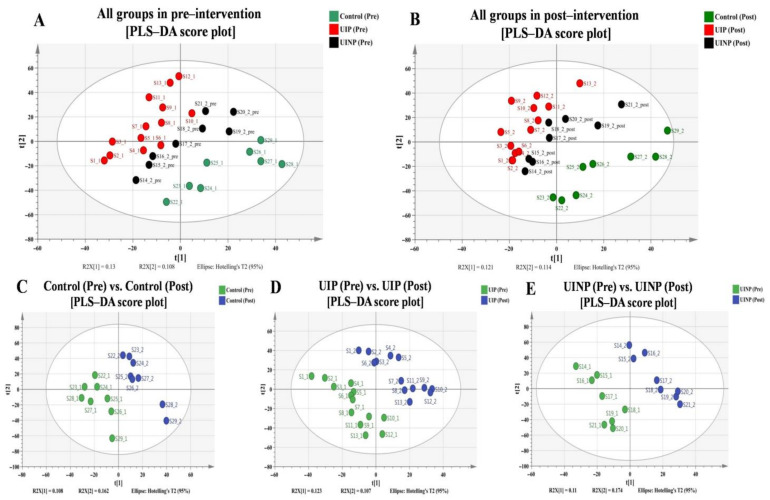
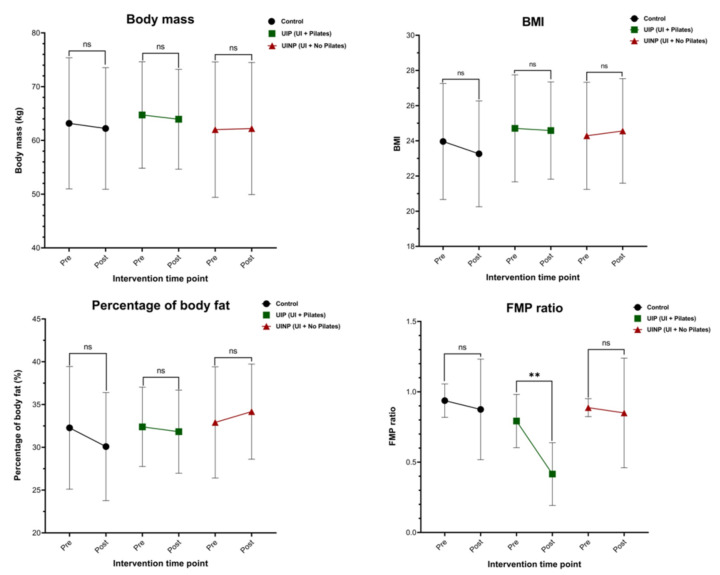
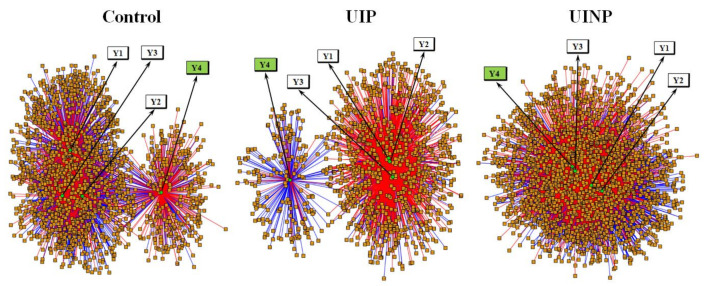
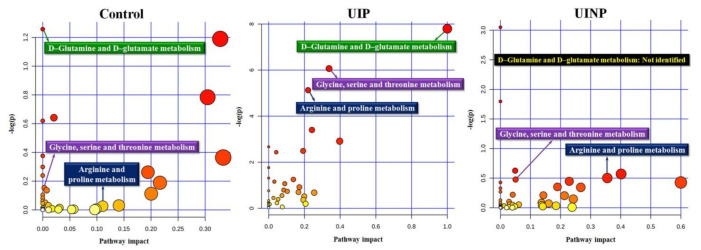
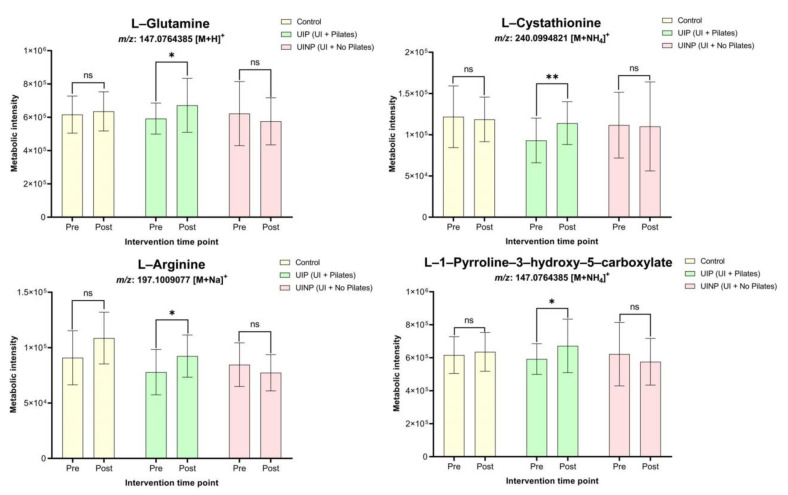
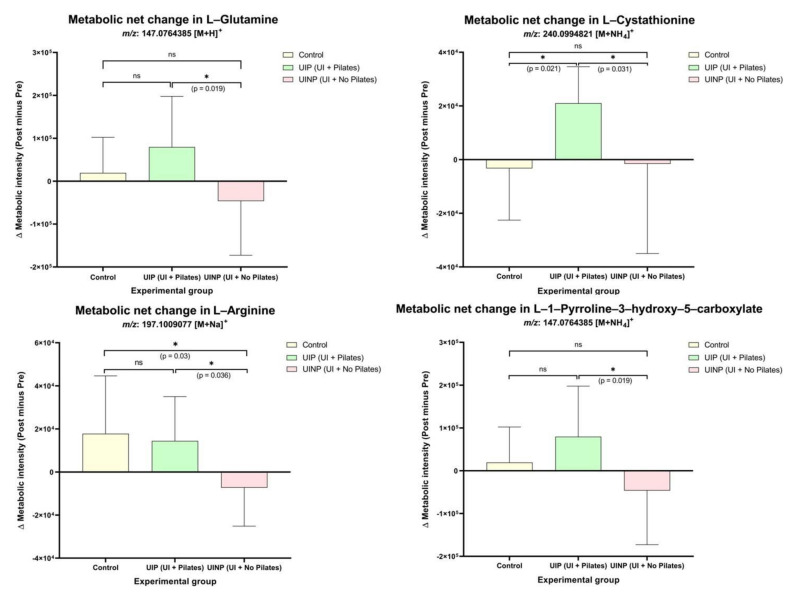
Pilates has been known as exercise intervention that improves the function of pelvic floor muscle (PFM) associated with impacting urinary incontinence (UI). This study investigated the effect of Pilates on UI in Korean women by determining the change in functional movement of PFM (FMP) and metabolic profiles. UI group with Pilates (UIP, = 13) participated in 8-weeks Oov Pilates program, and 8 subjects were assigned to Control and UI group with no Pilates (UINP), respectively. Before and after 8 weeks, plasma samples were collected from all participants, and ultrasonography was used to measure the functional change of PFM for calculating FMP ratio. Plasma samples were analyzed by mass spectrometry to identify the change of metabolic features. After 8-weeks intervention, FMP ratio was remarkably decreased in UIP (48.1% ↓, < 0.001), but not in Control and UINP ( > 0.05). In metabolic features, L-Glutamine (/: 147.07 [M + H]), L-Cystathionine (/: 240.09 [M + NH]), L-Arginine (/: 197.1 [M + Na]), and L-1-Pyrroline-3-hydroxy-5-carboxylate (/: 147.07 [M + NH]) were significantly elevated solely in UIP ( < 0.001). Our study elucidated that Pilates can ameliorate the FMP and enhance the specific metabolic characteristics, which was potentially associated with invigorated PFM contractility to effectively control the bladder base and continence.
普拉提作为一种运动干预方式,已知其可改善与影响尿失禁(UI)相关的盆底肌(PFM)功能。本研究通过测定PFM功能运动(FMP)变化和代谢谱,调查了普拉提对韩国女性尿失禁的影响。普拉提训练的UI组(UIP,n = 13)参加了为期8周的Oov普拉提课程,另外8名受试者分别被分配到对照组和无普拉提训练的UI组(UINP)。在8周前后,采集所有参与者的血浆样本,并使用超声测量PFM的功能变化以计算FMP比率。通过质谱分析血浆样本以识别代谢特征的变化。8周干预后,UIP组的FMP比率显著下降(下降48.1%,P < 0.001),而对照组和UINP组则无变化(P > 0.05)。在代谢特征方面,仅UIP组的L-谷氨酰胺(m/z:147.07 [M + H])、L-胱硫醚(m/z:240.09 [M + NH])、L-精氨酸(m/z:197.1 [M + Na])和L-1-吡咯啉-3-羟基-5-羧酸盐(m/z:147.07 [M + NH])显著升高(P < 0.001)。我们的研究表明,普拉提可以改善FMP并增强特定的代谢特征,这可能与增强PFM收缩力以有效控制膀胱底部和尿失禁有关。