Univ. Bordeaux, CNRS, Laboratoire IMS, UMR 5218 Talence, France.
Bordeaux INP, Univ. Bordeaux, CNRS, Laboratoire IMS, UMR 5218 Talence, France.
Int J Environ Res Public Health. 2021 Feb 21;18(4):2081. doi: 10.3390/ijerph18042081.
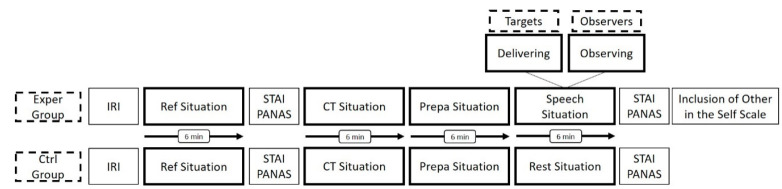
Because most humans live and work in populated environments, researchers recently took into account that people may not only experience first-hand stress, but also second-hand stress related to the ability to empathically share another person's stress response. Recently, researchers have begun to more closely examine the existence of such empathic stress and highlighted the human propensity to physiologically resonate with the stress responses of others. As in case of first-hand stress, empathic stress could be deleterious for health if people experience exacerbated activation of hypothalamic-pituitary-adrenal and autonomic nervous systems. Thus, exploring empathic stress in an observer watching someone else experiencing stress is critical to gain a better understanding of physiological resonance and conduct strategies for health prevention. In the current study, we investigated the influence of empathic stress responses on heart rate variability (HRV) with a specific focus on nonlinear dynamics. Classic and nonlinear markers of HRV time series were computed in both targets and observers during a modified Trier social stress test (TSST). We capitalized on multiscale entropy, a reliable marker of complexity for depicting neurovisceral interactions (brain-to-heart and heart-to-brain) and their role in physiological resonance. State anxiety and affect were evaluated as well. While classic markers of HRV were not impacted by empathic stress, we showed that the complexity marker reflected the existence of empathic stress in observers. More specifically, a linear model highlighted a physiological resonance phenomenon. We conclude on the relevance of entropy in HRV dynamics, as a marker of complexity in neurovisceral interactions reflecting physiological resonance in empathic stress.
由于大多数人类生活和工作在人口密集的环境中,研究人员最近考虑到人们不仅可能直接体验到压力,还可能间接体验到与共情他人压力反应能力相关的压力。最近,研究人员开始更仔细地研究这种共情压力的存在,并强调了人类与他人压力反应产生生理共鸣的倾向。与直接压力一样,如果人们经历下丘脑-垂体-肾上腺和自主神经系统过度激活,共情压力可能对健康有害。因此,探索观察者在观察他人经历压力时的共情压力对于更好地理解生理共鸣并采取健康预防策略至关重要。在本研究中,我们通过特别关注非线性动力学,研究了共情压力反应对心率变异性(HRV)的影响。在修改后的特里尔社会压力测试(TSST)中,我们在目标和观察者中计算了 HRV 时间序列的经典和非线性标记。我们利用了多尺度熵,这是一种可靠的复杂性标记,用于描述神经内脏相互作用(大脑到心脏和心脏到大脑)及其在生理共鸣中的作用。同时评估了状态焦虑和情感。虽然 HRV 的经典标记不受共情压力的影响,但我们表明,复杂性标记反映了观察者中存在共情压力。更具体地说,线性模型突出了一种生理共鸣现象。我们得出结论,熵在 HRV 动力学中具有相关性,作为神经内脏相互作用复杂性的标记,反映了共情压力中的生理共鸣。