Large Animal Clinic, Veterinary Academy, Lithuanian University of Health Sciences, Tilžės str 18, LT-47181 Kaunas, Lithuania.
Department of Animal Breeding, Veterinary Academy, Lithuanian University of Health Sciences, Tilžės Str 18, LT-47181 Kaunas, Lithuania.
Sensors (Basel). 2021 Feb 18;21(4):1414. doi: 10.3390/s21041414.
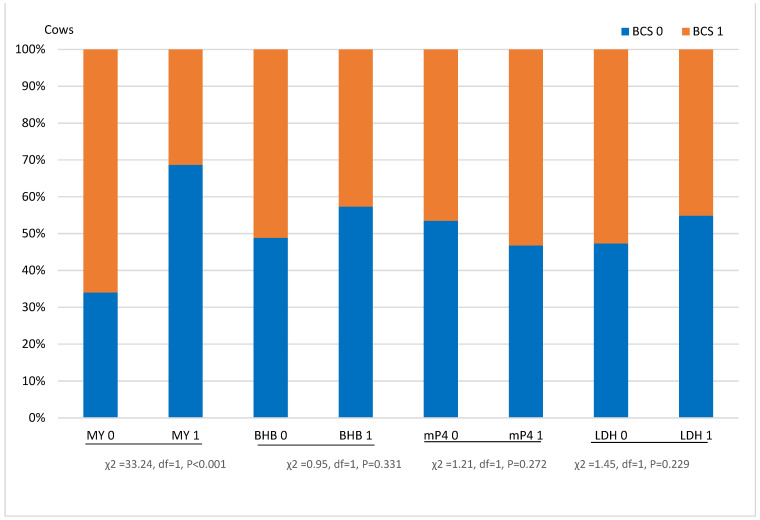
The aim of the current study was to evaluate the relation of automatically determined body condition score (BCS) and inline biomarkers such as β-hydroxybutyrate (BHB), milk yield (MY), lactate dehydrogenase (LDH), and progesterone (mP4) with the pregnancy success of cows. The cows ( = 281) had 2.1 ± 0.1. lactations on average, were 151.6 ± 0.06 days postpartum, and were once tested with "Easy scan" ultrasound (IMV imaging, Scotland) at 30-35 d post-insemination. According to their reproductive status, cows were grouped into two groups: non-pregnant ( = 194 or 69.0% of cows) and pregnant ( = 87 or 31.0% of cows). Data concerning their BCS, mP4, MY, BHB, and LDH were collected each day from the day of insemination for 7 days. The BCS was collected with body condition score camera (DeLaval Inc., Tumba, Sweden); mP4, MY, BHB, and LDH were collected with the fully automated real-time analyzer Herd Navigator™ (Lattec I/S, Hillerød, Denmark) in combination with a DeLaval milking robot (DeLaval Inc., Tumba, Sweden). Of all the biomarkers, three differences between groups were significant. The body condition score (BCS) of the pregnant cows was higher (+0.49 score), the milk yield (MY) was lower (-4.36 kg), and milk progesterone in pregnant cows was (+6.11 ng/mL) higher compared to the group of non-pregnant cows ( < 0.001). The pregnancy status of the cows was associated with their BCS assessment ( < 0.001). We estimated that cows with BCS > 3.2 were 22 times more likely to have reproductive success than cows with BCS ≤ 3.2.
本研究旨在评估自动确定的体况评分(BCS)与在线生物标志物(如β-羟丁酸(BHB)、产奶量(MY)、乳酸脱氢酶(LDH)和孕酮(mP4))与奶牛妊娠成功率的关系。这些奶牛的平均泌乳次数为 2.1 ± 0.1 次,产后天数为 151.6 ± 0.06 天,在授精后 30-35 天曾接受过“Easy scan”超声检查(IMV 成像,苏格兰)。根据其繁殖状况,将奶牛分为两组:未怀孕(= 194 或奶牛的 69.0%)和怀孕(= 87 或奶牛的 31.0%)。从授精之日起,每天收集与奶牛 BCS、mP4、MY、BHB 和 LDH 相关的数据,持续 7 天。BCS 通过体况评分相机(DeLaval Inc.,Tumba,瑞典)收集;mP4、MY、BHB 和 LDH 通过全自动实时分析仪 Herd Navigator ™(Lattec I/S,Hillerød,丹麦)与 DeLaval 挤奶机器人(DeLaval Inc.,Tumba,瑞典)结合收集。在所有生物标志物中,有三个组间差异具有统计学意义。怀孕奶牛的体况评分(BCS)更高(+0.49 分),产奶量(MY)更低(-4.36kg),并且与未怀孕奶牛相比,怀孕奶牛的牛奶孕酮更高(+6.11ng/mL)(<0.001)。奶牛的妊娠状况与他们的 BCS 评估相关(<0.001)。我们估计,BCS>3.2 的奶牛怀孕的可能性是 BCS≤3.2 的奶牛的 22 倍。