
射频辐射可减轻紫外线 B 诱导的皮肤炎症中的高迁移率族蛋白 B1 和 Toll 样受体的激活。
Radiofrequency Irradiation Attenuates High-Mobility Group Box 1 and Toll-like Receptor Activation in Ultraviolet B-Induced Skin Inflammation.
机构信息
Maylin Clinic, Goyang-si, Gyeonggi-do 10391, Korea.
Department of Anatomy & Cell Biology, Gachon University College of Medicine, Incheon 21936, Korea.
出版信息
Molecules. 2021 Feb 28;26(5):1297. doi: 10.3390/molecules26051297.
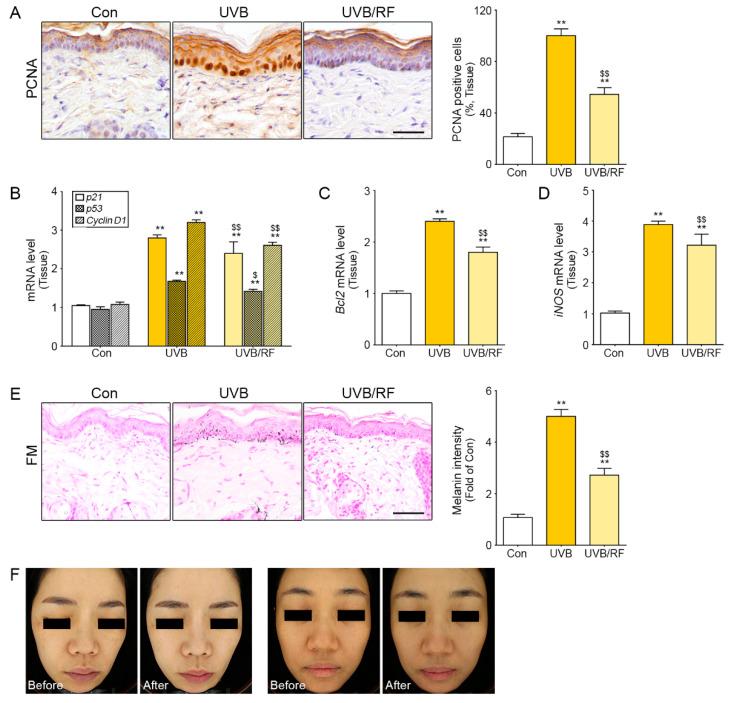
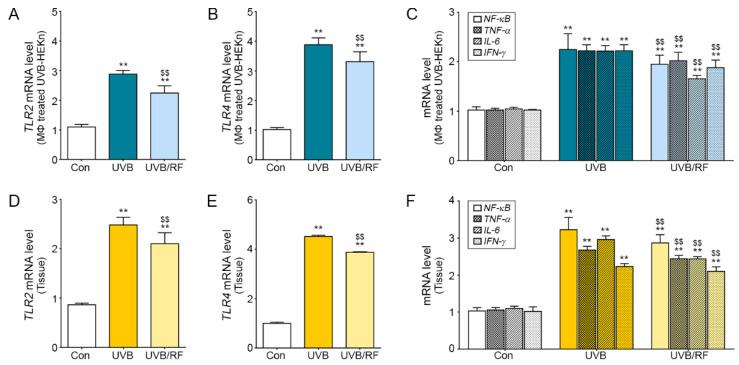
Ultraviolet B (UVB) exposure activates various inflammatory molecules of keratinocytes in the epidermis layer. Such UVB-mediated skin inflammation leaves post-inflammatory hyperpigmentation (PIH). Reports show a close relationship between PIH and high-mobility group box 1 (HMGB1) and its receptors. General clinical treatments of PIH, such as oral medication and laser treatment, have reported side effects. Recent studies reported the effects of radiofrequency (RF) irradiation on restoring dermal collagen, modulating the dermal vasculature, and thickening the basement membrane. To validate how RF regulates the inflammatory molecules from UVB-irradiated keratinocytes, we used UVB-radiated keratinocytes and macrophages, as well as animal skin. In addition, we examined two cases of RF-irradiated skin inflammatory diseases. We validated the effects of RF irradiation on keratinocytes by measuring expression levels of HMGB1, Toll-like receptors (TLRs), and other inflammatory factors. The results show that the RF modulates UVB-radiated keratinocytes to secrete fewer inflammatory factors and also modulates the expression of macrophages from HMGB1, TLRs, and inflammatory factors. RF irradiation could alleviate inflammatory skin diseases in patients. RF irradiation can regulate the macrophage indirectly through modulating the keratinocyte and inflammatory molecules of macrophages reduced in vitro and in vivo. Although the study is limited by the low number of cases, it demonstrates that RF irradiation can regulate skin inflammation in patients.
紫外线 B(UVB)照射会激活表皮层角质细胞中的各种炎症分子。这种由 UVB 介导的皮肤炎症会导致炎症后色素沉着(PIH)。报告显示,PIH 与高迁移率族蛋白 B1(HMGB1)及其受体密切相关。PIH 的一般临床治疗方法,如口服药物和激光治疗,都有报道称存在副作用。最近的研究报告了射频(RF)照射对恢复真皮胶原、调节真皮血管和增厚基底膜的影响。为了验证 RF 如何调节 UVB 照射的角质细胞中的炎症分子,我们使用了 UVB 照射的角质细胞和巨噬细胞,以及动物皮肤。此外,我们还检查了两例 RF 照射的皮肤炎症性疾病。我们通过测量 HMGB1、Toll 样受体(TLR)和其他炎症因子的表达水平,验证了 RF 照射对角质细胞的影响。结果表明,RF 调节了 UVB 照射的角质细胞,使其分泌较少的炎症因子,并调节了巨噬细胞中 HMGB1、TLR 和炎症因子的表达。RF 照射可以减轻患者的炎症性皮肤疾病。RF 照射可以通过调节角质细胞间接调节巨噬细胞,并且可以减少体外和体内的炎症分子。尽管这项研究受到病例数量少的限制,但它表明 RF 照射可以调节患者的皮肤炎症。


 Zotero 插件