
射频辐射通过降低黑色素合成和上调热休克蛋白 70 减少 UV-B 诱导的皮肤色素沉着的衰减作用。
Attenuation Effect of Radiofrequency Irradiation on UV-B-Induced Skin Pigmentation by Decreasing Melanin Synthesis and through Upregulation of Heat Shock Protein 70.
机构信息
Department of Anatomy & Cell Biology, Gachon University College of Medicine, Incheon 21936, Korea.
Functional Cellular Networks Laboratory, Department of Medicine, Graduate School and Lee Gil Ya Cancer and Diabetes Institute, College of Medicine, Gachon University, Incheon 21999, Korea.
出版信息
Molecules. 2021 Dec 17;26(24):7648. doi: 10.3390/molecules26247648.
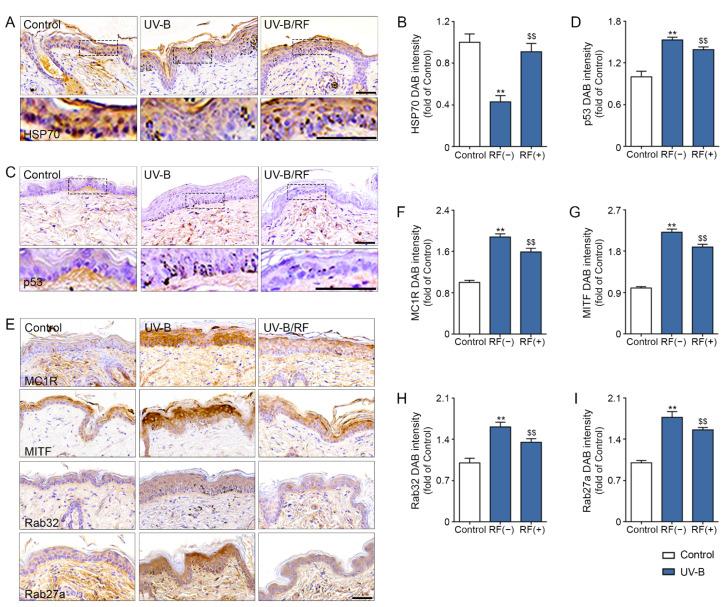
Excess melanin deposition in the skin causes cosmetic problems. HSP70 upregulation decreases microphthalmia-associated transcription factor (MITF) expression, which eventually decreases tyrosinase activity and melanogenesis. Ultraviolet (UV) radiation upregulates p53, which increases the melanocortin receptor (MC1R) and MITF. Furthermore, HSP70 decreases p53 and radiofrequency irradiation (RF) increases HSP70. We evaluated whether RF increased HSP70 and decreased p53, consequently decreasing the MITF/tyrosinase pathway and melanogenesis in UV-B radiated animal skin. Various RF combinations with 50, 100, and 150 ms and 5, 10, and 15 W were performed on the UV-B radiated mouse skin every 2 d for 28 d. When RF was performed with 100 ms/10 W, melanin deposition, evaluated by Fontana-Masson staining, decreased without skin crust formation in the UV-B radiated skin. Thus, we evaluated the effect of RF on decreasing melanogenesis in the HEMn and UV-B radiated skin at a setting of 100 ms/10 W. HSP70 expression was decreased in the UV-B radiated skin but was increased by RF. The expression of p53, MC1R, and MITF increased in the UV-B radiated skin but was decreased by RF. The expression of p53, MC1R, and MITF increased in the α-MSH treated HEMn but was decreased by RF. The decreasing effects of RF on p53, MC1R, CREB and MITF were higher than those of HSP70-overexpressed HEMn. The decreasing effect of RF on p53, MC1R, CREB, and MITF disappeared in the HSP70-silenced HEMn. MC1R, CREB, and MITF were not significantly decreased by the p53 inhibitor in α-MSH treated HEMn. RF induced a greater decrease in MC1R, CREB, and MITF than the p53 inhibitor. Therefore, RF may have decreased melanin synthesis by increasing HSP70 and decreasing p53, thus decreasing MC1R/CREB/MITF and tyrosinase activity.
皮肤中过多的黑色素沉积会导致美容问题。热休克蛋白 70(HSP70)的上调会降低小眼畸形相关转录因子(MITF)的表达,从而最终降低酪氨酸酶活性和黑色素生成。紫外线(UV)辐射会上调 p53,从而增加黑素皮质素受体(MC1R)和 MITF。此外,HSP70 会降低 p53,射频(RF)辐射会增加 HSP70。我们评估了 RF 是否会增加 HSP70 并降低 p53,从而减少 UV-B 辐射动物皮肤中的 MITF/酪氨酸酶途径和黑色素生成。在 UV-B 辐射的小鼠皮肤上,每 2 天进行一次不同的 RF 组合,持续 28 天,RF 组合的脉冲宽度为 50、100 和 150 ms,功率为 5、10 和 15 W。当以 100 ms/10 W 的参数进行 RF 时,在没有形成皮肤结痂的情况下,Fontana-Masson 染色评估的黑色素沉积减少。因此,我们在 100 ms/10 W 的设置下评估了 RF 对减少 HEMn 和 UV-B 辐射皮肤中黑色素生成的影响。HSP70 的表达在 UV-B 辐射的皮肤中减少,但被 RF 增加。p53、MC1R 和 MITF 的表达在 UV-B 辐射的皮肤中增加,但被 RF 减少。在 α-MSH 处理的 HEMn 中,p53、MC1R 和 MITF 的表达增加,但被 RF 减少。RF 对 p53、MC1R、CREB 和 MITF 的降低作用高于 HSP70 过表达的 HEMn。在 HSP70 沉默的 HEMn 中,RF 对 p53、MC1R、CREB 和 MITF 的降低作用消失。在 α-MSH 处理的 HEMn 中,p53 抑制剂对 MC1R、CREB 和 MITF 的降低作用不明显。RF 诱导的 MC1R、CREB 和 MITF 降低作用大于 p53 抑制剂。因此,RF 可能通过增加 HSP70 和降低 p53 来减少黑色素合成,从而降低 MC1R/CREB/MITF 和酪氨酸酶活性。



 Zotero 插件