Prezioso Giovanni, Perrone Serafina, Biasucci Giacomo, Pisi Giovanna, Fainardi Valentina, Strisciuglio Caterina, Marzano Francesco Nonnis, Moretti Sabrina, Pisani Francesco, Tchana Bertrand, Argentiero Alberto, Neglia Cosimo, Caffarelli Carlo, Bertolini Patrizia, Bersini Maria Teresa, Canali Andrea, Voccia Emanuele, Squarcia Antonella, Ghi Tullio, Verrotti Carla, Frusca Tiziana, Cecchi Rossana, Giordano Giovanna, Colasanti Filomena, Roccia Ilenia, Palanza Paola, Esposito Susanna
Pediatric Clinic, Department of Medicine and Surgery, University of Parma, 43126 Parma, Italy.
Unit of Neonatology, Department of Medicine and Surgery, University of Parma, 43126 Parma, Italy.
Life (Basel). 2021 Feb 22;11(2):171. doi: 10.3390/life11020171.
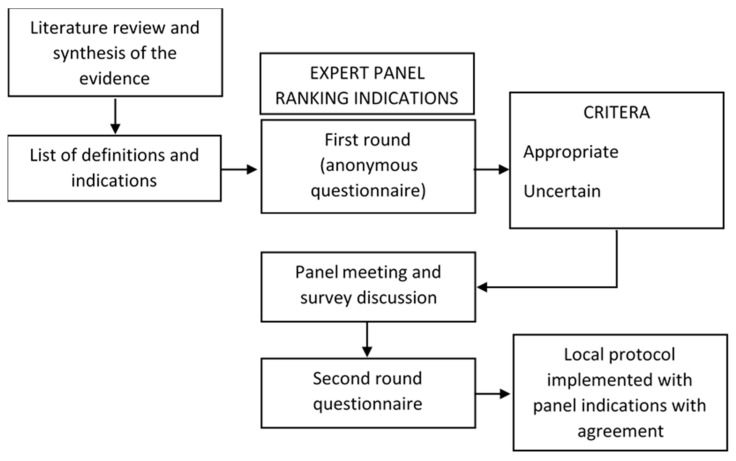
Unexpected events of breath, tone, and skin color change in infants are a cause of considerable distress to the caregiver and there is still debate on their appropriate management. The aim of this study is to survey the trend in prevention, decision-making, and management of brief resolved unexplained events (BRUE)/apparent life-threatening events (ALTE) and to develop a shared protocol among hospitals and primary care pediatricians regarding hospital admission criteria, work-up and post-discharge monitoring of patients with BRUE/ALTE. For the study purpose, a panel of 54 experts was selected to achieve consensus using the RAND/UCLA appropriateness method. Twelve scenarios were developed: one addressed to primary prevention of ALTE and BRUE, and 11 focused on hospital management of BRUE and ALTE. For each scenario, participants were asked to rank each option from '1' (extremely inappropriate) to '9' (extremely appropriate). Results derived from panel meeting and discussion showed several points of agreement but also disagreement with different opinion emerged and the need of focused education on some areas. However, by combining previous recommendations with expert opinion, the application of the RAND/UCLA appropriateness permitted us to drive pediatricians to reasoned and informed decisions in term of evaluation, treatment and follow-up of infants with BRUE/ALTE, reducing inappropriate exams and hospitalisation and highlighting priorities for educational interventions.
婴儿呼吸、音调及肤色的意外变化会给护理人员带来极大困扰,对于这些情况的恰当处理仍存在争议。本研究旨在调查短暂性不明原因事件(BRUE)/疑似危及生命事件(ALTE)的预防、决策及管理趋势,并就BRUE/ALTE患者的住院标准、检查及出院后监测制定医院与基层儿科医生之间通用的方案。为实现研究目的,选取了54位专家组成小组,采用兰德/加州大学洛杉矶分校适宜性方法达成共识。设计了12种场景:一种针对ALTE和BRUE的一级预防,另外11种聚焦于BRUE和ALTE的医院管理。对于每种场景,要求参与者将每个选项从“1”(极不恰当)到“9”(极恰当)进行排序。小组会议和讨论得出的结果显示出若干共识点,但也出现了不同意见分歧,以及在某些领域进行针对性教育的必要性。然而,通过将先前的建议与专家意见相结合,兰德/加州大学洛杉矶分校适宜性方法的应用使我们能够在对BRUE/ALTE婴儿进行评估、治疗和随访方面引导儿科医生做出合理明智的决策,减少不必要的检查和住院,并突出教育干预的重点。