Department of Biochemistry and Molecular Biology, Faculty of Pharmacy, Complutense University of Madrid, Plaza Ramón y Cajal s/n, Ciudad Universitaria, 28040 Madrid, Spain.
Laboratory of Medicinal Chemistry, Institute of Organic Chemistry (CSIC), Juan de la Cierva 3, 28006 Madrid, Spain.
Molecules. 2021 Feb 20;26(4):1127. doi: 10.3390/molecules26041127.
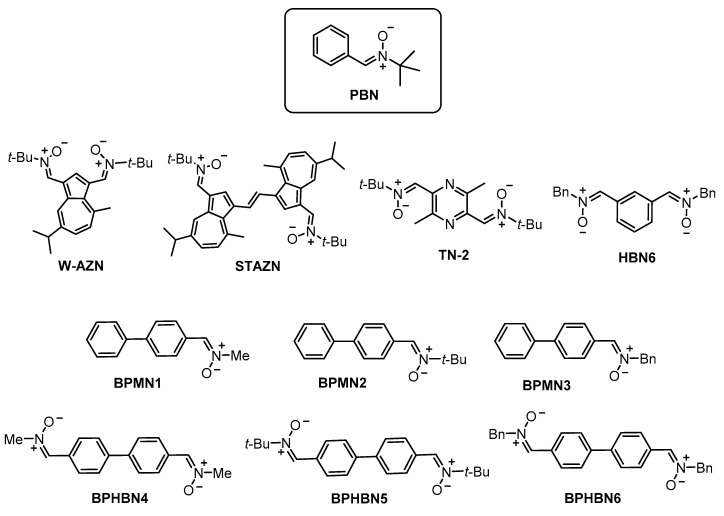
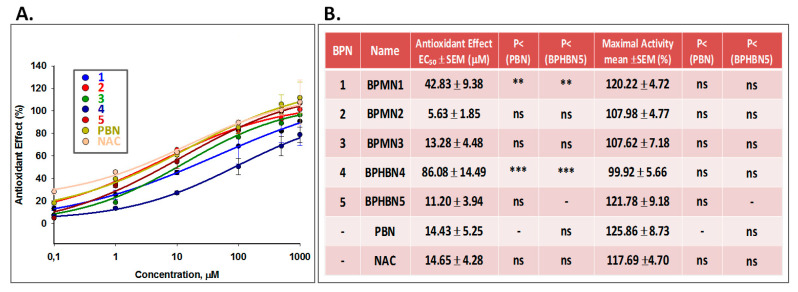
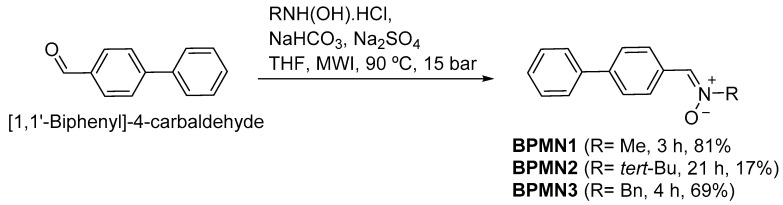
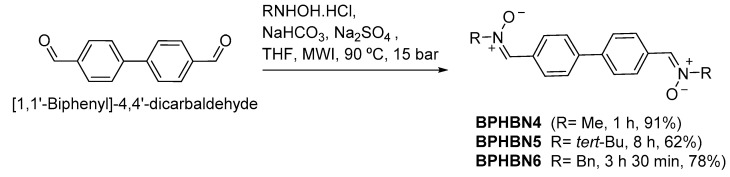
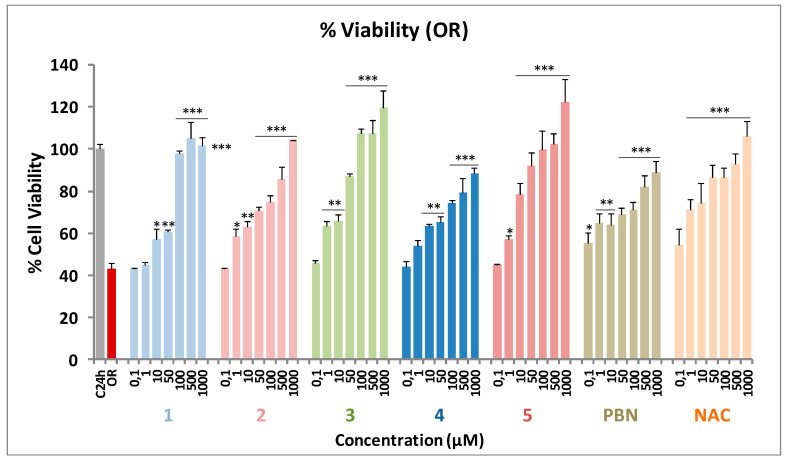
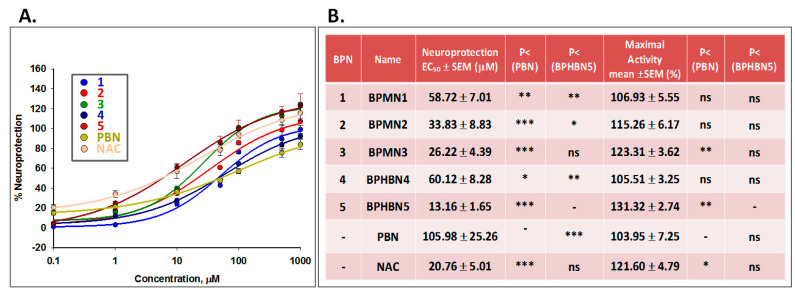
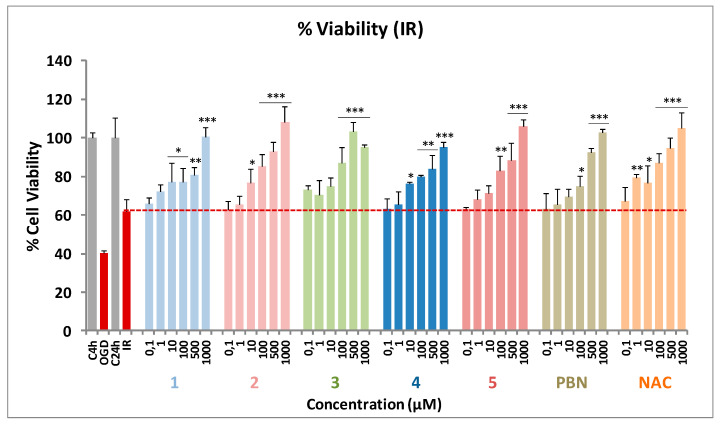
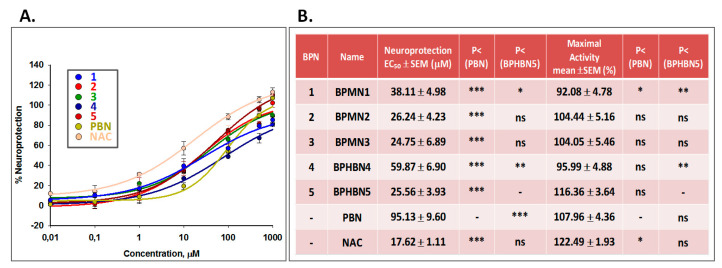
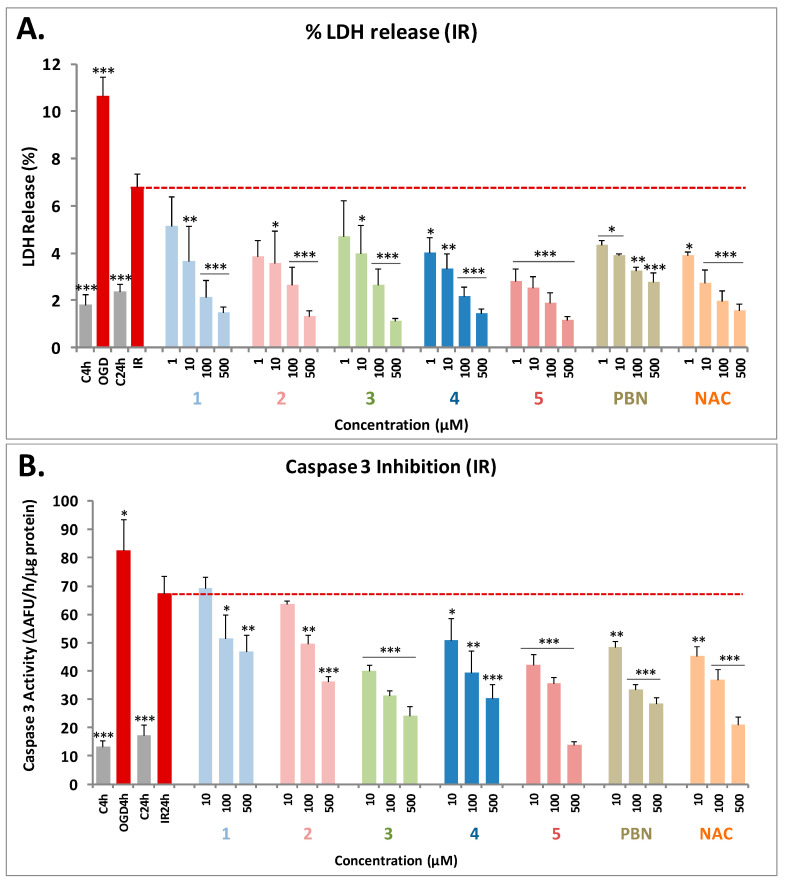
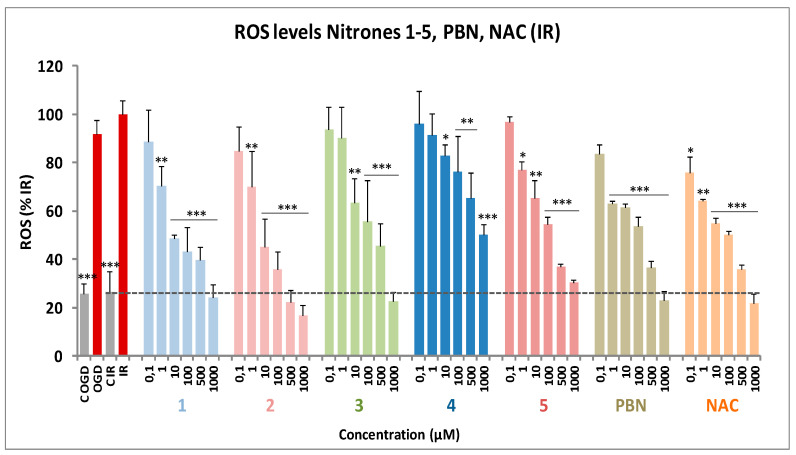
Herein, we report the neuroprotective and antioxidant activity of 1,1'-biphenyl nitrones () - as α-phenyl---butylnitrone analogues prepared from commercially available [1,1'-biphenyl]-4-carbaldehyde and [1,1'-biphenyl]-4,4'-dicarbaldehyde. The neuroprotection of - has been measured against oligomycin A/rotenone and in an oxygen-glucose deprivation in vitro ischemia model in human neuroblastoma SH-SY5Y cells. Our results indicate that - have better neuroprotective and antioxidant properties than α-phenyl---butylnitrone (), and they are quite similar to -acetyl-L-cysteine (), which is a well-known antioxidant agent. Among the nitrones studied, homo-bis-nitrone , bearing two --Bu radicals at the nitrone motif, has the best neuroprotective capacity (EC = 13.16 ± 1.65 and 25.5 ± 3.93 μM, against the reduction in metabolic activity induced by respiratory chain blockers and oxygen-glucose deprivation in an in vitro ischemia model, respectively) as well as anti-necrotic, anti-apoptotic, and antioxidant activities (EC = 11.2 ± 3.94 μM), which were measured by its capacity to reduce superoxide production in human neuroblastoma SH-SY5Y cell cultures, followed by mononitrone , with one -Bn radical, and , with only one --Bu substituent. The antioxidant activity of - has also been analyzed for their capacity to scavenge hydroxyl free radicals (82% at 100 μM), lipoxygenase inhibition, and the inhibition of lipid peroxidation (68% at 100 μM). Results showed that although the number of nitrone groups improves the neuroprotection profile of these , the final effect is also dependent on the substitutent that is being incorporated. Thus, bearing --Bu and -Bn groups show better neuroprotective and antioxidant properties than those substituted with Me. All these results led us to propose homo--nitrone as the most balanced and interesting nitrone based on its neuroprotective capacity in different neuronal models of oxidative stress and in vitro ischemia as well as its antioxidant activity.
本文报道了 1,1'-联苯亚硝酮 () - 作为 α-苯基--丁基硝酮类似物的神经保护和抗氧化活性,这些类似物是由商业上可获得的 [1,1'-联苯]-4-甲醛和[1,1'-联苯]-4,4'-二甲醛制备的。- 对寡霉素 A/鱼藤酮和体外缺氧缺血模型中人类神经母细胞瘤 SH-SY5Y 细胞的神经保护作用进行了测量。我们的结果表明,- 具有比 α-苯基--丁基硝酮 () 更好的神经保护和抗氧化性能,并且与 -乙酰-L-半胱氨酸 () 非常相似,-乙酰-L-半胱氨酸是一种众所周知的抗氧化剂。在所研究的硝酮中,带有两个 --Bu 自由基的同双硝酮 ,在带有硝酮基序的部位,具有最佳的神经保护能力(EC = 13.16 ± 1.65 和 25.5 ± 3.93 μM,分别针对呼吸链抑制剂诱导的代谢活性降低和体外缺血模型中的缺氧葡萄糖剥夺)以及抗坏死、抗凋亡和抗氧化活性(EC = 11.2 ± 3.94 μM),这是通过其在人神经母细胞瘤 SH-SY5Y 细胞培养物中减少超氧化物产生的能力来衡量的,其次是单硝酮 ,有一个 -Bn 自由基,和 ,只有一个 --Bu 取代基。- 的抗氧化活性也分析了其清除羟基自由基的能力(在 100 μM 时为 82%)、脂氧合酶抑制作用和脂质过氧化抑制作用(在 100 μM 时为 68%)。结果表明,尽管硝酮基团的数量改善了这些化合物的神经保护谱,但最终效果也取决于所引入的取代基。因此,带有 --Bu 和 -Bn 基团的 比带有 Me 的化合物具有更好的神经保护和抗氧化性能。所有这些结果都使我们提出同双--硝酮 作为最平衡和最有趣的硝酮,因为它在不同的氧化应激神经元模型和体外缺血中的神经保护能力以及抗氧化活性。