Gil-Miravet Isis, Fuertes-Saiz Alejandro, Benito Ana, Almodóvar Isabel, Ochoa Enrique, Haro Gonzalo
TXP Research Group, Universidad Cardenal Herrera-CEU, CEU Universities, 12006 Castellón, Spain.
Predepartamental Unit of Medicine, Universitat Jaume I, 12071 Castellón, Spain.
Brain Sci. 2021 Feb 20;11(2):269. doi: 10.3390/brainsci11020269.
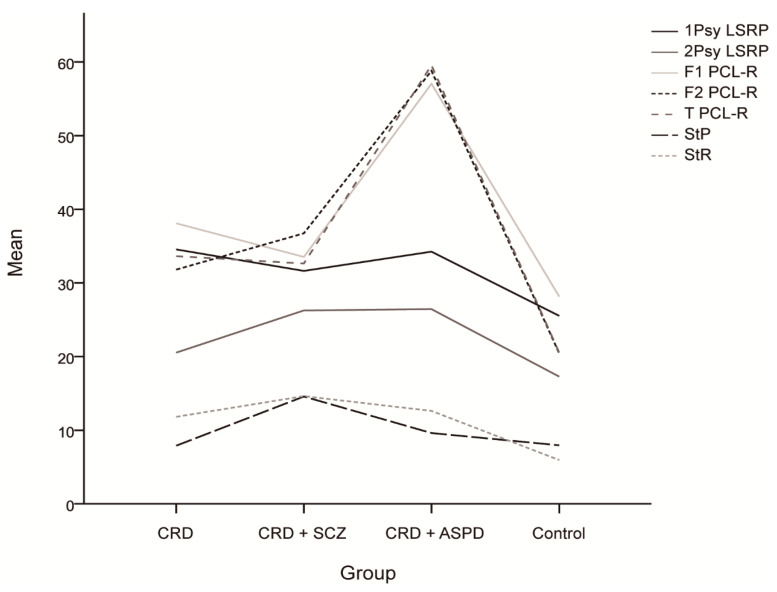
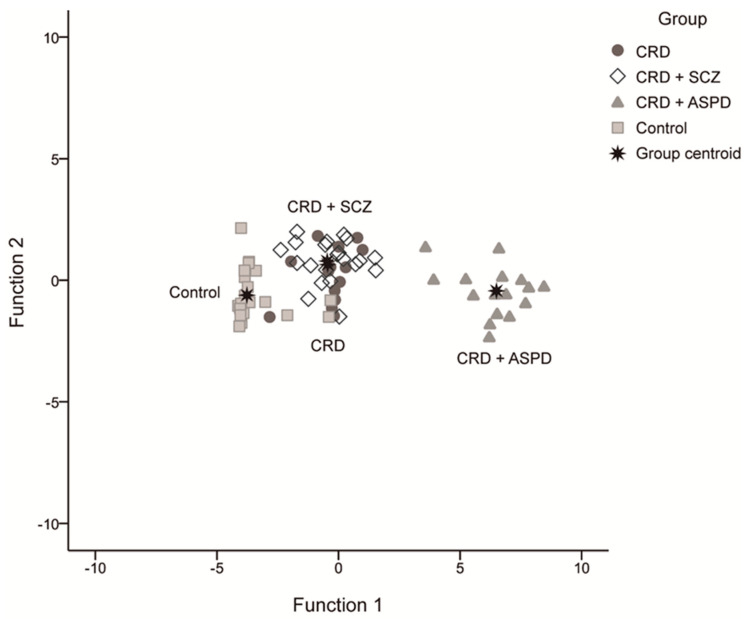
Cocaine addiction is frequently associated with different psychiatric disorders, especially schizophrenia and antisocial personality disorder. A small number of studies have used prepulse inhibition (PPI) as a discriminating factor between these disorders. This work evaluated PPI and the phenotype of patients with cocaine-related disorder (CRD) who presented a dual diagnosis of schizophrenia or antisocial personality disorder. A total of 74 men aged 18-60 years were recruited for this research. The sample was divided into four groups: CRD ( = 14), CRD and schizophrenia ( = 21), CRD and antisocial personality disorder ( = 16), and a control group ( = 23). We evaluated the PPI and other possible vulnerability factors in these patients by using different assessment scales. PPI was higher in the CRD group at 30 ms (F(3, 64) = 2.972, = 0.038). Three discriminant functions were obtained which allowed us to use the overall Hare Psychopathy Checklist Revised score, reward sensitivity, and PPI at 30 ms to predict inclusion of these patients in the different groups with a success rate of 79.7% (42.9% for CRD, 76.2% for CRD and schizophrenia, 100% for CRD and antisocial personality disorder, and 91.3% in the control group). Despite the differences we observed in PPI, this factor is of little use for discriminating between the different diagnostic groups and it acts more as a non-specific endophenotype in certain mental disorders, such as in patients with a dual diagnosis.
可卡因成瘾常与不同的精神障碍相关,尤其是精神分裂症和反社会人格障碍。少数研究将前脉冲抑制(PPI)作为区分这些障碍的一个因素。这项研究评估了患有可卡因相关障碍(CRD)且同时诊断为精神分裂症或反社会人格障碍的患者的PPI及表型。本研究共招募了74名年龄在18至60岁之间的男性。样本分为四组:CRD组( = 14)、CRD合并精神分裂症组( = 21)、CRD合并反社会人格障碍组( = 16)以及对照组( = 23)。我们通过使用不同的评估量表来评估这些患者的PPI及其他可能的易患因素。CRD组在30毫秒时的PPI较高(F(3, 64) = 2.972, = 0.038)。获得了三个判别函数,这使我们能够使用修订版的哈瑞精神病态检查表总分、奖赏敏感性以及30毫秒时的PPI来预测这些患者被纳入不同组别的情况,成功率为79.7%(CRD组为42.9%,CRD合并精神分裂症组为76.2%,CRD合并反社会人格障碍组为100%,对照组为91.3%)。尽管我们观察到了PPI的差异,但该因素在区分不同诊断组方面作用不大,在某些精神障碍中,如双重诊断的患者中,它更像是一种非特异性的内表型。