Insect Vector Laboratory, Advanced Centre for Plant Virology, ICAR-Indian Agricultural Research Institute, New Delhi 110012, India.
Queensland Alliance for Agriculture and Food Innovation, The University of Queensland, St. Lucia, Brisbane, QLD 4072, Australia.
Cells. 2021 Feb 14;10(2):392. doi: 10.3390/cells10020392.
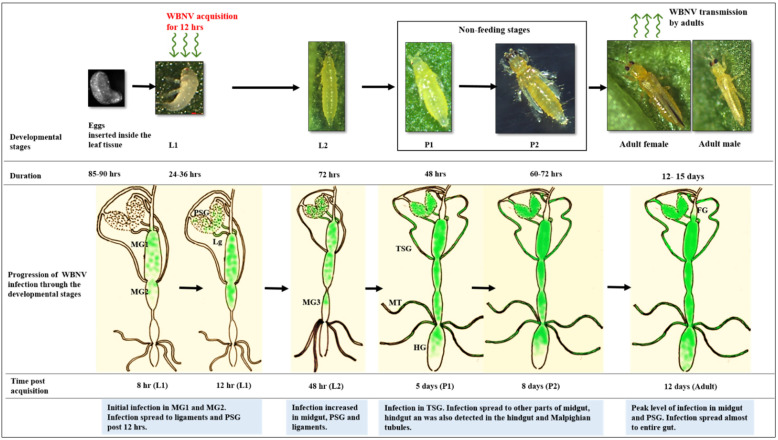
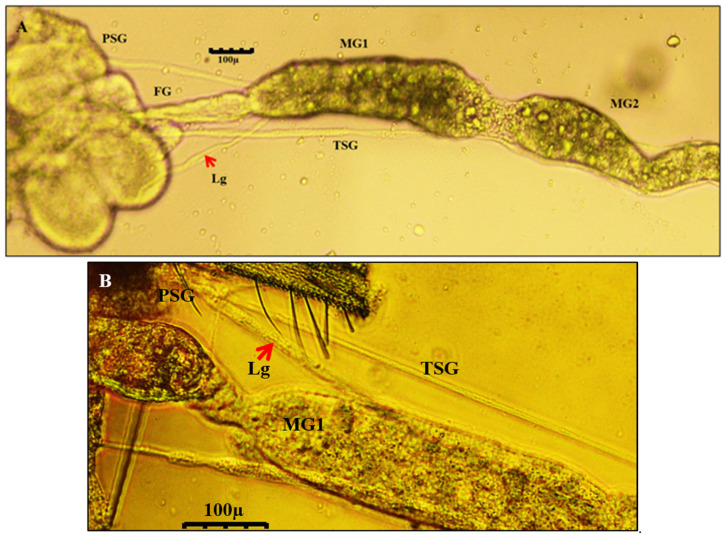
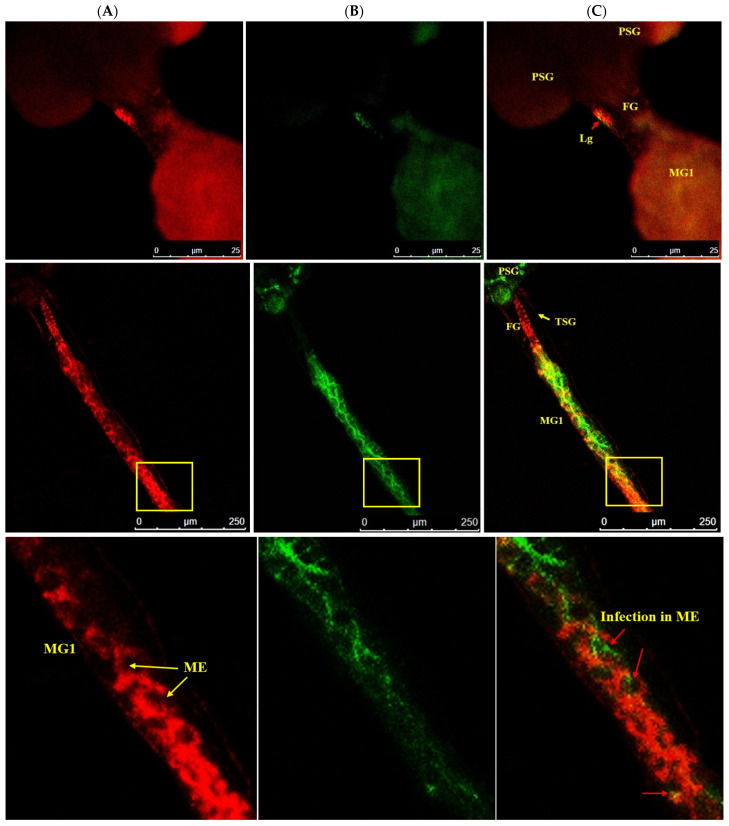
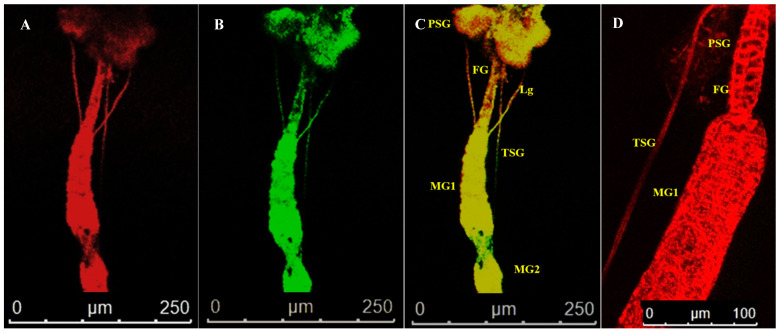
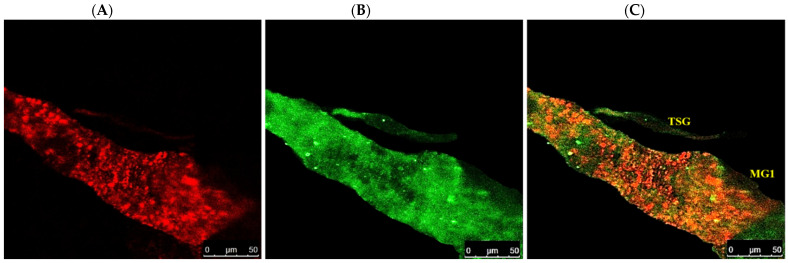
Thrips are important pests of agricultural, horticultural, and forest crops worldwide. In addition to direct damages caused by feeding, several thrips species can transmit diverse tospoviruses. The present understanding of thrips-tospovirus relationships is largely based on studies of tomato spotted wilt virus (TSWV) and Western flower thrips (). Little is known about other predominant tospoviruses and their thrips vectors. In this study, we report the progression of watermelon bud necrosis virus (WBNV) infection in its vector, melon thrips (). Virus infection was visualized in different life stages of thrips using WBNV-nucleocapsid protein antibodies detected with FITC-conjugated secondary antibodies. The anterior midgut was the first to be infected with WBNV in the first instar larvae. The midgut of was connected to the principal salivary glands (PSG) via ligaments and the tubular salivary glands (TSG). The infection progressed to the PSG primarily through the connecting ligaments during early larval instars. The TSG may also have an ancillary role in disseminating WBNV from the midgut to PSG in older instars of . Infection of WBNV was also spread to the Malpighian tubules, hindgut, and posterior portion of the foregut during the adult stage. Maximum virus-specific fluorescence in the anterior midgut and PSG indicated the primary sites for WBNV replication. These findings will help to better understand the thrips-tospovirus molecular relationships and identify novel potential targets for their management. To our knowledge, this is the first report of the WBNV dissemination path in its vector, .
蓟马是全球农业、园艺和森林作物的重要害虫。除了取食造成的直接损害外,一些蓟马物种还可以传播多种番茄斑萎病毒。目前对蓟马-番茄斑萎病毒关系的了解主要基于对番茄斑萎病毒和西花蓟马的研究。关于其他主要的番茄斑萎病毒及其蓟马载体知之甚少。在这项研究中,我们报告了西瓜芽坏死病毒(WBNV)在其载体瓜蓟马中的感染进展。使用 FITC 标记的二抗检测到 WBNV 核衣壳蛋白抗体,从而在不同的蓟马生活阶段可视化病毒感染。在第一龄幼虫中,前中肠是第一个感染 WBNV 的部位。的中肠通过韧带与主唾液腺(PSG)相连,管状唾液腺(TSG)。在早期幼虫龄期,感染主要通过连接韧带传播到 PSG。TSG 在较老的龄期的中肠到 PSG 中传播 WBNV 也可能具有辅助作用。WBNV 的感染也传播到马氏管、后肠和前肠的后段。在前中肠和 PSG 中检测到最大的病毒特异性荧光表明这是 WBNV 复制的主要部位。这些发现将有助于更好地了解蓟马-番茄斑萎病毒的分子关系,并确定其管理的新潜在目标。据我们所知,这是首次在其载体中报道 WBNV 的传播途径。