Department of Biomedicine, Neuroscience and Advanced Diagnostics (Bi.N.D.), Section of Biology and Genetics, University of Palermo, 90133 Palermo, Italy.
Institute for Biomedical Research and Innovation (IRIB), National Research Council (CNR), 90146 Palermo, Italy.
Int J Mol Sci. 2021 Feb 12;22(4):1857. doi: 10.3390/ijms22041857.
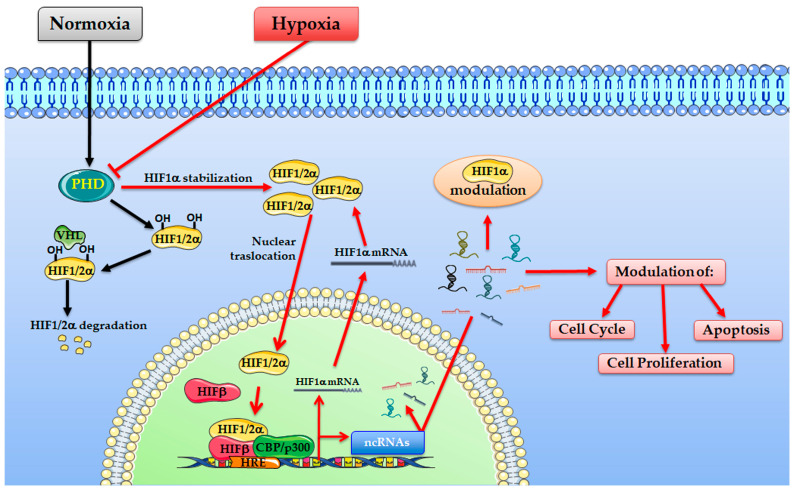
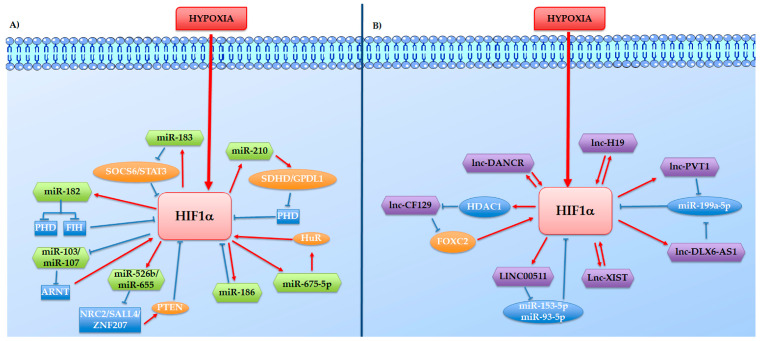
Hypoxia, a characteristic of the tumour microenvironment, plays a crucial role in cancer progression and therapeutic response. The hypoxia-inducible factors (HIF-1α, HIF-2α, and HIF-3α), are the master regulators in response to low oxygen partial pressure, modulating hypoxic gene expression and signalling transduction pathways. HIFs' activation is sufficient to change the cell phenotype at multiple levels, by modulating several biological activities from metabolism to the cell cycle and providing the cell with new characteristics that make it more aggressive. In the past few decades, growing numbers of studies have revealed the importance of non-coding RNAs (ncRNAs) as molecular mediators in the establishment of hypoxic response, playing important roles in regulating hypoxic gene expression at the transcriptional, post-transcriptional, translational, and posttranslational levels. Here, we review recent findings on the different roles of hypoxia-induced ncRNAs in cancer focusing on the data that revealed their involvement in tumour growth.
缺氧是肿瘤微环境的一个特征,在癌症进展和治疗反应中起着关键作用。缺氧诱导因子(HIF-1α、HIF-2α 和 HIF-3α)是对低氧分压做出反应的主要调节剂,调节缺氧基因表达和信号转导途径。HIF 的激活足以通过调节从代谢到细胞周期的多种生物活性,在多个水平上改变细胞表型,并赋予细胞新的特性,使其更具侵袭性。在过去的几十年中,越来越多的研究揭示了非编码 RNA(ncRNA)作为缺氧反应中分子介质的重要性,它们在转录、转录后、翻译和翻译后水平上调节缺氧基因表达中发挥着重要作用。在这里,我们综述了缺氧诱导的 ncRNA 在癌症中的不同作用的最新发现,重点介绍了揭示它们参与肿瘤生长的数据。