Usai Gabriele, Vangelisti Alberto, Simoni Samuel, Giordani Tommaso, Natali Lucia, Cavallini Andrea, Mascagni Flavia
Department of Agriculture, Food and Environment, University of Pisa, 56124 Pisa, Italy.
Plants (Basel). 2021 Feb 27;10(3):451. doi: 10.3390/plants10030451.
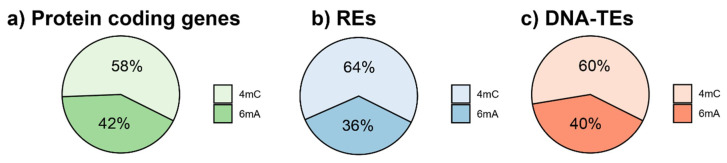
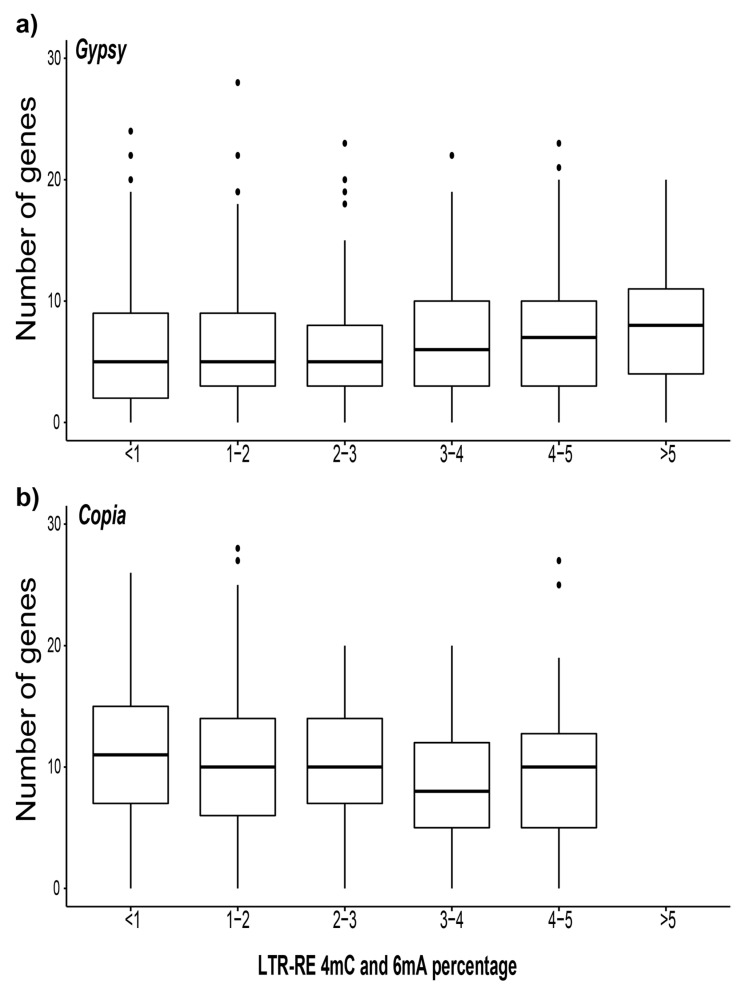
Transposable element activity can be harmful to the host's genome integrity, but it can also provide selective advantages. One strategy to cope with transposons is epigenetic control through DNA base modifications. We report the non-canonic DNA modification dynamics of fig ( L.) by exploiting high-quality genome reference and related N4-methylcytosine (4mC) and N6-methyladenine (6mA) data. Overall, 1.49% of transposon nucleotides showed either 4mC or 6mA modifications: the 4mC/6mA ratio was similar in Class I and Class II transposons, with a prevalence of 4mC, which is comparable to coding genes. Different percentages of 4mC or 6mA were observed among LTR-retrotransposon lineages and sub-lineages. Furthermore, both the and retroelements showed higher modification rates in the LTR and coding regions compared with their neighbour regions. Finally, the unconventional methylation of retrotransposons is unrelated to the number of close genes, suggesting that the 4mC and 6mA frequency in LTR-retrotransposons should not be related to transcriptional repression in the adjacency of the element. In conclusion, this study highlighted unconventional DNA modification patterns in fig transposable elements. Further investigations will focus on functional implications, in regards to how modified retroelements affect the expression of neighbouring genes, and whether these epigenetic markers can spread from repeats to genes, shaping the plant phenotype.
转座元件的活性可能对宿主基因组的完整性有害,但它也能提供选择优势。应对转座子的一种策略是通过DNA碱基修饰进行表观遗传控制。我们通过利用高质量的基因组参考以及相关的N4-甲基胞嘧啶(4mC)和N6-甲基腺嘌呤(6mA)数据,报告了榕属植物(Ficus L.)的非经典DNA修饰动态。总体而言,1.49%的转座子核苷酸显示出4mC或6mA修饰:I类和II类转座子中的4mC/6mA比率相似,4mC占优势,这与编码基因相当。在LTR-逆转座子谱系和亚谱系中观察到不同百分比的4mC或6mA。此外,与相邻区域相比,和逆转元件在LTR和编码区域均显示出更高的修饰率。最后,逆转座子的非常规甲基化与邻近基因的数量无关,这表明LTR-逆转座子中的4mC和6mA频率不应与元件附近的转录抑制相关。总之,本研究突出了榕属植物转座元件中的非常规DNA修饰模式。进一步的研究将集中在功能影响方面,即修饰的逆转元件如何影响邻近基因的表达,以及这些表观遗传标记是否能从重复序列传播到基因,从而塑造植物表型。