Huang Mei-Hsuen, Lin Yu-Hsien, Lyu Ping-Chiang, Liu Yi-Chung, Chang Yuan-Shiun, Chung Jing-Gung, Lin Wei-Yong, Hsieh Wen-Tsong
Department of Chinese Pharmaceutical Sciences and Chinese Medicine Resources, China Medical University, Taichung 404333, Taiwan.
School of Pharmacy, China Medical University, Taichung 406040, Taiwan.
Antioxidants (Basel). 2021 Feb 27;10(3):362. doi: 10.3390/antiox10030362.
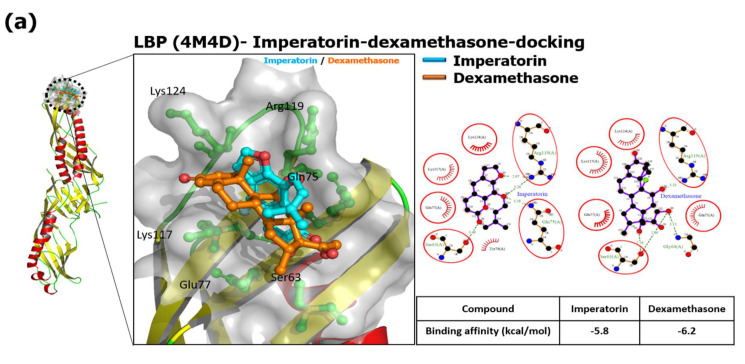
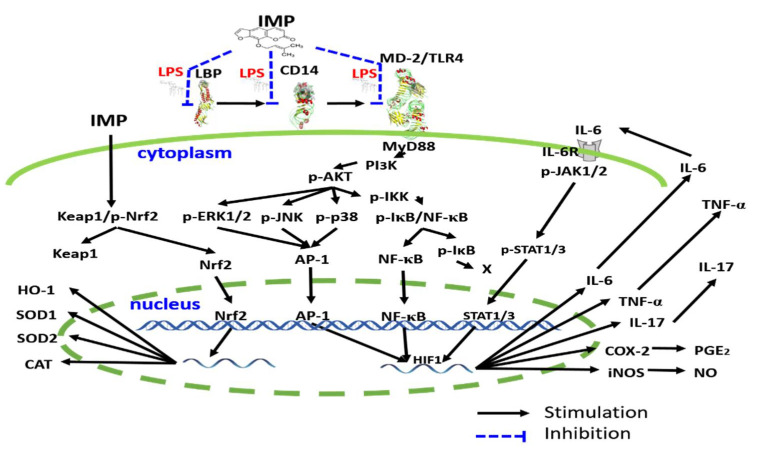
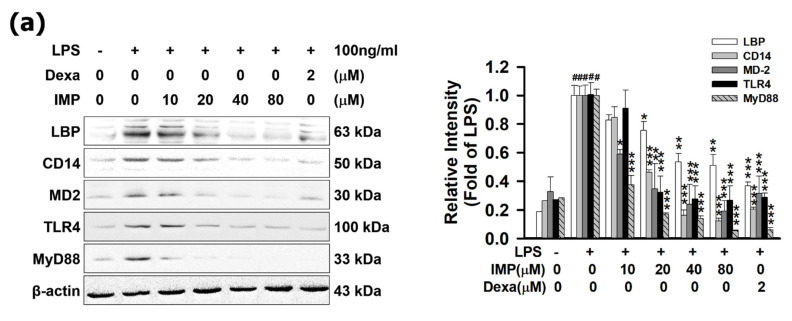
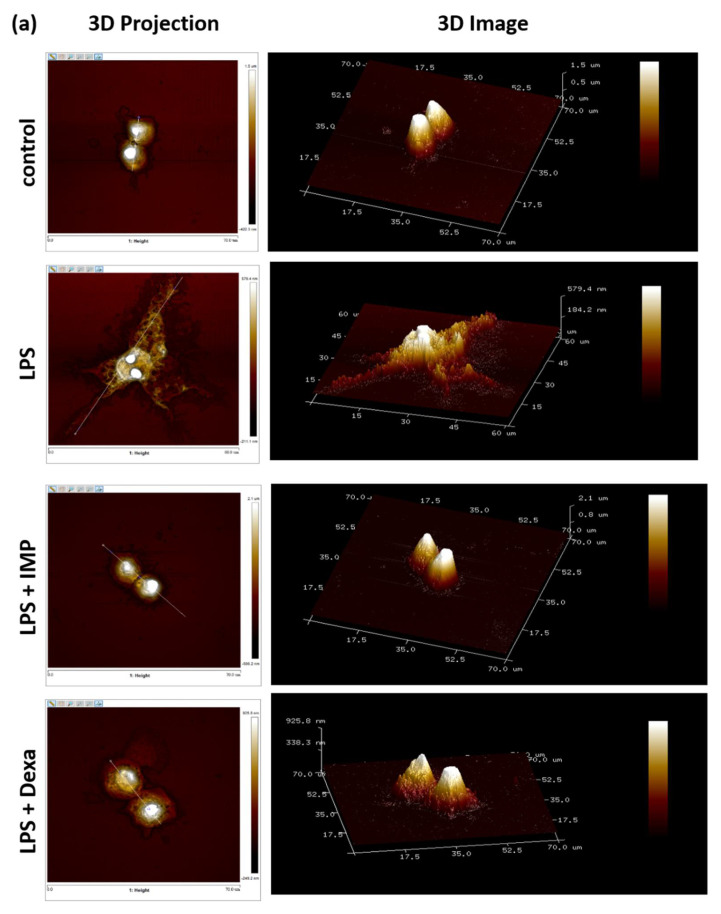
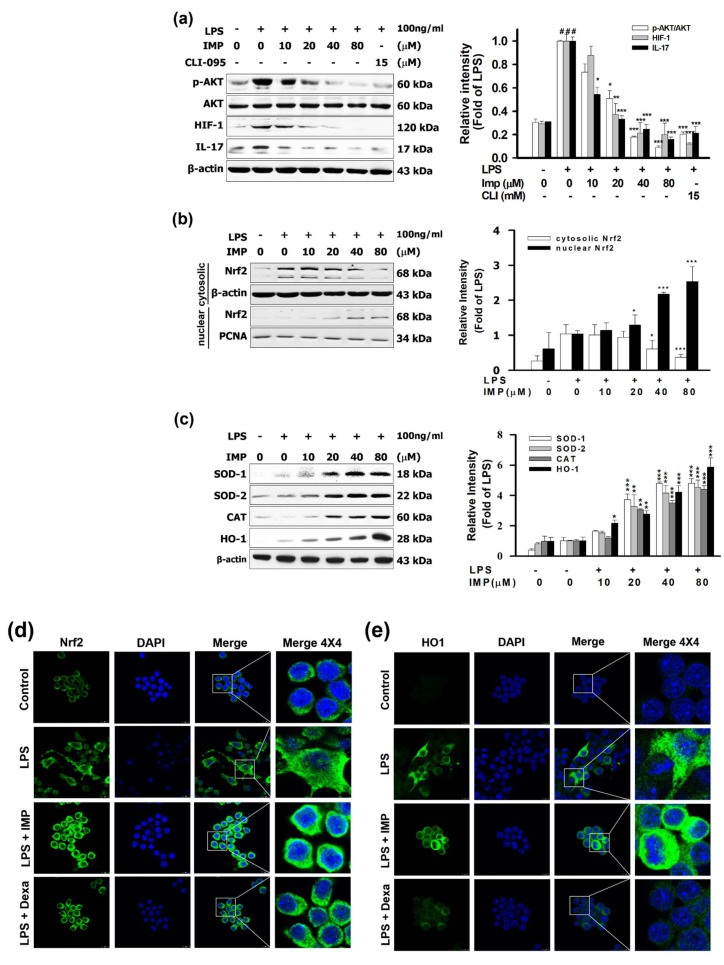
Imperatorin (IMP) could downregulate several inflammatory transcription factor signaling pathways. Some studies have pointed out that IMP could interfere with toll-like receptor 4 (TLR4) signaling. This study evaluates how IMP interferes with the TLR4 co-receptors signaling through the protein-ligand docking model, Western blotting, immunofluorescence (IF), and atomic force microscopy (AFM) assays in lipopolysaccharide (LPS) stimulated macrophage-like RAW264.7 cells in vitro. The results of the protein-ligand docking demonstrate that IMP interferes with LPS binding to the LPS-binding protein (LBP), the cluster of differentiation 14 (CD14), and the toll-like receptor 4/myeloid differentiation factor 2 (TLR4/MD-2) co-receptors in LPS-stimulated RAW264.7 cells. Compared with TLR4 antagonist CLI-095 or dexamethasone, IMP could suppress the protein expressions of LBP, CD14, and TLR4/MD-2 in LPS-stimulated cells. Furthermore, the three-dimensional (3D) image assay of the AFM showed IMP could prevent the LPS-induced morphological change in RAW264.7 cells. Additionally, IMP could activate the nuclear factor erythroid 2-related factor 2 (Nrf2) signaling pathway, and it increased the antioxidative protein expression of heme oxygenase-1 (HO-1), superoxidase dismutase (SOD), and catalase (CAT). Our results are the first to reveal that the anti-inflammatory effect of IMP interferes with LPS binding to TLR4 co-receptor signaling and activates the antioxidative Nrf2 signaling pathway.
欧前胡素(IMP)可下调多种炎症转录因子信号通路。一些研究指出,IMP可干扰Toll样受体4(TLR4)信号传导。本研究通过蛋白质-配体对接模型、蛋白质印迹法、免疫荧光(IF)和原子力显微镜(AFM)检测,评估IMP在体外脂多糖(LPS)刺激的巨噬细胞样RAW264.7细胞中如何干扰TLR4共受体信号传导。蛋白质-配体对接结果表明,IMP在LPS刺激的RAW264.7细胞中干扰LPS与LPS结合蛋白(LBP)、分化簇14(CD14)以及Toll样受体4/髓样分化因子2(TLR4/MD-2)共受体的结合。与TLR4拮抗剂CLI-095或地塞米松相比,IMP可抑制LPS刺激细胞中LBP、CD14和TLR4/MD-2的蛋白表达。此外,AFM的三维(3D)图像检测显示IMP可阻止LPS诱导的RAW264.7细胞形态变化。此外,IMP可激活核因子红细胞2相关因子2(Nrf2)信号通路,并增加血红素加氧酶-1(HO-1)、超氧化物歧化酶(SOD)和过氧化氢酶(CAT)的抗氧化蛋白表达。我们的结果首次揭示了IMP的抗炎作用是通过干扰LPS与TLR4共受体信号的结合并激活抗氧化Nrf2信号通路来实现的。