David M. Rubenstein Center for Hearing Research and Department of Otolaryngology-HNS, Johns Hopkins University School of Medicine, 515 Traylor Building, 720 Rutland Ave, Baltimore, MD 21205, United States; Solomon H. Snyder Department of Neuroscience, Johns Hopkins University School of Medicine, United States.
David M. Rubenstein Center for Hearing Research and Department of Otolaryngology-HNS, Johns Hopkins University School of Medicine, 515 Traylor Building, 720 Rutland Ave, Baltimore, MD 21205, United States; Biomedical Neuroscience Institute, BNI, Faculty of Medicine, Universidad de Chile, Santiago, Chile.
Hear Res. 2022 Jun;419:108207. doi: 10.1016/j.heares.2021.108207. Epub 2021 Feb 18.
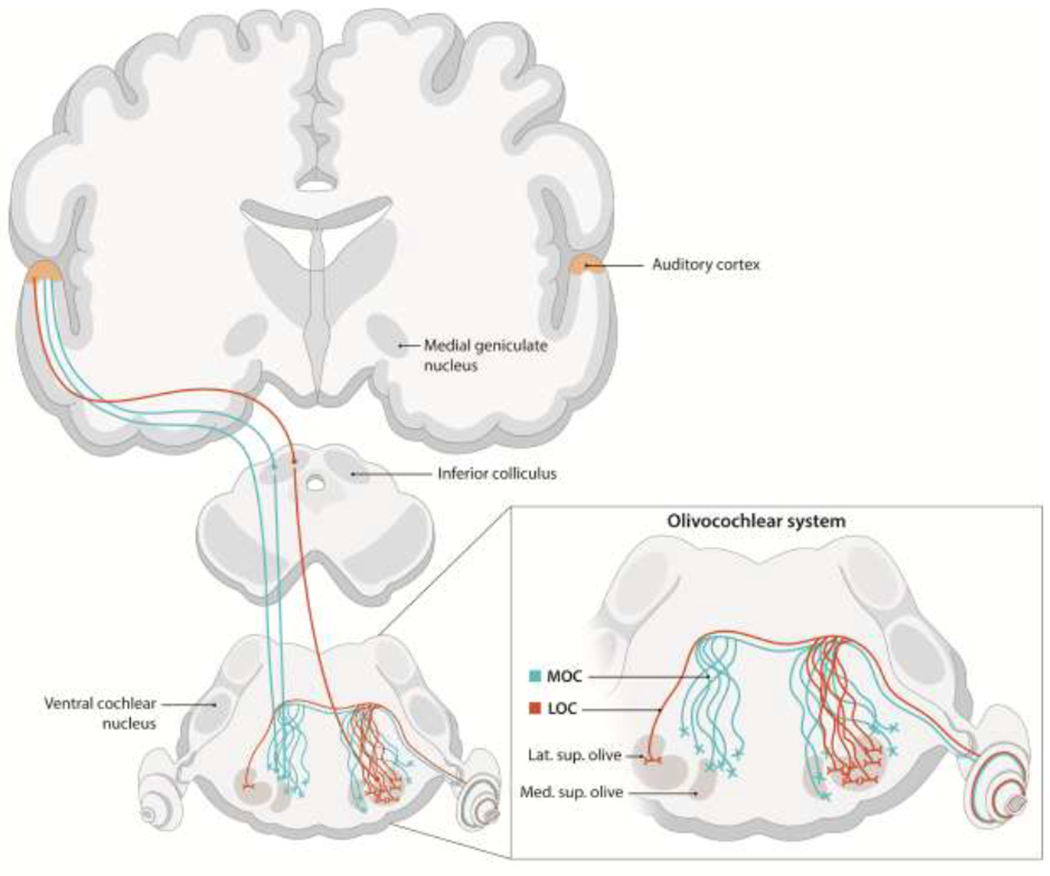
The role of the mammalian auditory olivocochlear efferent system in hearing has long been the subject of debate. Its ability to protect against damaging noise exposure is clear, but whether or not this is the primary function of a system that evolved in the absence of industrial noise remains controversial. Here we review the behavioral consequences of olivocochlear activation and diminished olivocochlear function. Attempts to demonstrate a role for hearing in noise have yielded conflicting results in both animal and human studies. A role in selective attention to sounds in the presence of distractors, or attention to visual stimuli in the presence of competing auditory stimuli, has been established in animal models, but again behavioral studies in humans remain equivocal. Auditory processing deficits occur in models of congenital olivocochlear dysfunction, but these deficits likely reflect abnormal central auditory development rather than direct effects of olivocochlear feedback. Additional proposed roles in age-related hearing loss, tinnitus, hyperacusis, and binaural or spatial hearing, are intriguing, but require additional study. These behavioral studies almost exclusively focus on medial olivocochlear effects, and many relied on lesioning techniques that can have unspecific effects. The consequences of lateral olivocochlear and of corticofugal pathway activation for perception remain unknown. As new tools for targeted manipulation of olivocochlear neurons emerge, there is potential for a transformation of our understanding of the role of the olivocochlear system in behavior across species.
哺乳动物听觉橄榄耳蜗传出系统在听力中的作用一直是争论的主题。它能够防止损伤性噪声暴露,这一点是明确的,但在没有工业噪声的情况下进化而来的系统,其主要功能是否就是如此,仍然存在争议。在这里,我们回顾了橄榄耳蜗激活和橄榄耳蜗功能减弱的行为后果。在动物和人类研究中,试图证明听觉在噪声中的作用产生了相互矛盾的结果。在存在干扰物的情况下对声音进行选择性注意,或者在存在竞争听觉刺激的情况下对视觉刺激进行注意,在动物模型中已经得到了证实,但人类的行为研究仍然存在争议。在先天性橄榄耳蜗功能障碍的模型中会出现听觉处理缺陷,但这些缺陷可能反映的是中枢听觉发育异常,而不是橄榄耳蜗反馈的直接影响。在与年龄相关的听力损失、耳鸣、听觉过敏和双耳或空间听觉中提出的其他作用,虽然很有趣,但需要进一步的研究。这些行为研究几乎完全集中在中橄榄耳蜗的影响上,而且许多研究依赖于可能产生非特异性影响的损伤技术。外侧橄榄耳蜗和皮质传出通路激活对感知的影响仍然未知。随着针对橄榄耳蜗神经元进行靶向操作的新工具的出现,有可能彻底改变我们对橄榄耳蜗系统在跨物种行为中的作用的理解。