Department of Global Pediatric Medicine, St. Jude Children's Research Hospital, Memphis, TN, USA.
Department of Pediatric Hematology and Oncology, Fundacion Perez Scremini-Hospital Pereira Rossell, Montevideo, Uruguay; Department of Pediatric Hematology and Oncology, Hospital Sant Joan de Déu, Barcelona, Spain.
Lancet Child Adolesc Health. 2021 May;5(5):332-340. doi: 10.1016/S2352-4642(21)00031-6. Epub 2021 Mar 4.
Although mortality due to COVID-19 has been reportedly low among children with cancer, changes in health-care services due to the pandemic have affected cancer care delivery. This study aimed to assess the effect of the COVID-19 pandemic on childhood cancer care worldwide.
A cross-sectional survey was distributed to paediatric oncology providers worldwide from June 22 to Aug 21, 2020, through the St Jude Global Alliance and International Society for Paediatric Oncology listservs and regional networks. The survey included 60 questions to assess institution characteristics, the number of patients diagnosed with COVID-19, disruptions to cancer care (eg, service closures and treatment abandonment), adaptations to care, and resources (including availability of clinical staff and personal protective equipment). Surveys were included for analysis if respondents answered at least two thirds of the items, and the responses were analysed at the institutional level.
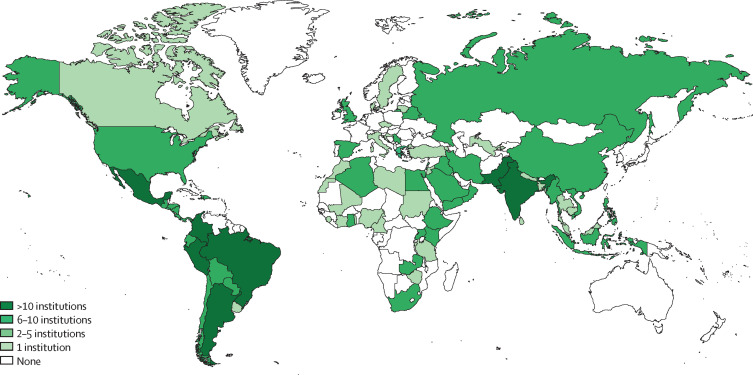
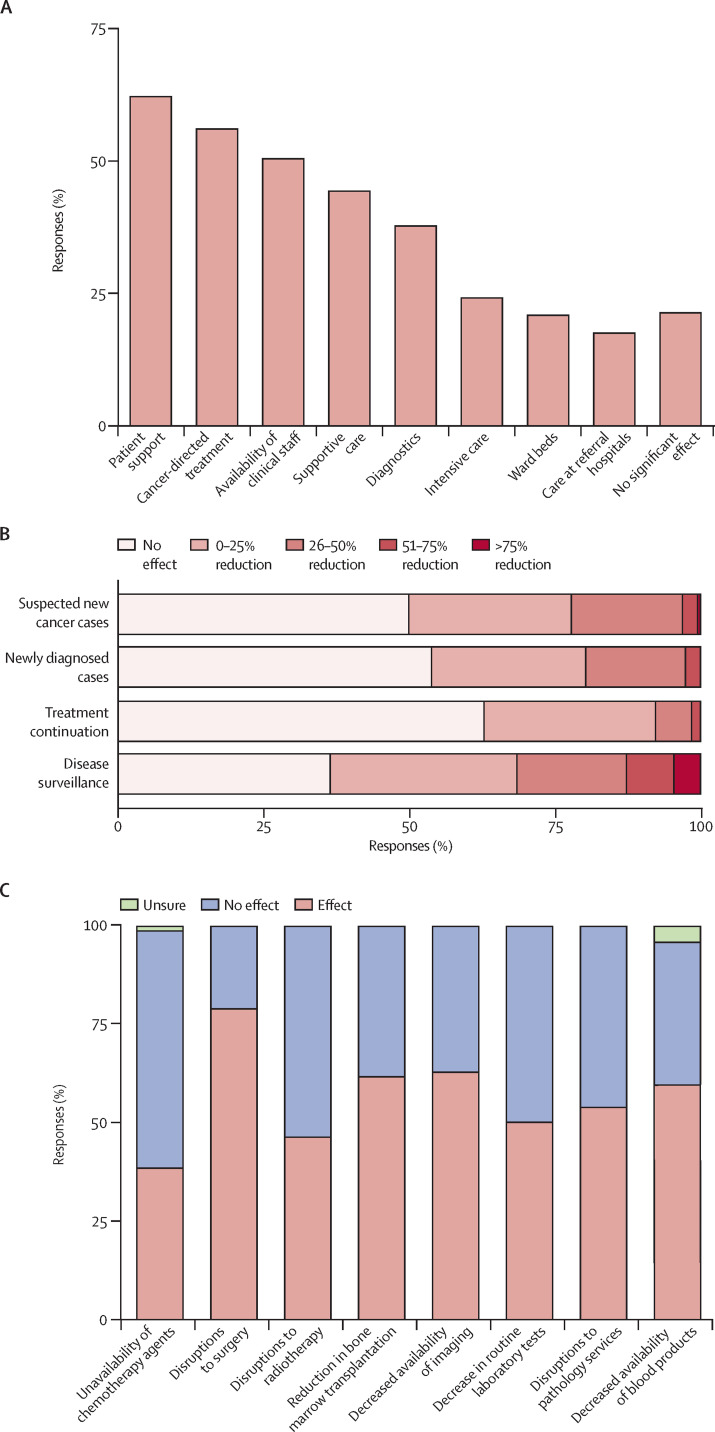
Responses from 311 health-care professionals at 213 institutions in 79 countries from all WHO regions were included in the analysis. 187 (88%) of 213 centres had the capacity to test for SARS-CoV-2 and a median of two (range 0-350) infections per institutution were reported in children with cancer. 15 (7%) centres reported complete closure of paediatric haematology-oncology services (median 10 days, range 1-75 days). Overall, 2% (5 of 213) of centres were no longer evaluating new cases of suspected cancer, while 43% (90 of 208) of the remaining centers described a decrease in newly diagnosed paediatric cancer cases. 73 (34%) centres reported increased treatment abandonment (ie, failure to initiate cancer therapy or a delay in care of 4 weeks or longer). Changes to cancer care delivery included: reduced surgical care (153 [72%]), blood product shortages (127 [60%]), chemotherapy modifications (121 [57%]), and interruptions to radiotherapy (43 [28%] of 155 institutions that provided radiotherapy before the pandemic). The decreased number of new cancer diagnoses did not vary based on country income status (p=0·14). However, unavailability of chemotherapy agents (p=0·022), treatment abandonment (p<0·0001), and interruptions in radiotherapy (p<0·0001) were more frequent in low-income and middle-income countries than in high-income countries. These findings did not vary based on institutional or national numbers of COVID-19 cases. Hospitals reported using new or adapted checklists (146 [69%] of 213), processes for communication with patients and families (134 [63%]), and guidelines for essential services (119 [56%]) as a result of the pandemic.
The COVID-19 pandemic has considerably affected paediatric oncology services worldwide, posing substantial disruptions to cancer diagnosis and management, particularly in low-income and middle-income countries. This study emphasises the urgency of an equitably distributed robust global response to support paediatric oncology care during this pandemic and future public health emergencies.
American Lebanese Syrian Associated Charities.
For the Spanish translation of the abstract see Supplementary Materials section.
据报道,儿童癌症患者因 COVID-19 导致的死亡率较低,但由于大流行,医疗服务发生了变化,从而影响了癌症的治疗。本研究旨在评估 COVID-19 大流行对全球儿童癌症治疗的影响。
通过圣裘德全球联盟和国际儿科肿瘤学会的列表服务和区域网络,于 2020 年 6 月 22 日至 8 月 21 日向全球儿科肿瘤医生发放了一项横断面调查。该调查包括 60 个问题,以评估机构特征、COVID-19 确诊患者人数、癌症治疗中断(例如服务关闭和治疗中断)、治疗适应以及资源(包括临床人员和个人防护设备的可用性)。如果调查对象回答了至少三分之二的问题,则将调查结果纳入分析,分析在机构层面进行。
在来自世卫组织所有区域的 79 个国家的 213 个机构中,共有 311 名医疗保健专业人员对调查做出了回应。213 个中心中有 187 个(88%)有能力检测 SARS-CoV-2,每个机构报告的癌症儿童感染中位数为 2 例(范围为 0-350 例)。15 个(7%)中心报告儿科血液肿瘤学服务完全关闭(中位数为 10 天,范围为 1-75 天)。总体而言,2%(213 个中心中的 5 个)的中心不再评估疑似癌症的新病例,而其余 90 个(208 个中心中的 43%)中心报告新诊断的儿科癌症病例减少。73 个(34%)中心报告治疗中断增加(即未能开始癌症治疗或护理延迟 4 周或更长时间)。癌症治疗的改变包括:减少手术治疗(153 例[72%])、血液制品短缺(127 例[60%])、化疗方案改变(121 例[57%])以及放射治疗中断(155 个提供放射治疗的机构中有 43 个[28%])。新癌症诊断数量的减少与国家收入状况无关(p=0·14)。然而,化疗药物缺乏(p=0·022)、治疗中断(p<0·0001)和放射治疗中断(p<0·0001)在低收入和中等收入国家比在高收入国家更为频繁。这些发现与机构或国家的 COVID-19 病例数量无关。医院报告使用了新的或改编的检查表(213 个中的 146 个[69%])、与患者和家属沟通的流程(134 个[63%])以及基本服务指南(119 个[56%]),这是大流行的结果。
COVID-19 大流行极大地影响了全球的儿科肿瘤服务,对癌症的诊断和管理造成了严重的中断,特别是在低收入和中等收入国家。本研究强调,需要采取公平分配的强有力的全球应对措施,在此次大流行和未来的公共卫生紧急情况下支持儿科肿瘤治疗。
美国黎巴嫩叙利亚裔协会慈善基金会。