School of Medical Imaging, Bengbu Medical College, Bengbu, 233030, Anhui, China.
Department of Stomatology, First Affiliated Hospital of Bengbu Medical College, Bengbu, 233004, Anhui, China.
BMC Oral Health. 2021 Mar 6;21(1):99. doi: 10.1186/s12903-021-01419-0.
This study aimed to evaluate the associations among oral health-related knowledge, attitudes, practice (KAP), self-rated oral health and oral health-related quality of life (OHRQoL) among Chinese college students.
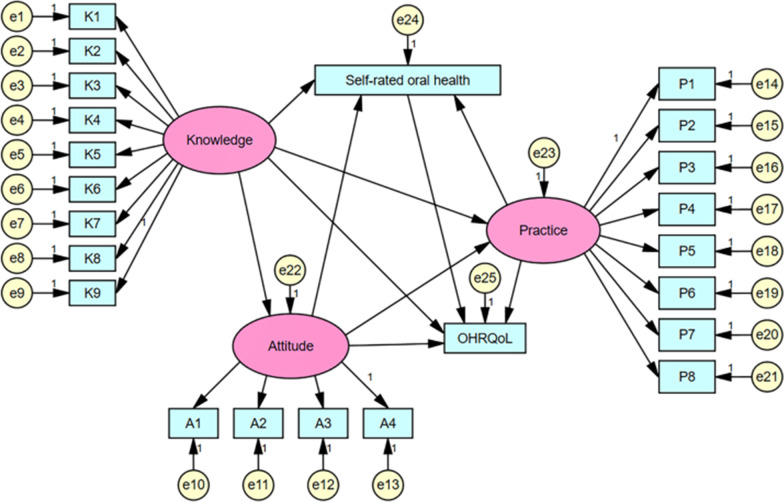
Of the 2000 participants, 1751 (87.55%) students answered an online questionnaire between October 2019 and January 2020. The questionnaire included demographic characteristics, knowledge, attitudes, and practice related to oral health, self-rated oral health, and OHRQoL. Structural equation modelling was applied to assess the associations among study variables.
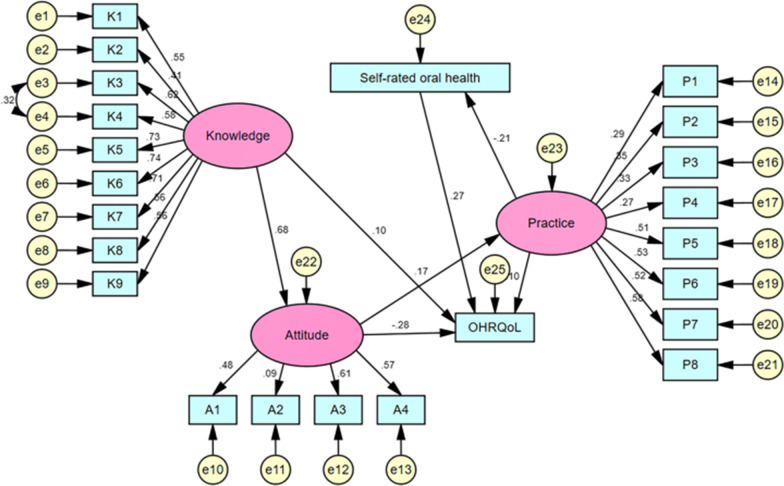
Among the total students, oral health-related knowledge and attitudes were satisfactory, while the oral health practice was not optimistic. The final model showed satisfactory fitness to the data. Oral health knowledge was associated with attitudes directly and positively. Attitudes toward oral health had a direct and positive effect on practice. Oral health knowledge had an indirect effect on practice through attitudes. Oral health practice was directly associated with self-rated oral health. Oral health knowledge, practice, and self-rated oral health all affected OHRQoL directly and positively, while attitudes had a direct negative impact on OHRQoL.
OHRQoL was influenced by oral health knowledge, attitudes, practice, and self-rated oral health. Our findings support the KAP theory. Limitations of the KAP model were also found.
本研究旨在评估中国大学生口腔健康相关知识、态度、实践(KAP)、自我评估口腔健康和口腔健康相关生活质量(OHRQoL)之间的关系。
在 2000 名参与者中,有 1751 名(87.55%)学生于 2019 年 10 月至 2020 年 1 月期间在线回答了问卷。问卷包括人口统计学特征、口腔健康相关知识、态度和实践、自我评估口腔健康和口腔健康相关生活质量。结构方程模型用于评估研究变量之间的关系。
在所有学生中,口腔健康相关知识和态度令人满意,而口腔健康实践情况不容乐观。最终模型显示数据拟合良好。口腔健康知识与态度直接且呈正相关。对口腔健康的态度对实践有直接的积极影响。口腔健康知识通过态度对实践产生间接影响。口腔健康实践与自我评估的口腔健康直接相关。口腔健康知识、实践和自我评估的口腔健康均直接且积极地影响 OHRQoL,而态度对 OHRQoL 有直接的负面影响。
OHRQoL 受到口腔健康知识、态度、实践和自我评估口腔健康的影响。我们的研究结果支持 KAP 理论。还发现了 KAP 模型的局限性。