Romeo Ramona, Boden-El Mourabit Damian, Scheller Anja, Mark Melanie D, Faissner Andreas
Department of Cell Morphology and Molecular Neurobiology, Ruhr-University Bochum, Bochum, Germany.
Behavioral Neuroscience, Ruhr-University Bochum, Bochum, Germany.
Front Cell Neurosci. 2021 Feb 18;15:642521. doi: 10.3389/fncel.2021.642521. eCollection 2021.
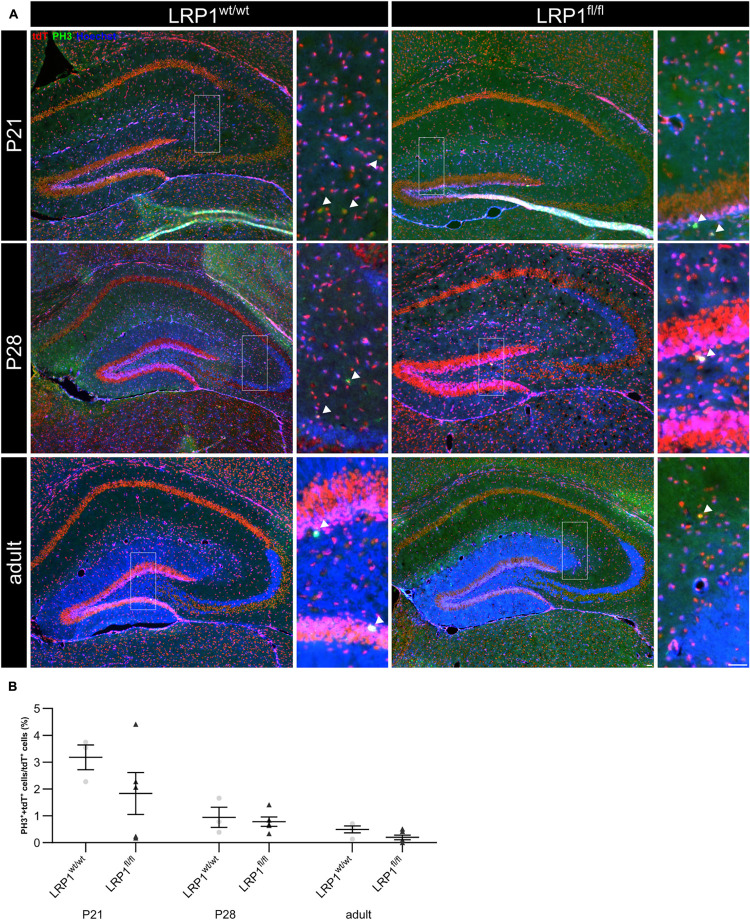
Astrocytes are the most abundant cell type within the central nervous system (CNS) with various functions. Furthermore, astrocytes show a regional and developmental heterogeneity traceable with specific markers. In this study, the influence of the low-density lipoprotein receptor-related protein 1 (LRP1) on astrocytic maturation within the hippocampus was analyzed during development. Previous studies mostly focused on the involvement of LRP1 in the neuronal compartment, where the deletion caused hyperactivity and motor dysfunctions in knockout animals. However, the influence of LRP1 on glia cells is less intensively investigated. Therefore, we used a newly generated mouse model, where LRP1 is specifically deleted from GLAST-positive astrocytes co-localized with the expression of the reporter tdTomato to visualize recombination and knockout events . The influence of LRP1 on the maturation of hippocampal astrocytes was assessed with immunohistochemical stainings against stage-specific markers as well as on mRNA level with RT-PCR analysis. The examination revealed that the knockout induction caused a significantly decreased number of mature astrocytes at an early developmental timepoint compared to control animals. Additionally, the delayed maturation of astrocytes also caused a reduced activity of neurons within the hippocampus. As previous studies showed that the glial specification and maturation of astrocytes is dependent on the signaling cascades Ras/Raf/MEK/Erk and PI3K/Akt, the phosphorylation of the signaling molecules Erk1/2 and Akt was analyzed. The hippocampal tissue of LRP1-deficient animals at P21 showed a significantly decreased amount of activated Erk in comparison to control tissue leading to the conclusion that the activation of this signaling cascade is dependent on LRP1 in astrocytes, which in turn is necessary for proper maturation of astrocytes. Our results showed that the deletion of LRP1 at an early developmental timepoint caused a delayed maturation of astrocytes in the hippocampus based on an altered activation of the Ras/Raf/MEK/Erk signaling pathway. However, with ongoing development these effects were compensated and the number of mature astrocytes was comparable as well as the activity of neurons. Therefore, LRP1 acts as an early regulator of the differentiation and maturation of astrocytes within the hippocampus.
星形胶质细胞是中枢神经系统(CNS)中数量最多的细胞类型,具有多种功能。此外,星形胶质细胞表现出可通过特定标志物追踪的区域和发育异质性。在本研究中,分析了低密度脂蛋白受体相关蛋白1(LRP1)在发育过程中对海马体中星形胶质细胞成熟的影响。先前的研究主要集中在LRP1在神经元区室中的作用,其缺失会导致基因敲除动物出现多动和运动功能障碍。然而,LRP1对神经胶质细胞的影响研究较少。因此,我们使用了一种新生成的小鼠模型,其中LRP1从与报告基因tdTomato表达共定位的GLAST阳性星形胶质细胞中特异性缺失,以可视化重组和基因敲除事件。通过针对阶段特异性标志物的免疫组织化学染色以及RT-PCR分析在mRNA水平上评估LRP1对海马体星形胶质细胞成熟的影响。检查发现,与对照动物相比,在发育早期敲除诱导导致成熟星形胶质细胞数量显著减少。此外,星形胶质细胞成熟延迟也导致海马体中神经元的活性降低。由于先前的研究表明星形胶质细胞的神经胶质细胞特化和成熟依赖于信号级联Ras/Raf/MEK/Erk和PI3K/Akt,因此分析了信号分子Erk1/2和Akt的磷酸化情况。与对照组织相比,P21时LRP1缺陷动物的海马体组织中活化的Erk量显著减少,得出结论:该信号级联的激活在星形胶质细胞中依赖于LRP1,而这反过来又是星形胶质细胞正常成熟所必需的。我们的结果表明,在发育早期删除LRP1会导致海马体中星形胶质细胞成熟延迟,这是基于Ras/Raf/MEK/Erk信号通路激活的改变。然而,随着发育的进行,这些影响得到了补偿,成熟星形胶质细胞的数量以及神经元的活性相当。因此,LRP1作为海马体中星形胶质细胞分化和成熟的早期调节因子。