Lima Carla R, Sahu Pradeep K, Martins Daniel F, Reed William R
Rehabilitation Science, University of Alabama at Birmingham, Birmingham, AL, United States.
Neurosciences Centre, All India Institute of Medical Sciences, New Delhi, India.
Front Cell Neurosci. 2021 Feb 19;15:649529. doi: 10.3389/fncel.2021.649529. eCollection 2021.
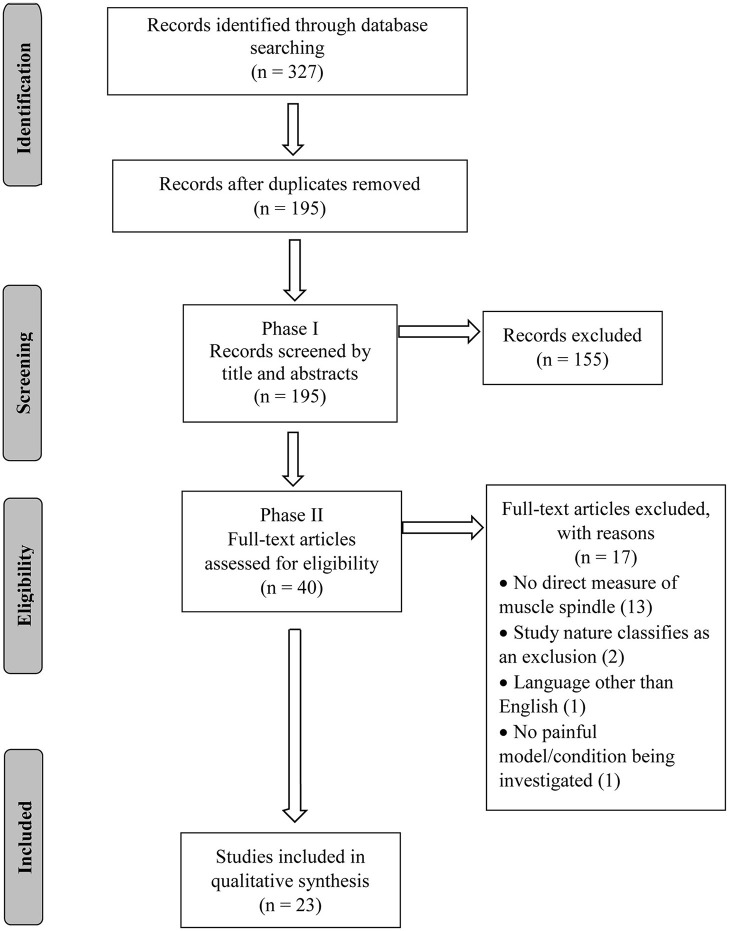
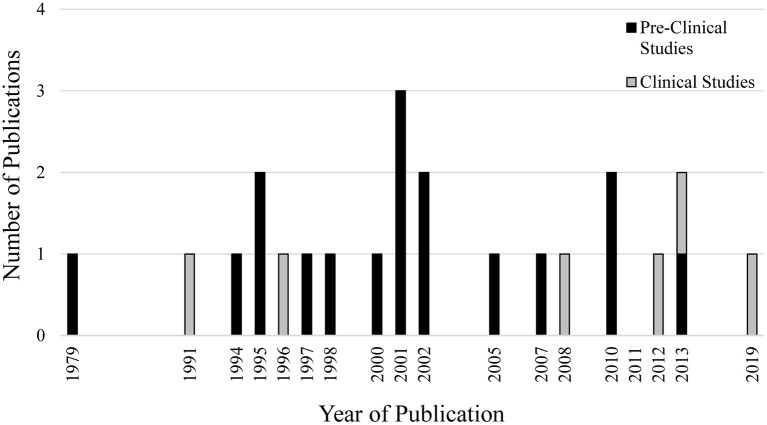
Musculoskeletal pain disorders are among the leading causes of years lived with disability worldwide representing a significant burden to society. Studies investigating a "nociceptive-fusimotor" relationship using experimentally-induced pain/noxious stimuli and muscle spindle afferent (MSA) response have been published over several decades. The purpose of this scoping review was to systematically identify and summarize research findings related to the impact of experimentally-induced pain or noxious stimulation on direct MSA discharge/response. PubMed, Cumulative Index to Nursing and Allied Health Literature (CINAHL), Cochrane and Embase were searched from database inception to August 2020. Eligible studies were: (a) published in English; (b) clinical or pre-clinical studies; (c) original data studies; (d) included the investigation of MSA response to experimentally-induced pain or noxious stimulation; (e) included quantification of at least one direct physiological measure associated with MSA activity/response. Two-phase screening procedures were conducted by a pair of independent reviewers and data extracted from eligible studies. The literature search resulted in 195 articles of which 23 met inclusion criteria. Six studies (26%) were classified as clinical and 17 (74%) as pre-clinical. Two clinical studies investigated the effects of sacral dermatome pin-pricking on MSA response, while the remaining 4 studies investigated the effects of tonic muscle and/or skin pain induced by injection/infusion of hypertonic saline into the tibialis anterior muscle or subdermal tissues. In pre-clinical studies, muscle pain was induced by injection of noxious substances or the surgical removal of the meniscus at the knee joint. Clinical studies in awake humans reported that experimentally-induced pain did not affect, or else slightly decreased MSA spontaneous discharge and/or response during weak dorsiflexor muscle contraction, thus failing to support an excitatory nociceptive-fusimotor relationship. However, a majority of pre-clinical studies indicated that ipsilateral and contralateral muscle injection of noxious substances altered MSA resting discharge and/or response to stretch predominately through static fusimotor reflex mechanisms. Methodological differences (use of anesthesia, stretch methodology, etc.) may ultimately be responsible for the discrepancies between clinical and pre-clinical findings. Additional investigative efforts are needed to reconcile these discrepancies and to clearly establish or refute the existence of nociceptive-fusimotor relationship in muscular pain.
肌肉骨骼疼痛障碍是全球致残年限的主要原因之一,给社会带来了沉重负担。几十年来,已有多项研究通过实验性诱导疼痛/有害刺激和肌梭传入(MSA)反应来探究“伤害性-肌梭运动”关系。本综述的目的是系统地识别和总结与实验性诱导疼痛或有害刺激对直接MSA放电/反应的影响相关的研究结果。检索了PubMed、护理及相关健康文献累积索引(CINAHL)、Cochrane和Embase数据库,检索时间从建库至2020年8月。符合条件的研究包括:(a)以英文发表;(b)临床或临床前研究;(c)原始数据研究;(d)包括对MSA对实验性诱导疼痛或有害刺激的反应的研究;(e)包括对至少一项与MSA活动/反应相关的直接生理指标的量化。由一对独立评审员进行两阶段筛选程序,并从符合条件的研究中提取数据。文献检索共得到195篇文章,其中23篇符合纳入标准。六项研究(26%)为临床研究,17项(74%)为临床前研究。两项临床研究调查了骶部皮节针刺对MSA反应的影响,其余四项研究调查了向胫骨前肌或皮下组织注射/输注高渗盐水诱导的强直性肌肉和/或皮肤疼痛的影响。在临床前研究中,通过注射有害物质或手术切除膝关节半月板来诱导肌肉疼痛。清醒人类的临床研究报告称,实验性诱导疼痛在弱背屈肌收缩期间不影响或略微降低MSA自发放电和/或反应,因此不支持兴奋性伤害性-肌梭运动关系。然而,大多数临床前研究表明,同侧和对侧肌肉注射有害物质主要通过静态肌梭运动反射机制改变了MSA静息放电和/或对拉伸的反应。方法学差异(麻醉的使用、拉伸方法等)可能最终导致了临床和临床前研究结果之间的差异。需要进一步的研究努力来调和这些差异,并明确证实或反驳肌肉疼痛中伤害性-肌梭运动关系的存在。