Matsugi Akiyoshi, Nagino Koji, Shiozaki Tomoyuki, Okada Yohei, Mori Nobuhiko, Nakamura Junji, Douchi Shinya, Oku Kosuke, Nagano Kiyoshi, Tamaru Yoshiki
Faculty of Rehabilitation, Shijonawate Gakuen University, Osaka, Japan.
Faculty of Allied Health Sciences, Kansai University of Welfare Sciences, Osaka, Japan.
Front Hum Neurosci. 2021 Feb 17;15:646127. doi: 10.3389/fnhum.2021.646127. eCollection 2021.
Noisy galvanic vestibular stimulation (nGVS) is often used to improve postural stability in disorders, such as neurorehabilitation montage. For the safe use of nGVS, we investigated whether arterial pressure (AP) and heart rate vary during static supine and slow whole-body tilt with random nGVS (0.4 mA, 0.1-640 Hz, gaussian distribution) in a healthy elderly population.
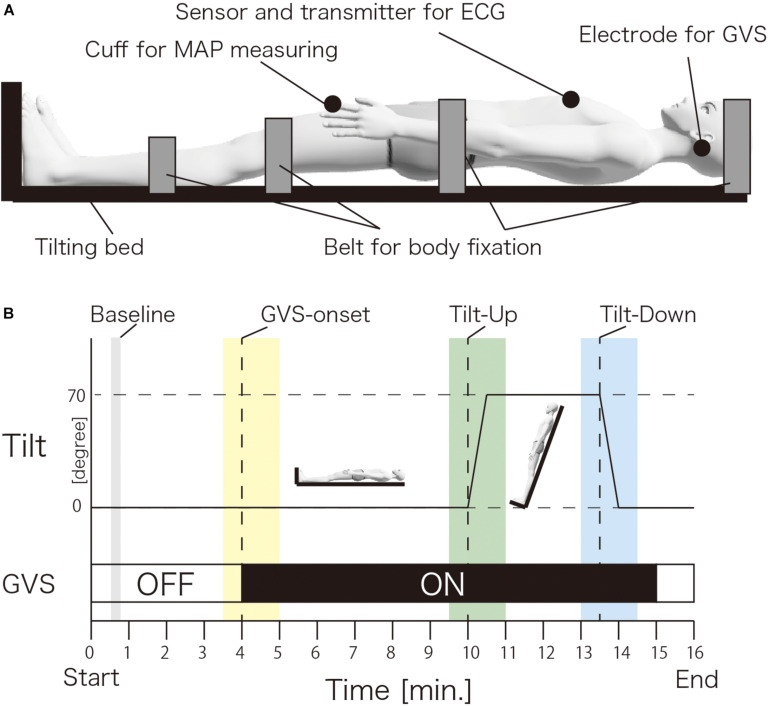
This study was conducted with a double-blind, sham-controlled, cross-over design. Seventeen healthy older adults were recruited. They were asked to maintain a static supine position on a bed for 10 min, and the bed was tilted up (TU) to 70 degrees within 30 s. After maintaining this position for 3 min, the bed was passively tilted down (TD) within 30 s. Real-nGVS or sham-nGVS was applied from 4 to 15 min. The time course of mean arterial pressure (MAP) and RR interval variability (RRIV) were analyzed to estimate the autonomic nervous activity.
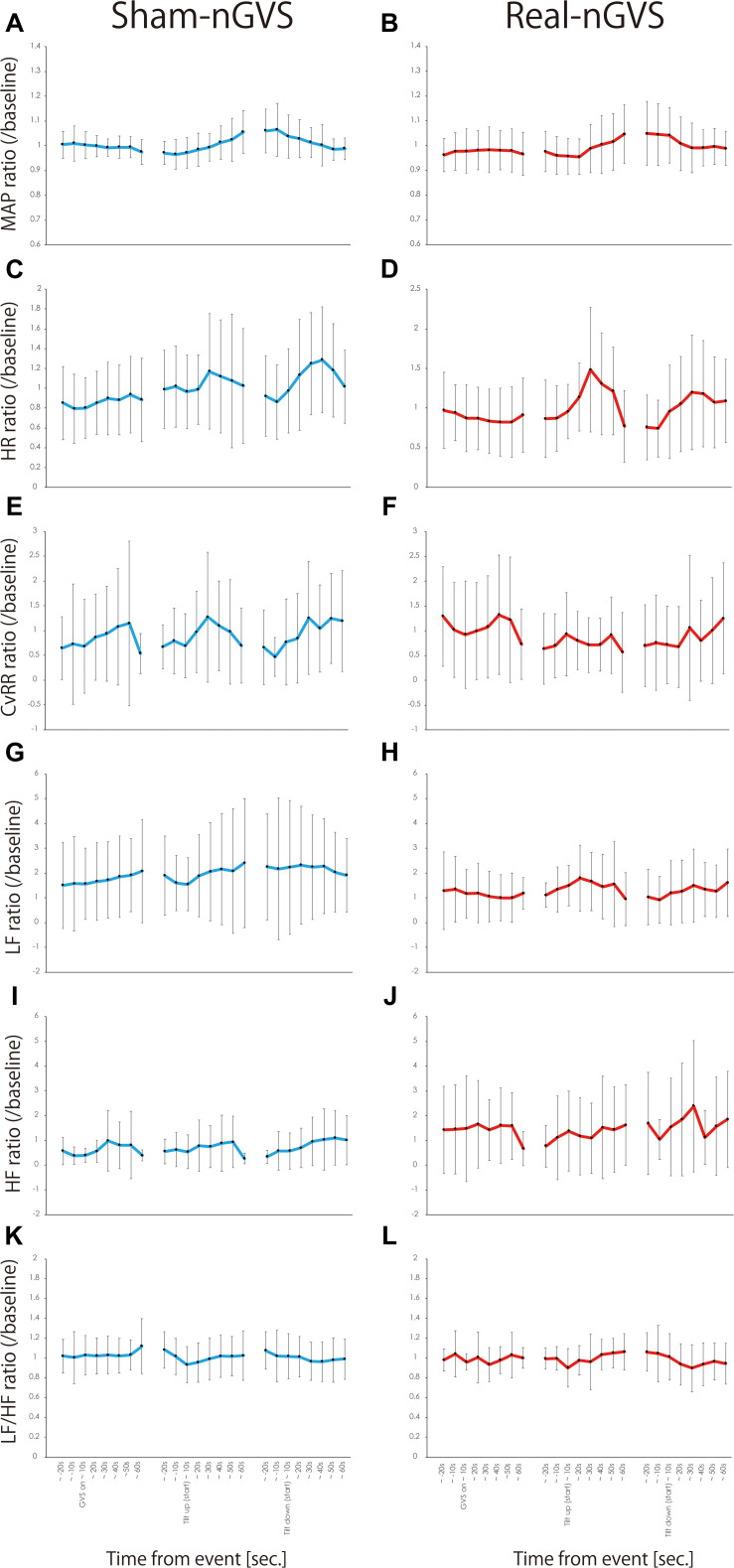
nGVS and/or time, including pre-/post-event (nGVS-start, TU, and TD), had no impact on MAP and RRIV-related parameters. Further, there was no evidence supporting the argument that nGVS induces pain, vertigo/dizziness, and uncomfortable feeling.
nGVS may not affect the AP and RRIV during static position and whole-body tilting or cause pain, vertigo/dizziness, and discomfort in the elderly.
噪声性电前庭刺激(nGVS)常用于改善神经康复方案等疾病中的姿势稳定性。为安全使用nGVS,我们调查了在健康老年人群中,进行随机nGVS(0.4 mA,0.1 - 640 Hz,高斯分布)时,静卧和缓慢全身倾斜过程中动脉压(AP)和心率是否会发生变化。
本研究采用双盲、假刺激对照、交叉设计。招募了17名健康老年人。要求他们在床上静卧10分钟,然后在30秒内将床倾斜至70度(向上倾斜,TU)。保持该姿势3分钟后,在30秒内将床被动向下倾斜(TD)。在4至15分钟内施加真nGVS或假nGVS。分析平均动脉压(MAP)和RR间期变异性(RRIV)的时间进程,以评估自主神经活动。
nGVS和/或时间,包括事件前/后(nGVS开始、TU和TD),对MAP和RRIV相关参数没有影响。此外,没有证据支持nGVS会引起疼痛、眩晕/头晕和不适感这一观点。
nGVS在静卧和全身倾斜过程中可能不会影响AP和RRIV,也不会在老年人中引起疼痛、眩晕/头晕和不适。