Di Rosa Elisa, Masina Fabio, Vallesi Antonino, Mapelli Daniela
Department of General Psychology, University of Padua, Padua, Italy.
School of Psychology, Keele University, Newcastle-under-Lyme, United Kingdom.
Front Psychiatry. 2021 Feb 19;12:567718. doi: 10.3389/fpsyt.2021.567718. eCollection 2021.
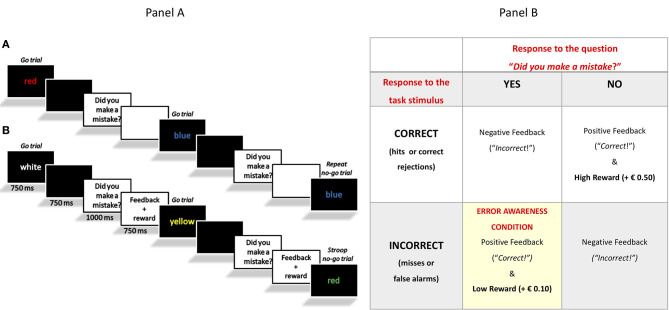
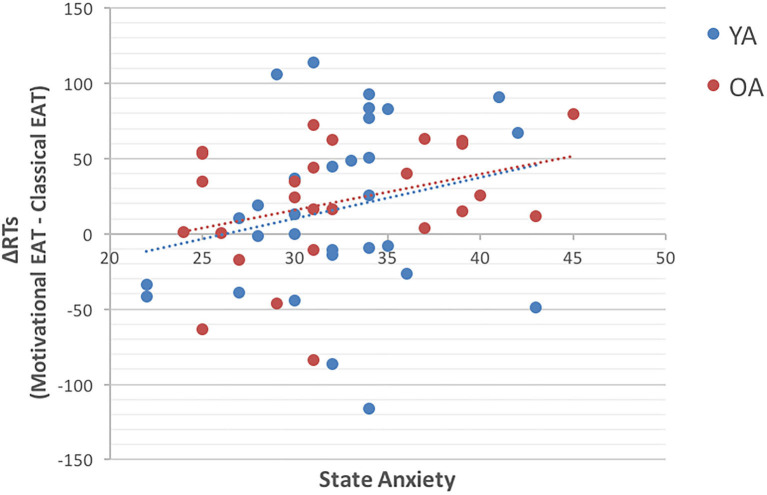
Aging is associated with several changes in cognitive functions, as well as in motivational and affective processes, which in turn interact with cognitive functions. The present study aimed to investigate error awareness (EA), which declines with aging, in relation to motivation and anxiety. Adopting an experimental task, we firstly tested the hypothesis that EA could be enhanced through reward motivation. Secondly, we explored the relation between state and trait anxiety and EA, investigating the hypothesis of an association between EA and anxiety, and between anxiety and the potential benefit of motivation on EA. Thirty healthy younger (age range: 19-35 years; mean age 25.4 ± 5.1; 10 M) and 30 healthy older adults (age range: 61-83 years; mean age 69.7 ± 5.5; 12 M) took part in the study and performed both the classic Error Awareness Task (EAT) and one experimental task, called the Motivational EAT. In this new task, motivational incentives were delivered after aware correct responses and aware errors. For every participant, standard measures of state and trait anxiety and cognitive functions were collected. Confirming the presence of a significant age-related EA decline, results did not reveal any influence of reward motivation on EA, nor any relation between EA and anxiety. However, both younger and older adults had longer response times (RTs) and made more errors during the Motivational EAT, with the more anxious participants showing the greater RT slowing. Findings suggest that reward motivation might not be always beneficial for cognitive performance, as well as that anxiety does not relate to EA capacity. Results also recommend further investigation, as well as the assessment of EA in patients with either motivational deficits like apathy, and/or with anxiety disorders.
衰老与认知功能以及动机和情感过程的多种变化相关,而这些变化又与认知功能相互作用。本研究旨在探讨随着衰老而下降的错误意识(EA)与动机和焦虑之间的关系。通过一项实验任务,我们首先检验了EA可通过奖励动机得到增强这一假设。其次,我们探究了状态焦虑和特质焦虑与EA之间的关系,考察了EA与焦虑之间以及焦虑与动机对EA的潜在益处之间存在关联的假设。30名健康的年轻人(年龄范围:19 - 35岁;平均年龄25.4 ± 5.1;10名男性)和30名健康的老年人(年龄范围:61 - 83岁;平均年龄69.7 ± 5.5;12名男性)参与了该研究,并完成了经典的错误意识任务(EAT)和一项名为动机性EAT的实验任务。在这项新任务中,在意识到正确反应和意识到错误后给予动机激励。为每位参与者收集了状态焦虑、特质焦虑和认知功能的标准测量数据。结果证实了存在与年龄相关的显著EA下降,未发现奖励动机对EA有任何影响,也未发现EA与焦虑之间存在任何关系。然而,年轻人和老年人在动机性EAT中都有更长的反应时间(RTs)且犯了更多错误,焦虑程度越高的参与者RT减慢越明显。研究结果表明,奖励动机可能并不总是对认知表现有益,而且焦虑与EA能力无关。结果还建议进一步开展研究,以及对患有冷漠等动机缺陷和/或焦虑症的患者进行EA评估。