Division of Pediatric Surgery, Department of Surgery, Children's Hospital of Pittsburgh, University of Pittsburgh School of Medicine, Pittsburgh, PA, United States.
Section of Rheumatology, Department of Medicine, Yale School of Medicine, New Haven, CT, United States.
Front Endocrinol (Lausanne). 2021 Feb 18;11:624590. doi: 10.3389/fendo.2020.624590. eCollection 2020.
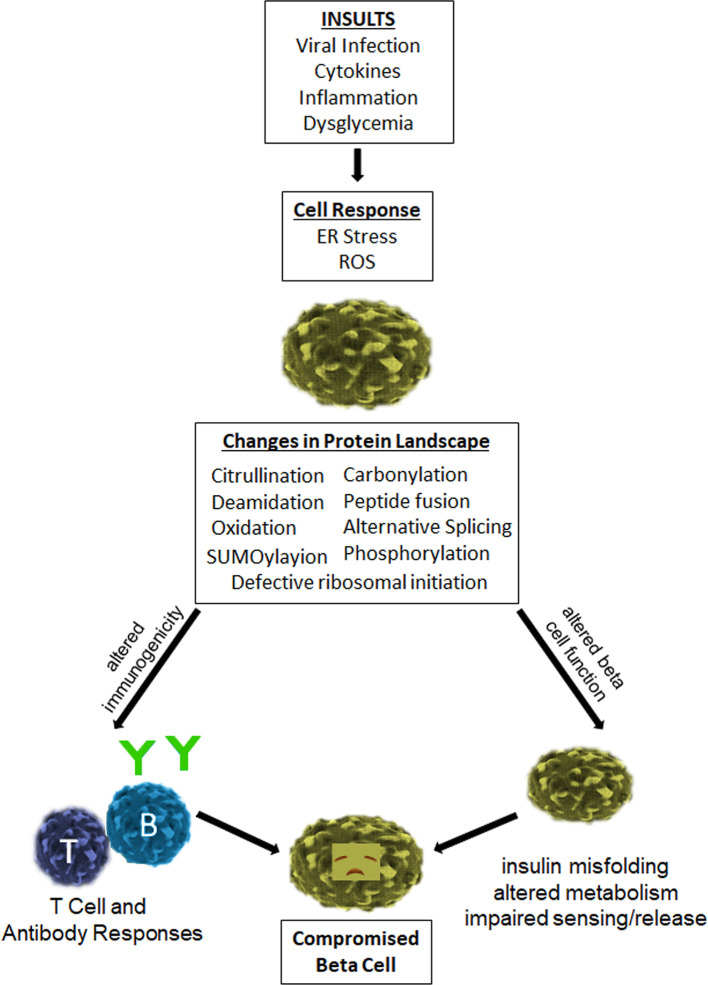
Due to their secretory function, β cells are predisposed to higher levels of endoplasmic reticulum (ER) stress and greater sensitivity to inflammation than other cell types. These stresses elicit changes in β cells that alter their function and immunogenicity, including defective ribosomal initiation, post-translational modifications (PTMs) of endogenous β cell proteins, and alternative splicing. Multiple published reports confirm the presence of not only CD8+ T cells, but also autoreactive CD4+ T cells within pancreatic islets. Although the specificities of T cells that infiltrate human islets are incompletely characterized, they have been confirmed to include neo-epitopes that are formed through stress-related enzymatic modifications of β cell proteins. This article summarizes emerging knowledge about stress-induced changes in β cells and data supporting a role for neo-antigen formation and cross-talk between immune cells and β cells that provokes autoimmune attack - leading to a breakdown in tissue-specific tolerance in subjects who develop type 1 diabetes.
由于其分泌功能,β细胞易受到内质网(ER)应激和炎症的影响,比其他细胞类型更为敏感。这些应激会引起β细胞的变化,改变其功能和免疫原性,包括核糖体起始缺陷、内源性β细胞蛋白的翻译后修饰(PTMs)和选择性剪接。多项已发表的报告证实,不仅在胰岛中存在 CD8+T 细胞,而且还存在自身反应性 CD4+T 细胞。尽管浸润人类胰岛的 T 细胞的特异性尚未完全描述,但已证实它们包括通过β细胞蛋白的应激相关酶修饰形成的新表位。本文总结了关于β细胞应激诱导变化的新知识,并提供了支持新抗原形成和免疫细胞与β细胞之间相互作用的证据,这些作用会引发自身免疫攻击,导致 1 型糖尿病患者组织特异性耐受的破坏。