Department of Neurology, Beijing Tiantan Hospital, Capital Medical University, Beijing, China.
National Center for Clinical Medicine of Neurological Diseases, Beijing, China.
Front Immunol. 2021 Feb 17;12:621599. doi: 10.3389/fimmu.2021.621599. eCollection 2021.
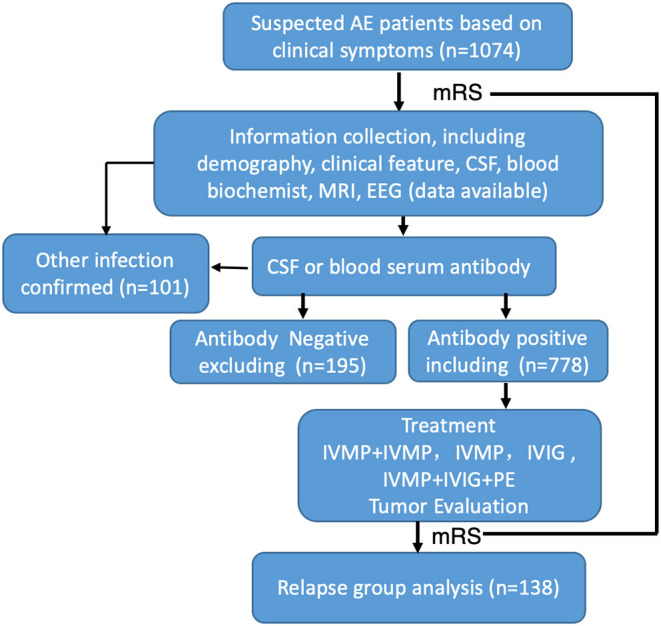
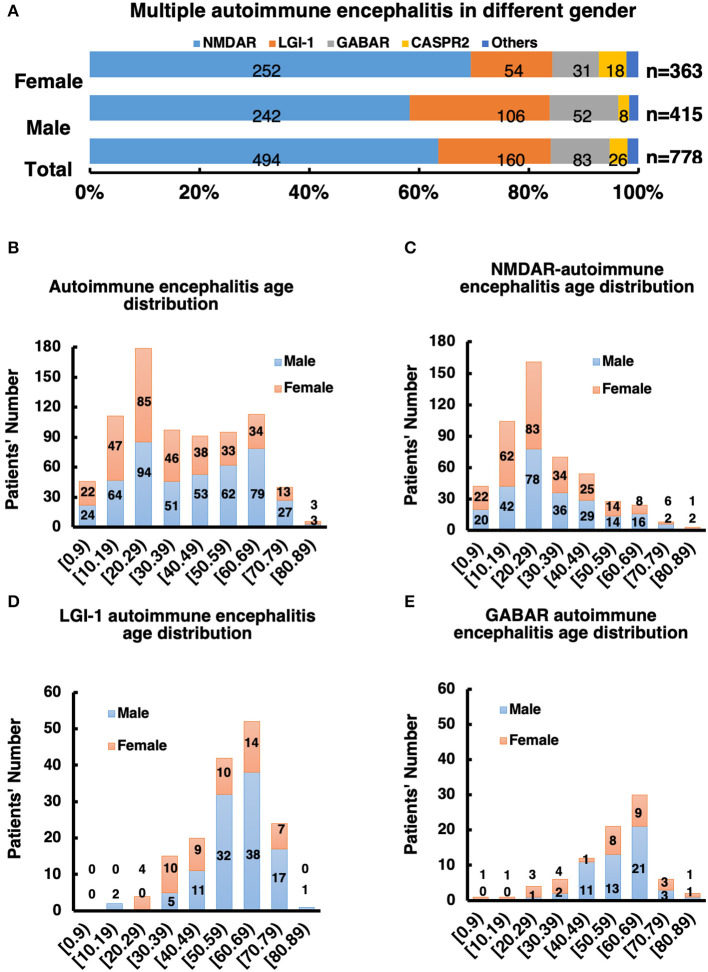
The epidemiological characteristics of patients with antibody-medicated autoimmune encephalitis in China remain unclear, and a large-scale epidemiological survey is necessary. A multiple-center retrospective study was performed. We collected 1,047 patients with suspected autoimmune encephalitis and ultimately enrolled 778 defined patients across centers in China. All patients were positive for serum [or cerebrospinal fluid (CSF)] antibodies. Demographic information and clinical data from January 2014 to January 2019 from 22 centers in China were reviewed. A total of 778 patients with autoimmune encephalitis were enrolled in the study. In general, the ratio of males to females was ~1.2:1. The main subtypes of autoimmune encephalitis were NMDAR-AE (61.35%), LGI-1-AE (20.61%), and GABAbR-AE (12.40%). According to the characteristics of age of onset, the incidence of autoimmune encephalitis showed a "double peak" distribution entailing a 20-year-old age group and a 60-year-old age group. We next analyzed the proportion of patients with tumors in this cohort. More specifically, there were 34 patients with tumors and 85 with tumor marker positivity. Relapse occurred in 81 patients within at least 1 year's follow up study: 52 with NMDAR-AE (18.2%); 19 with LGI-1-AE (16.8%); 5 with GABAbR-AE (9%); and 3 with CASPR2-AE. Due to the vast differences in demographic features, the incidence of cancer and the genetic characteristics between the populations in China and Western countries, the demographics, sex distribution, concomitant tumor rate, clinical features, and relapse characteristics associated with autoimmune encephalitis in China shows a similar profile with Western countries with some minor differences.
中国抗体介导自身免疫性脑炎患者的流行病学特征尚不清楚,需要进行大规模的流行病学调查。一项多中心回顾性研究。我们收集了 1047 例疑似自身免疫性脑炎患者的资料,最终纳入了中国 22 家中心的 778 例确诊患者。所有患者的血清[或脑脊液 (CSF)]抗体均为阳性。对 2014 年 1 月至 2019 年 1 月期间中国 22 家中心的患者人口统计学信息和临床资料进行了回顾性分析。共有 778 例自身免疫性脑炎患者入组本研究。一般来说,男性与女性的比例约为 1.2:1。自身免疫性脑炎的主要亚型为 NMDAR-AE(61.35%)、LGI-1-AE(20.61%)和 GABAbR-AE(12.40%)。根据发病年龄特征,自身免疫性脑炎的发病率呈“双峰”分布,涉及 20 岁年龄组和 60 岁年龄组。我们进一步分析了该队列中肿瘤患者的比例。具体来说,有 34 例患者存在肿瘤,85 例患者肿瘤标志物阳性。在至少 1 年的随访研究中,81 例患者出现复发:52 例为 NMDAR-AE(18.2%);19 例为 LGI-1-AE(16.8%);5 例为 GABAbR-AE(9%);3 例为 CASPR2-AE。由于人口特征、癌症发病率和中西方人群遗传特征存在巨大差异,中国自身免疫性脑炎的人口统计学、性别分布、伴发肿瘤率、临床特征和复发特征与西方国家相似,但存在一些细微差异。