Department of Neurology, Odense University Hospital, Odense, Denmark.
Department of Clinical Research, University of Southern Denmark, Odense, Denmark.
Front Immunol. 2021 Dec 16;12:719432. doi: 10.3389/fimmu.2021.719432. eCollection 2021.
The two most common autoimmune encephalitides (AE), -methyl-D-Aspartate receptor (NMDAR) and Leucine-rich Glioma-Inactivated 1 (LGI1) encephalitis, have been known for more than a decade. Nevertheless, no well-established biomarkers to guide treatment or estimate prognosis exist. Neurofilament light chain (NfL) has become an unspecific screening marker of axonal damage in CNS diseases, and has proven useful as a diagnostic and disease activity marker in neuroinflammatory diseases. Only limited reports on NfL in AE exist. We investigated NfL levels at diagnosis and follow-up in NMDAR and LGI1-AE patients, and evaluated the utility of CSF-NfL as a biomarker in AE.
Patients were included from the National Danish AE cohort (2009-present) and diagnosed based upon autoantibody positivity and diagnostic consensus criteria. CSF-NfL was analyzed by single molecule array technology. Clinical and diagnostic information was retrospectively evaluated and related to NfL levels at baseline and follow-up. NMDAR-AE patients were subdivided into: idiopathic/teratoma associated or secondary NMDAR-AE (post-viral or concomitant with malignancies/demyelinating disease).
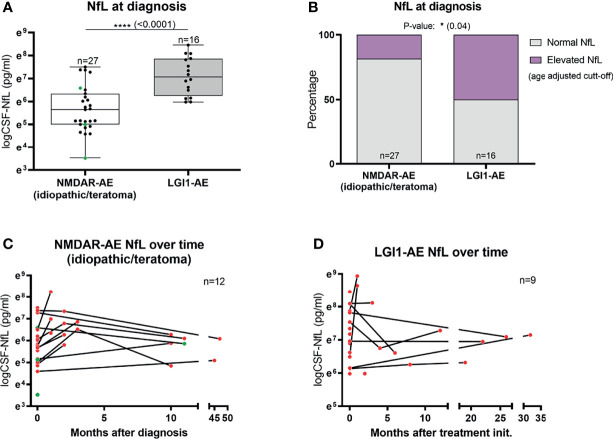
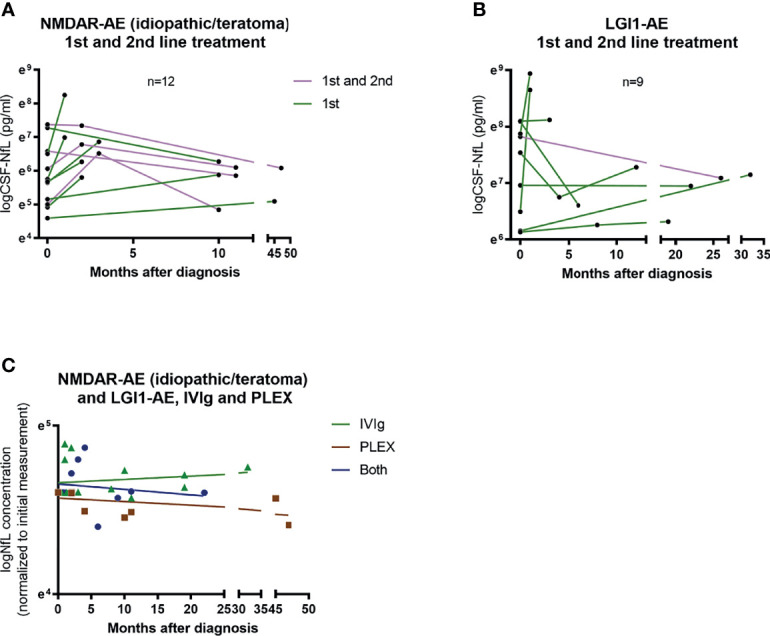
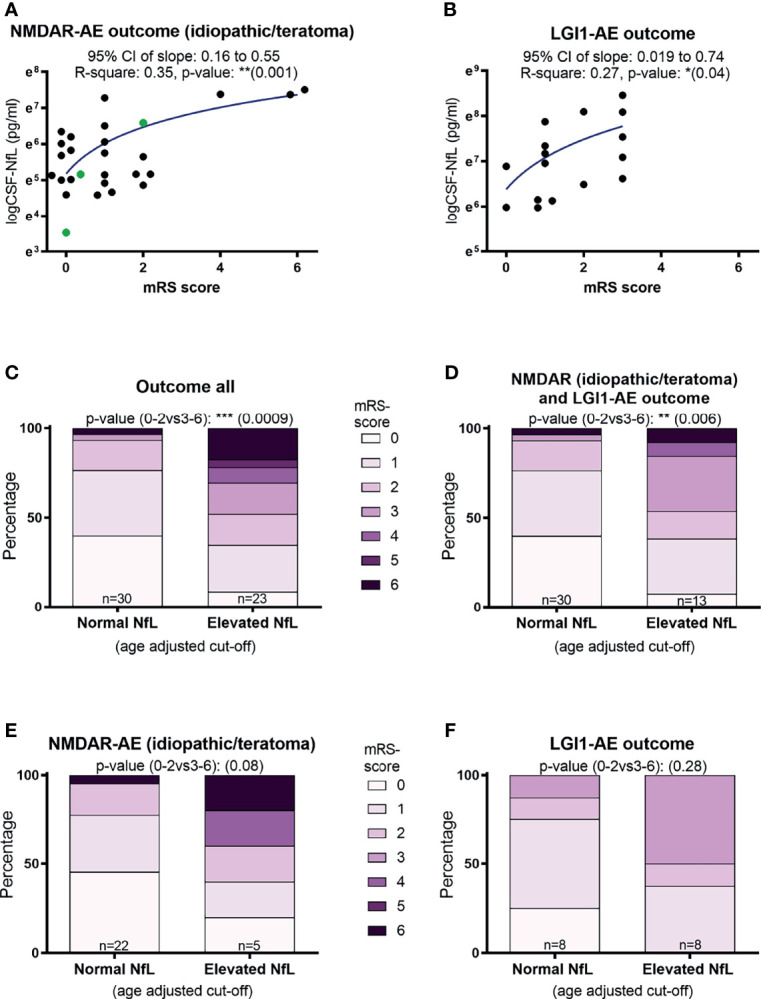
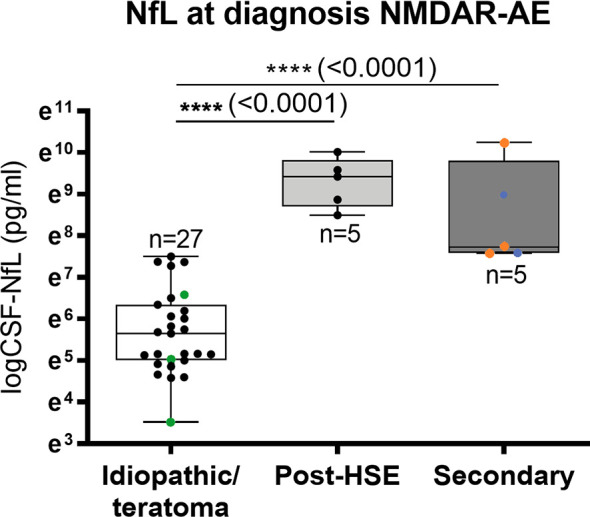
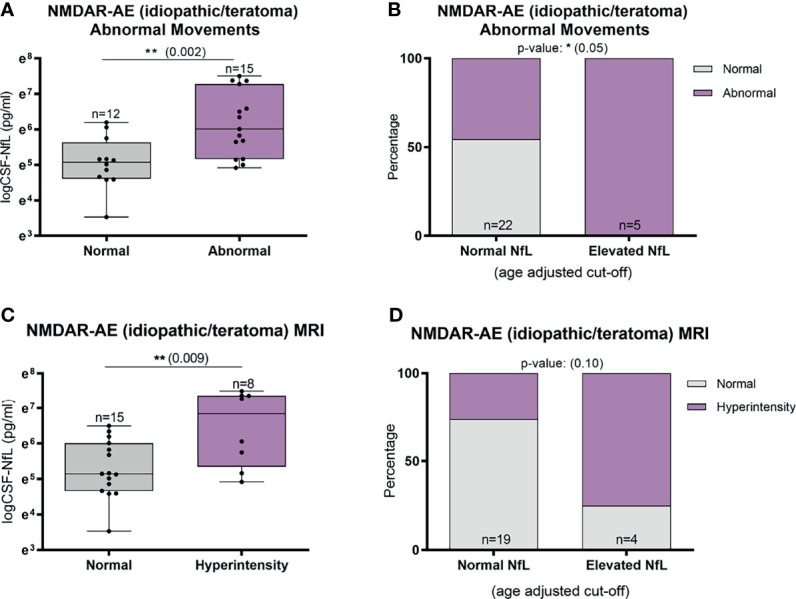
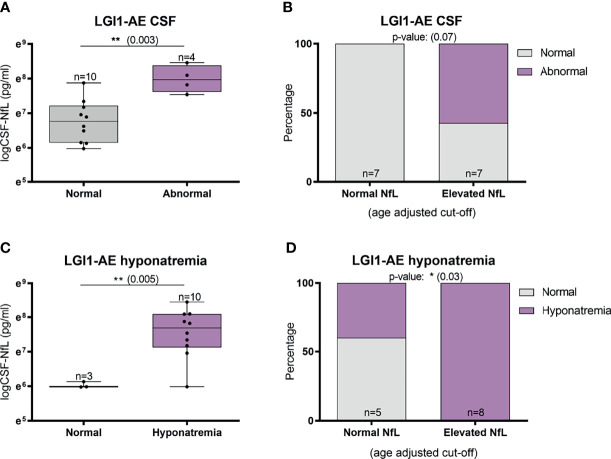
A total of 74 CSF samples from 53 AE patients (37 NMDAR and 16 LGI1 positive) were included in the study. Longitudinal CSF-NfL levels was measured in 21 patients. Median follow-up time was 23.8 and 43.9 months for NMDAR and LGI1-AE respectively. Major findings of this study are: i) CSF-NfL levels were higher in LGI1-AE than in idiopathic/teratoma associated NMDAR-AE at diagnosis; ii) CSF-NfL levels in NMDAR-AE patients distinguished idiopathic/teratoma cases from cases with other underlying etiologies (post-viral or malignancies/demyelinating diseases) and iii) Elevated CSF-NfL at diagnosis seems to be associated with worse long-term disease outcomes in both NMDAR and LGI1-AE.
CSF-NfL measurement may be beneficial as a prognostic biomarker in NMDAR and LGI1-AE, and high CSF-NfL could foster search for underlying etiologies in NMDAR-AE. Further studies on larger cohorts, using standardized methods, are warranted.
抗 -N- 甲基-D- 天冬氨酸受体(NMDAR)和富亮氨酸胶质瘤失活 1 型(LGI1)脑炎是两种最常见的自身免疫性脑炎,其已被认识十余年。然而,目前尚无用于指导治疗或评估预后的可靠生物标志物。神经丝轻链(NfL)已成为中枢神经系统疾病轴突损伤的非特异性筛查标志物,并已被证明在神经炎症性疾病中作为诊断和疾病活动标志物具有一定的应用价值。目前仅有关于 NfL 在自身免疫性脑炎中应用的有限报道。本研究旨在探讨 NMDAR 和 LGI1-AE 患者的 NfL 水平在诊断时及随访时的变化,并评估脑脊液 NfL 作为自身免疫性脑炎生物标志物的效用。
本研究纳入了自 2009 年以来丹麦全国性自身免疫性脑炎队列中的患者,其诊断基于自身抗体阳性和诊断共识标准。通过单分子阵列技术分析脑脊液 NfL。回顾性评估临床和诊断信息,并与基线和随访时的 NfL 水平相关联。将 NMDAR-AE 患者分为特发性/畸胎瘤相关或继发性 NMDAR-AE(病毒后或合并恶性肿瘤/脱髓鞘疾病)。
本研究共纳入了 53 例自身免疫性脑炎患者(37 例 NMDAR 阳性和 16 例 LGI1 阳性)的 74 份脑脊液样本。21 例患者进行了纵向脑脊液 NfL 水平检测。NMDAR 和 LGI1-AE 的中位随访时间分别为 23.8 个月和 43.9 个月。本研究的主要发现包括:i)LGI1-AE 患者的脑脊液 NfL 水平高于特发性/畸胎瘤相关的 NMDAR-AE;ii)NMDAR-AE 患者的脑脊液 NfL 水平可区分特发性/畸胎瘤病例与具有其他潜在病因(病毒后或恶性肿瘤/脱髓鞘疾病)的病例;iii)诊断时脑脊液 NfL 升高似乎与 NMDAR 和 LGI1-AE 的长期疾病结局较差有关。
脑脊液 NfL 测量可能有益于 NMDAR 和 LGI1-AE 的预后生物标志物,而高脑脊液 NfL 可能有助于在 NMDAR-AE 中寻找潜在病因。有必要进行更大规模队列的研究,并采用标准化方法。