Crizzle Alexander M, Mullen Nadia, Mychael Diane, Meger Natasha, Toxopeus Ryan, Gibbons Carrie, Ostap Simeon, Dubois Sacha, Bédard Michel
School of Public Health, University of Saskatchewan, Saskatoon, SK, Canada.
School of Public Health and Health Systems, University of Waterloo, Waterloo, ON, Canada.
Can Geriatr J. 2021 Mar 2;24(1):14-21. doi: 10.5770/cgj.24.444. eCollection 2021 Mar.
Studies have reported poor sensitivity and specificity of the Screen for the Identification of Cognitively Impaired Medically At-Risk Drivers, a modification of the DemTech (SIMARD-MD) to screen for drivers with cognitive impairment. The purpose of this study was to determine whether the SIMARD-MD can accurately predict pass/fail on a road test in drivers with cognitive impairment (CI) and healthy drivers.
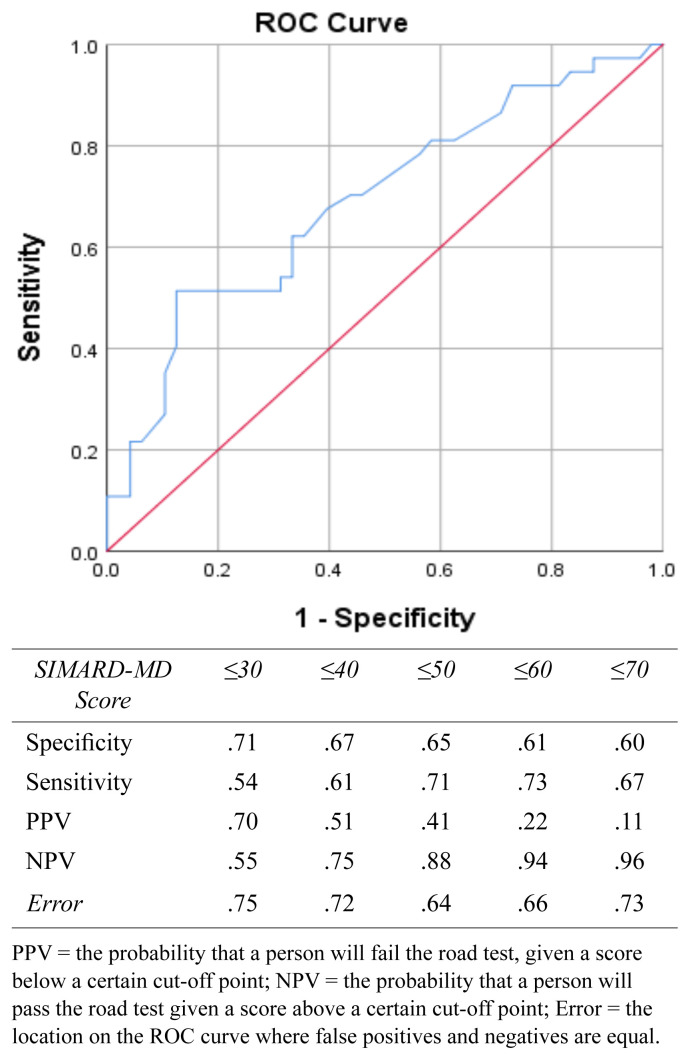
Data from drivers with CI were collected from two comprehensive driving assessment centres (n=86) and compared with healthy drivers (n=30). All participants completed demographic measures, clinical measures, and a road rest (pass/fail). Analyses consisted of correlations between the SIMARD-MD and the other clinical measures, and a receiver-operating-characteristic (ROC) curve to determine the predictive ability of the SIMARD-MD.
All healthy drivers passed the road test compared with 44.2% of the CI sample. On the SIMARD-MD, the CI sample scored significantly worse than healthy drivers ( < .001). The ROC curve showed the SIMARD-MD, regardless of any cut-point, misclassified a large number of CI individuals (AUC=.692; 95% CI = 0.578, 0.806).
Given the high level of misclassification, the SIMARD-MD should not be used with either healthy drivers or those with cognitive impairment for making decisions about driving.
研究报告称,用于识别有医学风险的认知障碍驾驶员的筛查工具(SIMARD-MD,DemTech的一种改良版)在筛查认知障碍驾驶员方面的敏感性和特异性较差。本研究的目的是确定SIMARD-MD能否准确预测认知障碍(CI)驾驶员和健康驾驶员在路考中的通过/失败情况。
从两个综合驾驶评估中心收集了CI驾驶员的数据(n = 86),并与健康驾驶员(n = 30)进行比较。所有参与者都完成了人口统计学测量、临床测量和路考(通过/失败)。分析包括SIMARD-MD与其他临床测量之间的相关性,以及用于确定SIMARD-MD预测能力的受试者操作特征(ROC)曲线。
所有健康驾驶员都通过了路考,而CI样本中只有44.2%通过。在SIMARD-MD测试中,CI样本的得分明显低于健康驾驶员(P <.001)。ROC曲线显示,无论设定何种临界点,SIMARD-MD都会将大量CI个体误分类(AUC = 0.692;95%CI = 0.578, 0.806)。
鉴于误分类水平较高,SIMARD-MD不应被用于健康驾驶员或认知障碍驾驶员的驾驶决策。