Cheng Zhiheng, Dai Yifeng, Huang Wenhui, Zhong Qingfu, Zhu Pei, Zhang Wenjuan, Wu Zhihua, Lin Qing, Zhu Huoyan, Cui Longzhen, Qian Tingting, Deng Cong, Fu Lin, Liu Yan, Zeng Tiansheng
Department of Hematology, The Second Affiliated Hospital of Guangzhou Medical University, Guangzhou, China.
Department of Pathology and Medical Biology, University of Groningen, University Medical Center Groningen, Groningen, Netherlands.
Front Oncol. 2021 Feb 18;10:553344. doi: 10.3389/fonc.2020.553344. eCollection 2020.
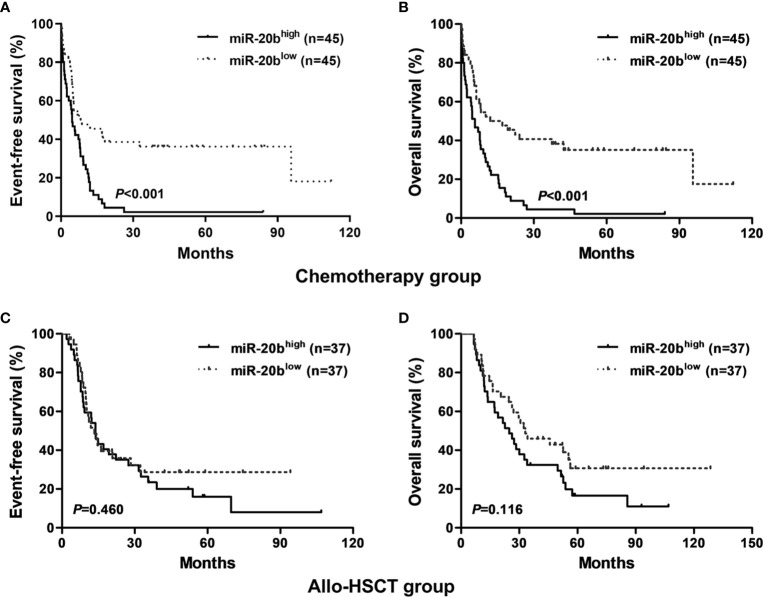
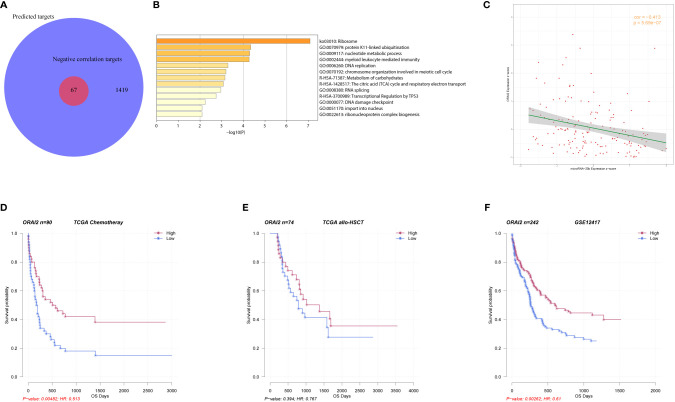
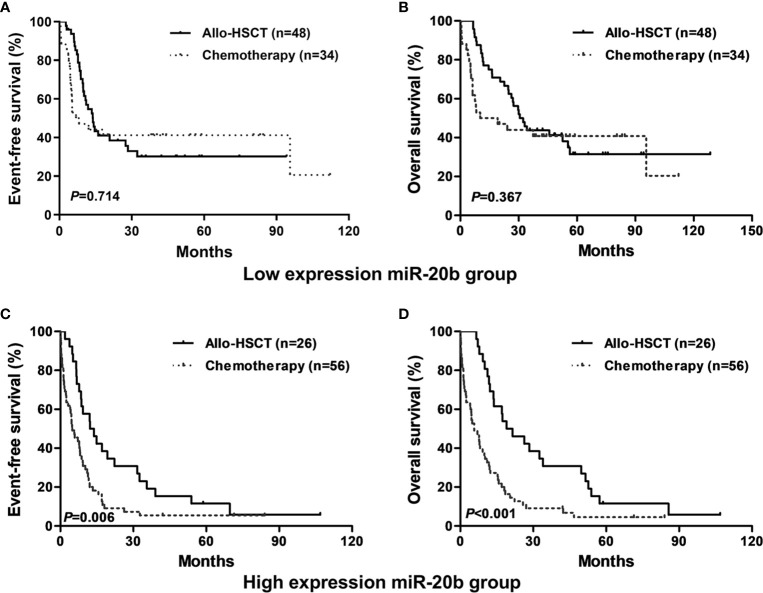
Acute myeloid leukemia (AML) is a highly heterogeneous disease that requires fine-grained risk stratification for the best prognosis of patients. As a class of small non-coding RNAs with important biological functions, microRNAs play a crucial role in the pathogenesis of AML. To assess the prognostic impact of miR-20b on AML in the presence of other clinical and molecular factors, we screened 90 AML patients receiving chemotherapy only and 74 also undergoing allogeneic hematopoietic stem cell transplantation (allo-HSCT) from the Cancer Genome Atlas (TCGA) database. In the chemotherapy-only group, high miR-20b expression subgroup had shorter event-free survival (EFS) and overall survival (OS, both < 0.001); whereas, there were no significant differences in EFS and OS between high and low expression subgroups in the allo-HSCT group. Then we divided all patients into high and low expression groups based on median miR-20b expression level. In the high expression group, patients treated with allo-HSCT had longer EFS and OS than those with chemotherapy alone (both < 0.01); however, there were no significant differences in EFS and OS between different treatment subgroups in the low expression group. Further analysis showed that miR-20b was negatively correlated with genes in "ribosome," "myeloid leukocyte mediated immunity," and "DNA replication" signaling pathways. , the gene with the strongest correlation with miR-20b, also had significant prognostic value in patients undergoing chemotherapy but not in the allo-HSCT group. In conclusion, our findings suggest that high miR-20b expression is a poor prognostic indicator for AML, but allo-HSCT may override its prognostic impact.
急性髓系白血病(AML)是一种高度异质性疾病,需要进行精细的风险分层以实现患者的最佳预后。作为一类具有重要生物学功能的小非编码RNA,微小RNA在AML的发病机制中起着关键作用。为了评估在存在其他临床和分子因素的情况下miR-20b对AML的预后影响,我们从癌症基因组图谱(TCGA)数据库中筛选了90例仅接受化疗的AML患者以及74例也接受异基因造血干细胞移植(allo-HSCT)的患者。在仅接受化疗的组中,高miR-20b表达亚组的无事件生存期(EFS)和总生存期(OS,均<0.001)较短;而在allo-HSCT组中,高表达和低表达亚组之间的EFS和OS没有显著差异。然后我们根据miR-20b表达水平的中位数将所有患者分为高表达组和低表达组。在高表达组中,接受allo-HSCT治疗的患者的EFS和OS比仅接受化疗的患者更长(均<0.01);然而,在低表达组中,不同治疗亚组之间的EFS和OS没有显著差异。进一步分析表明,miR-20b与“核糖体”、“髓系白细胞介导的免疫”和“DNA复制”信号通路中的基因呈负相关。与miR-20b相关性最强的基因在接受化疗的患者中也具有显著的预后价值,但在allo-HSCT组中则没有。总之,我们的研究结果表明,高miR-20b表达是AML的不良预后指标,但allo-HSCT可能会抵消其预后影响。