Cheng Zhiheng, Dai Yifeng, Zeng Tiansheng, Liu Yan, Cui Longzhen, Qian Tingting, Si Chaozeng, Huang Wenhui, Pang Ying, Ye Xu, Shi Jinlong, Fu Lin
Department of Hematology, The Second Affiliated Hospital of Guangzhou Medical University, Guangzhou, China.
Department of Pathology and Medical Biology, University of Groningen, University Medical Center Groningen, Groningen, Netherlands.
Front Oncol. 2020 Mar 24;10:379. doi: 10.3389/fonc.2020.00379. eCollection 2020.
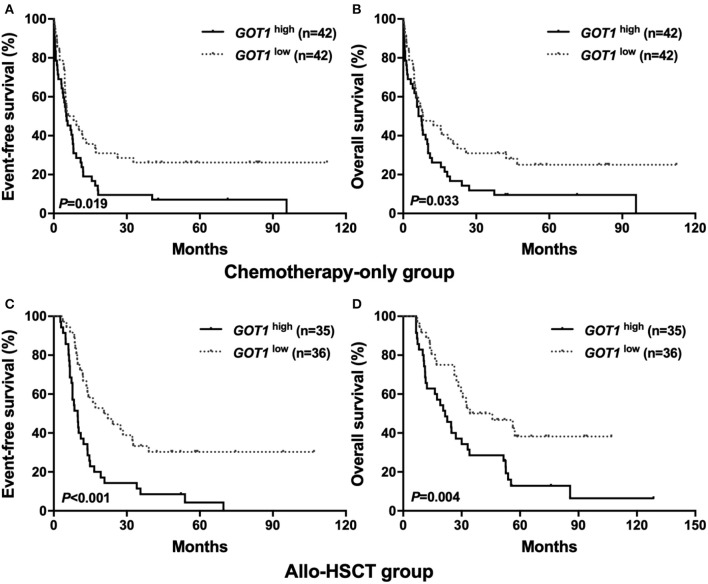
One of the key features of acute myeloid leukemia (AML), a group of very aggressive myeloid malignancies, is their strikingly heterogenous outcomes. Accurate biomarkers are needed to improve prognostic assessment. Glutamate oxaloacetate transaminase 1 (GOT1) is essential for cell proliferation and apoptosis by regulating cell's metabolic dependency on glucose. It is unclear whether the expression level of has clinical implications in AML. Therefore, we analyzed the data of 155 AML patients with expression information from The Cancer Genome Atlas (TCGA) database. Among them, 84 patients were treated with chemotherapy alone, while 71 received allogeneic hematopoietic stem cell transplantation (allo-HSCT). In both treatment groups, high expression was associated with shorter event-free survival (EFS) and overall survival (OS) (all < 0.05). Multivariate analysis identified several independent risk factors for both EFS and OS in the chemotherapy-only group, including high expression, age ≥60 years, white blood cell count ≥15 × 10/L, bone marrow blasts ≥70%, and or mutations (all < 0.05); but in the allo-HSCT group, the only independent risk factor for survival was high expression ( < 0.05 for both EFS and OS). Kyoto Encyclopedia of Genes and Genomes (KEGG) enrichment analysis showed that the genes related to expression were mainly concentrated in "hematopoietic cell lineage" and "leukocyte transendothelial migration" signaling pathways. Collectively, expression may be a useful prognostic indicator in AML, especially in patients who have undergone allo-HSCT.
急性髓系白血病(AML)是一组极具侵袭性的髓系恶性肿瘤,其关键特征之一是预后结果显著异质性。需要准确的生物标志物来改善预后评估。谷氨酸草酰乙酸转氨酶1(GOT1)通过调节细胞对葡萄糖的代谢依赖性,对细胞增殖和凋亡至关重要。尚不清楚其表达水平在AML中是否具有临床意义。因此,我们分析了来自癌症基因组图谱(TCGA)数据库的155例有该表达信息的AML患者的数据。其中,84例患者仅接受化疗,而71例接受了异基因造血干细胞移植(allo-HSCT)。在两个治疗组中,高表达均与无事件生存期(EFS)和总生存期(OS)缩短相关(所有P<0.05)。多因素分析确定了仅接受化疗组中EFS和OS的几个独立危险因素,包括高表达、年龄≥60岁、白细胞计数≥15×10⁹/L、骨髓原始细胞≥70%以及NPM1或FLT3突变(所有P<0.05);但在allo-HSCT组中,生存的唯一独立危险因素是高表达(EFS和OS的P均<0.05)。京都基因与基因组百科全书(KEGG)富集分析表明,与该表达相关的基因主要集中在“造血细胞谱系”和“白细胞跨内皮迁移”信号通路中。总体而言,该表达可能是AML中一个有用的预后指标,尤其是在接受allo-HSCT的患者中。