AUF DER BULT Diabetes Center for Children and Adolescents, Hannover, Germany.
Institute for Epidemiology and Medical Biometry,ZIBMT,Ulm University, Ulm, Germany.
Diabetes Technol Ther. 2021 Aug;23(8):527-536. doi: 10.1089/dia.2020.0675. Epub 2021 Jul 23.
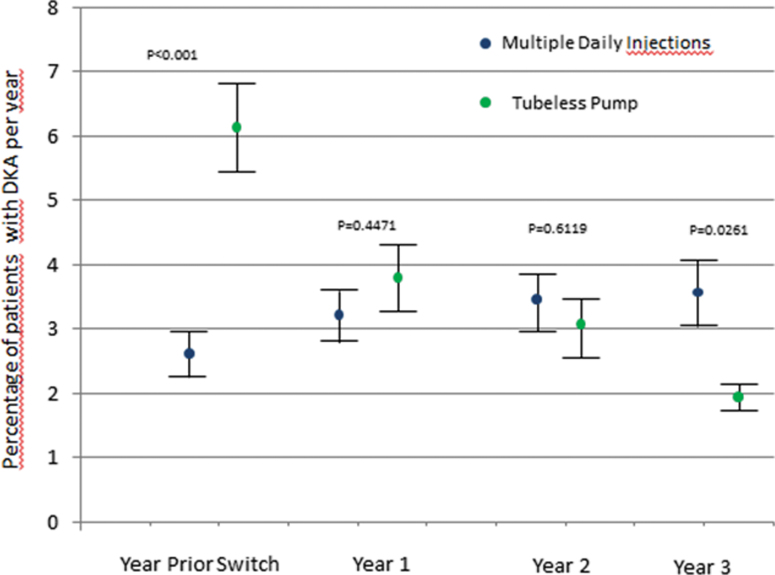
To characterize patients with diabetes treated with a tubeless insulin pump (Omnipod Insulin Management System; Insulet Corp., Acton, MA), and to evaluate the frequency of acute complications with long-term use of the system. This retrospective analysis of the German/Austrian Diabetes Patienten Verlaufsdokumentation (DPV) registry included data from 3657 patients with diabetes ( = 3582 type 1, = 25 type 2, = 50 latent autoimmune diabetes in adults/other) treated with a tubeless insulin pump. Hemoglobin A1c (HbA1c) levels and frequency of diabetic ketoacidosis (DKA) and severe hypoglycemia (SH) were compared between 1 year pre- and 1 year ( = 2911) or up to 3 years ( = 1311) post-tubeless insulin pump initiation and compared with a contemporary cohort on multiple daily injections (MDI) with 3-year data ( = 1874). Patients using tubeless insulin pump therapy had a median age of 13.7 years [interquartile range 10.8, 17.3], diabetes duration 3.7 years [1.7, 8.0], and HbA1c 7.5% [6.9, 8.2]. In patients with 3 years of follow-up data ( = 1311), the percentage with ≥1 episode of DKA, SH (Level 3, requiring assistance), and SH (coma) event with prior treatment was 6.3%, 5.5%, and 1.7%, respectively. After 3 years of tubeless insulin pump therapy, the frequency of DKA, SH (Level 3), and SH (coma) decreased to 2.2%, 4.1%, and 0.5%, respectively. Both DKA and SH remained significantly lower compared with MDI after adjustment in multiple regression analysis. High treatment retention rates (>90%) were observed. Real-world registry data document that tubeless insulin pump therapy is associated with good glycemic control and a low frequency of DKA and SH in an age group prone to acute complications.
为了描述使用无管胰岛素泵(Omnipod Insulin Management System;Insulet Corp.,马萨诸塞州阿克顿)治疗的糖尿病患者的特征,并评估该系统长期使用时急性并发症的发生频率。这项对德国/奥地利糖尿病患者病程记录(DPV)登记处的回顾性分析纳入了 3657 名使用无管胰岛素泵治疗的糖尿病患者( = 3582 型 1 例, = 25 型 2 例, = 50 例成人隐匿性自身免疫性糖尿病/其他)的数据。比较了无管胰岛素泵治疗前 1 年和治疗后 1 年( = 2911 例)或长达 3 年( = 1311 例)时的糖化血红蛋白(HbA1c)水平和糖尿病酮症酸中毒(DKA)及严重低血糖(SH)的发生频率,并与接受多次每日注射(MDI)治疗且具有 3 年数据的同期队列( = 1874 例)进行了比较。使用无管胰岛素泵治疗的患者的中位年龄为 13.7 岁[四分位间距 10.8, 17.3],糖尿病病程 3.7 年[1.7, 8.0],HbA1c 7.5%[6.9, 8.2]。在具有 3 年随访数据的患者中( = 1311 例),既往治疗后发生≥1 次 DKA、SH(Level 3,需要帮助)和 SH(昏迷)事件的患者比例分别为 6.3%、5.5%和 1.7%。无管胰岛素泵治疗 3 年后,DKA、SH(Level 3)和 SH(昏迷)的频率分别降至 2.2%、4.1%和 0.5%。多因素回归分析调整后,DKA 和 SH 的发生率仍显著低于 MDI。观察到高治疗保留率(>90%)。真实世界登记处的数据表明,在易发生急性并发症的年龄组中,无管胰岛素泵治疗与良好的血糖控制和较低的 DKA 和 SH 发生率相关。