Department of Breast Imaging, Tianjin Medical University Cancer Institute and Hospital, Tianjin, China.
National Clinical Research Center for Cancer, Key Laboratory of Cancer Prevention and Therapy, Tianjin's Clinical Research Center for Cancer, Key Laboratory of Breast Cancer Prevention and Therapy, Tianjin Medical University, Ministry of Education, Tianjin, China.
BMC Med Imaging. 2021 Mar 8;21(1):43. doi: 10.1186/s12880-021-00565-9.
The purpose of this study was to investigate the relationship between breast density, age, and mammographic lesion type among Chinese breast cancer patients included in a large clinical dataset.
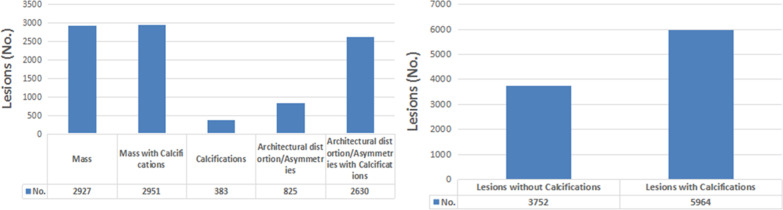
A review of mammographic images acquired between July 2014 and June 2017 from a total of 9716 retrospectively registered breast cancer patients was conducted. Mammographic breast density was defined according to the American College of Radiology Breast Imaging Reporting and Data System (ACR BI-RADS) 4-class density rating. Mammographic lesion types were defined according to the ACR BI-RADS, including mass, mass with calcifications, calcifications, architectural distortion/asymmetries, and architectural distortion/asymmetries with calcifications. Three experienced breast radiologists interpreted all mammograms. The chi-square (χ) test and Pearson correlation analyses were performed to assess the relationship between breast density, age, and mammographic lesion type.
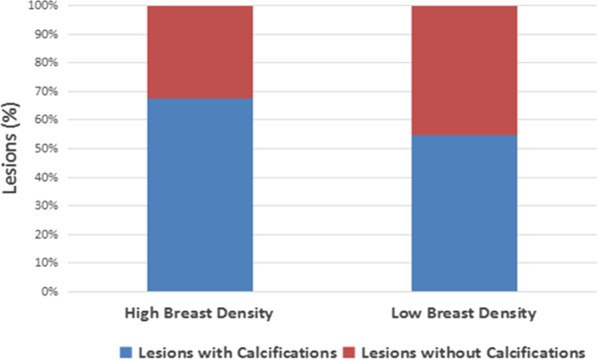
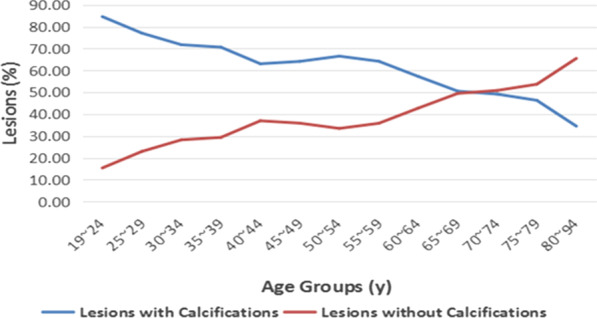
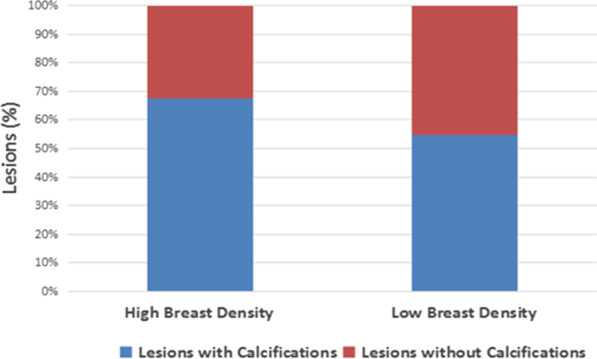
A significant inverse relationship was observed between the BI-RADS breast density rating given by radiologists and patient age (r = - 0.521, p < 0.01). The breast density distribution in breast cancer patients from China reversed at the age of 55 years, and exhibited one age peak in the age 55-59 year group. The percentage of lesions with calcifications decreased with increasing age (p < 0.01), and increased with increasing breast density (p < 0.01).
In general, we identified a relationship between patient breast density, age, and mammographic lesion type. This finding may provide a basis for clinical diagnoses and support development of breast cancer screening programs in China.
本研究旨在探讨中国乳腺癌患者大临床数据集的乳腺密度、年龄与乳腺影像学病变类型之间的关系。
回顾性分析 2014 年 7 月至 2017 年 6 月期间共 9716 例经注册的乳腺癌患者的乳腺 X 线摄影图像。乳腺密度根据美国放射学院乳腺影像学报告和数据系统(ACR BI-RADS)4 级密度分级标准定义。乳腺影像学病变类型根据 ACR BI-RADS 定义,包括肿块、肿块伴钙化、钙化、结构扭曲/不对称和结构扭曲/不对称伴钙化。由 3 名有经验的乳腺放射科医生对所有乳腺 X 线片进行解读。采用卡方检验(χ2 检验)和 Pearson 相关分析评估乳腺密度、年龄与乳腺影像学病变类型之间的关系。
放射科医生给出的 BI-RADS 乳腺密度分级与患者年龄之间呈显著负相关(r = -0.521,p<0.01)。中国乳腺癌患者的乳腺密度分布在 55 岁时发生逆转,在 55-59 岁年龄组出现一个年龄高峰。伴有钙化的病变百分比随年龄的增加而降低(p<0.01),随乳腺密度的增加而增加(p<0.01)。
总体而言,我们发现了患者的乳腺密度、年龄与乳腺影像学病变类型之间的关系。这一发现可能为临床诊断提供依据,并为中国的乳腺癌筛查计划提供支持。