Shuai Yu, Fan Erxi, Zhong Qiuyue, Chen Qiying, Feng Guangyong, Gou Xiaoxia, Zhang Guihai
Department of Respiratory and Critical Care Medicine, Guizhou Aerospace Hospital, Zunyi, 563000, Guizhou, People's Republic of China.
Affiliated Hospital of Zunyi Medical University, Zunyi, 563000, Guizhou, People's Republic of China.
Cancer Cell Int. 2021 Mar 8;21(1):159. doi: 10.1186/s12935-021-01850-x.
Human cell division cycle associated 8 (CDCA8) a key regulator of mitosis, has been described as a potential prognostic biomarker for a variety of cancers, such as breast, colon and lung cancers. We aimed to evaluate the potential role of CDCA8 expression in the prognosis of liver cancer by analysing data from The Cancer Genome Atlas (TCGA).
The Wilcoxon rank-sum test was used to compare the difference in CDCA8 expression between liver cancer tissues and matched normal tissues. Then, we applied logistic regression and the Wilcoxon rank-sum test to identify the association between CDCA8 expression and clinicopathologic characteristics. Cox regression and the Kaplan-Meier method were used to examine the clinicopathologic features correlated with overall survival (OS) in patients from the TCGA. Gene set enrichment analysis (GSEA) was performed to explore possible mechanisms of CDCA8 according to the TCGA dataset.
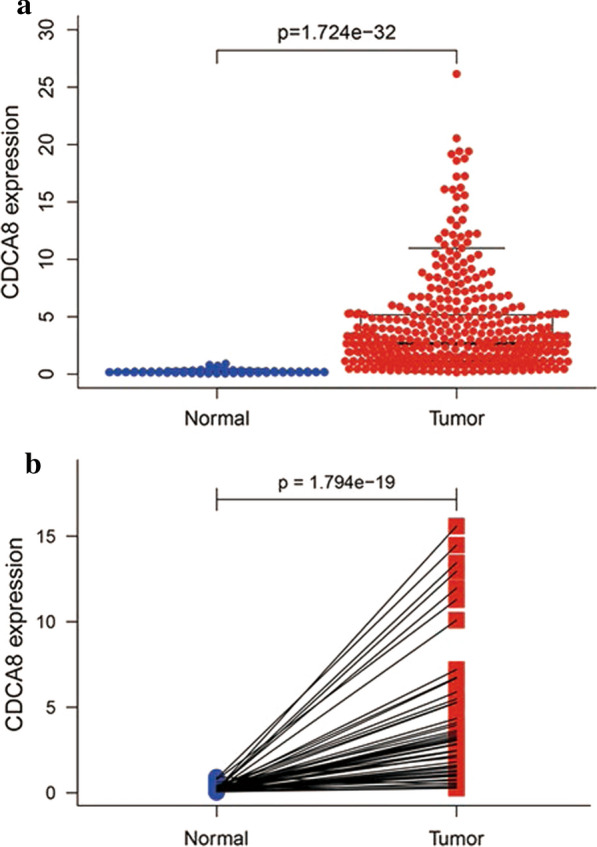
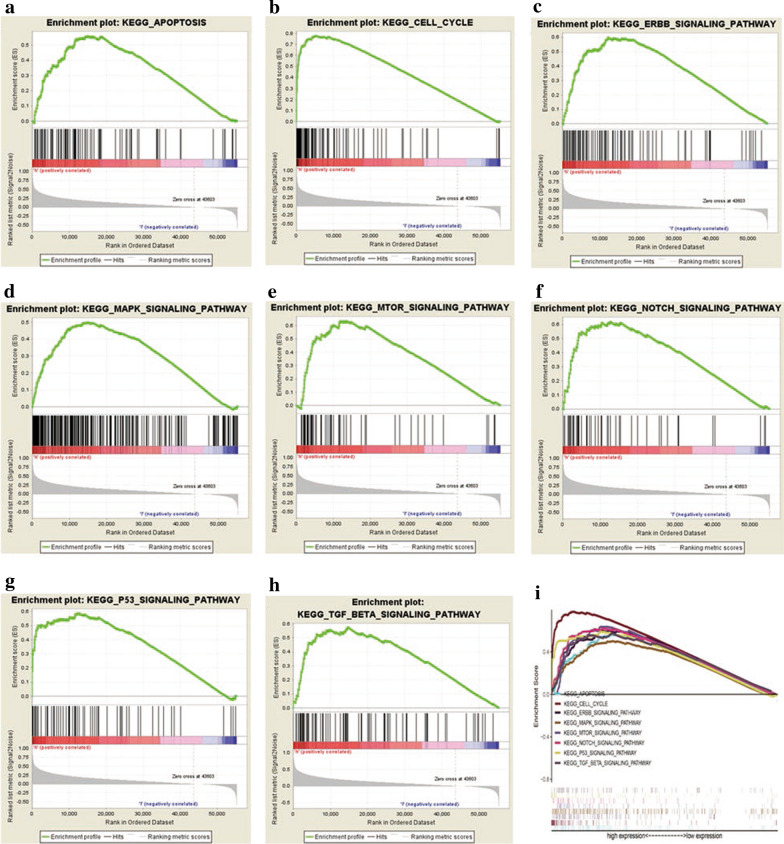
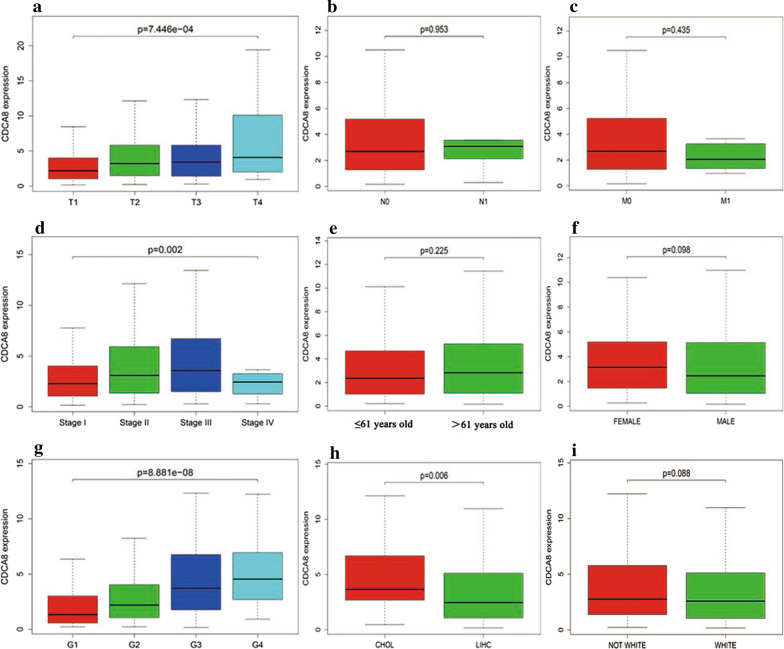
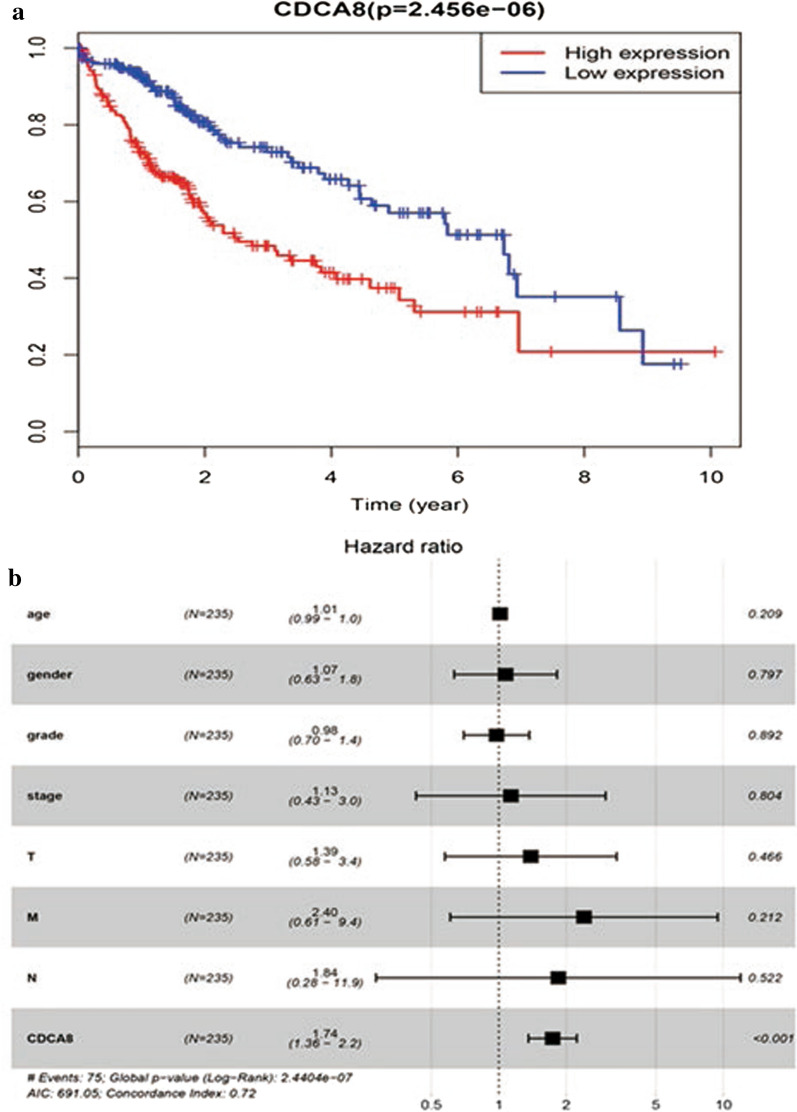
CDCA8 expression was higher in liver cancer tissues than in matched normal tissues. Logistic regression and the Wilcoxon rank-sum test revealed that the increased level of CDCA8 expression in liver cancer tissues was notably related to T stage (OR = 1.64 for T1/2 vs. T3/4), clinical stage (OR = 1.66 for I/II vs. III/IV), histologic grade (OR = 6.71 for G1 vs. G4) and histological type (OR = 0.24 for cholangiocarcinoma [CHOL] vs. hepatocellular carcinoma [LIHC]) (all P-values < 0.05). Kaplan-Meier survival analysis indicated that high CDCA8 expression was related to a poor prognosis in liver cancer (P = 2.456 × 10). Univariate analysis showed that high CDCA8 expression was associated with poor OS in liver cancer patients, with a hazard ratio (HR) of 1.85 (95% confidence interval [CI]: 1.47-2.32; P = 1.16 × 10). Multivariate analysis showed that CDCA8 expression was independently correlated with OS (HR = 1.74; CI: 1.25-12.64; P = 1.27 × 10). GSEA revealed that the apoptosis, cell cycle, ErbB, MAPK, mTOR, Notch, p53 and TGF-β signaling pathways were differentially enriched in the CDCA8 high expression phenotype.
High CDCA8 expression is a potential molecular predictor of a poor prognosis in liver cancer.
人类细胞分裂周期相关蛋白8(CDCA8)是有丝分裂的关键调节因子,已被描述为多种癌症(如乳腺癌、结肠癌和肺癌)的潜在预后生物标志物。我们旨在通过分析癌症基因组图谱(TCGA)的数据来评估CDCA8表达在肝癌预后中的潜在作用。
采用Wilcoxon秩和检验比较肝癌组织与配对正常组织中CDCA8表达的差异。然后,我们应用逻辑回归和Wilcoxon秩和检验来确定CDCA8表达与临床病理特征之间的关联。采用Cox回归和Kaplan-Meier法分析TCGA患者中与总生存期(OS)相关的临床病理特征。根据TCGA数据集进行基因集富集分析(GSEA),以探索CDCA8可能的作用机制。
肝癌组织中CDCA8表达高于配对的正常组织。逻辑回归和Wilcoxon秩和检验显示,肝癌组织中CDCA8表达水平的升高与T分期(T1/2期与T3/4期相比,OR = 1.64)、临床分期(I/II期与III/IV期相比,OR = 1.66)、组织学分级(G1级与G4级相比,OR = 6.71)和组织学类型(胆管癌[CHOL]与肝细胞癌[LIHC]相比,OR = 0.24)显著相关(所有P值<0.05)。Kaplan-Meier生存分析表明,CDCA8高表达与肝癌预后不良相关(P = 2.456×10)。单因素分析显示,CDCA8高表达与肝癌患者的OS不良相关,风险比(HR)为1.85(95%置信区间[CI]:1.47 - 2.32;P = 1.16×10)。多因素分析显示,CDCA8表达与OS独立相关(HR = 1.74;CI:1.25 - 12.64;P = 1.27×10)。GSEA显示,凋亡、细胞周期、ErbB、MAPK、mTOR、Notch、p53和TGF-β信号通路在CDCA8高表达表型中差异富集。
CDCA8高表达是肝癌预后不良的潜在分子预测指标。