Gao Jiuping, Yang Ting, Wang Xu, Zhang Yi, Wang Jing, Zhang Beilei, Tang Dihong, Liu Yanqiong, Gao Ting, Lin Qiuhui, Tang Jun, Cai Jingting
Department of Gynecological Oncology, The Affiliated Tumor Hospital of Xiangya Medical School of Central South University, Changsha, China.
Department of Gynecology and Obstetrics, Xiangya Hospital Central South University, Changsha, China.
Cancer Cell Int. 2021 Mar 8;21(1):157. doi: 10.1186/s12935-021-01817-y.
Uterine leiomyosarcoma (ULMS) is a malignant tumor found in the smooth muscle lining the walls of the uterus. Cancer stem cells (CSCs) are responsible for metastasis, drug resistance, and relapse of cancer, resulting in treatment failure. However, little is known about CSCs and their associated-markers in ULMS. We aimed to characterize and identify a subpopulation of CD133 cancer stem-like cells derived from SK-UT-1 cell line.
SK-UT-1 cells were sphere-forming cultured in vitro. We also sorted the CD133 cells derived from SK-UT-1 cell line by immunomagnetic beads. CD133 subpopulation and apoptotic cells were detected by flow cytometry. Self-renewal and anchorage-independent growth capabilities were examined using sphere and colony formation assays. The tumorigenicity of the fourth-passage spheres and parental SK-UT-1 cells was used by mouse xenograft model in vivo. Cell proliferation ability and sensitivity to doxorubicin (DXR) were assessed by CCK-8 assay. Cell migration and invasion were tested by wound healing assay or Transwell migration and invasion assays. Expressions of CSC-related marker were analyzed by Western blotting.
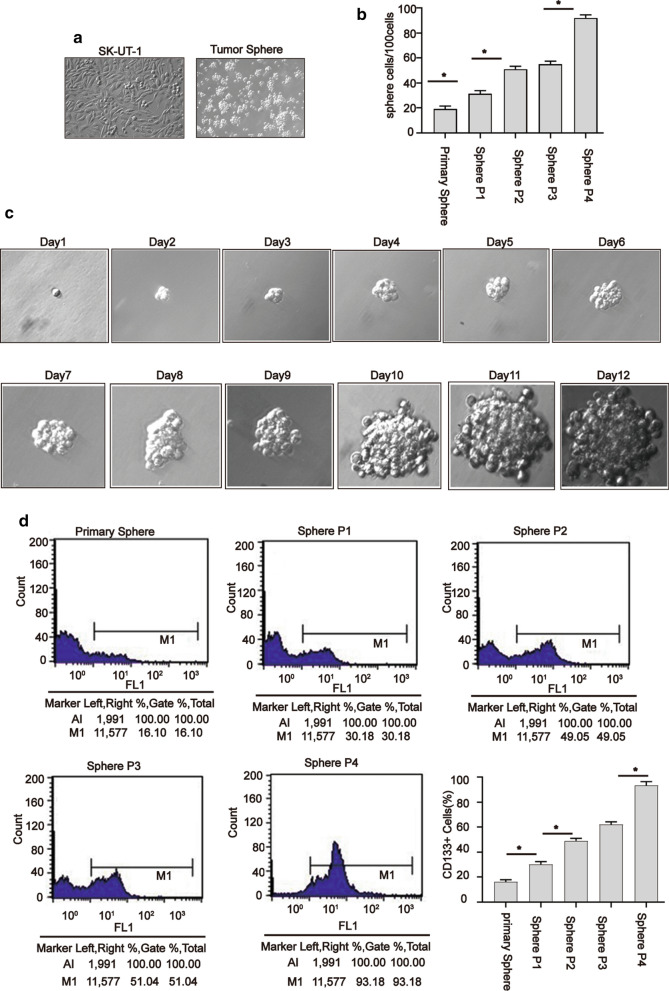
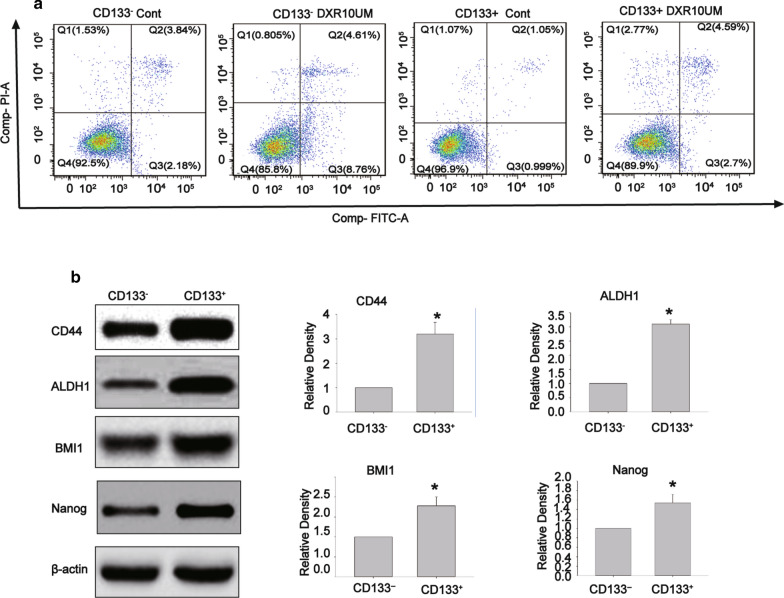
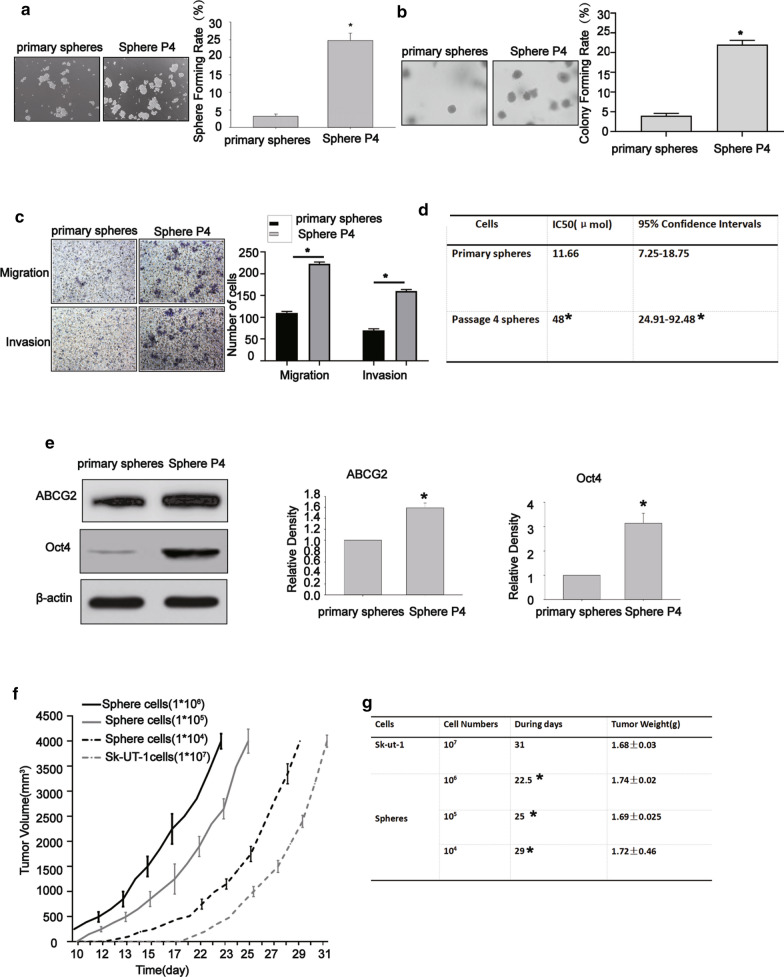
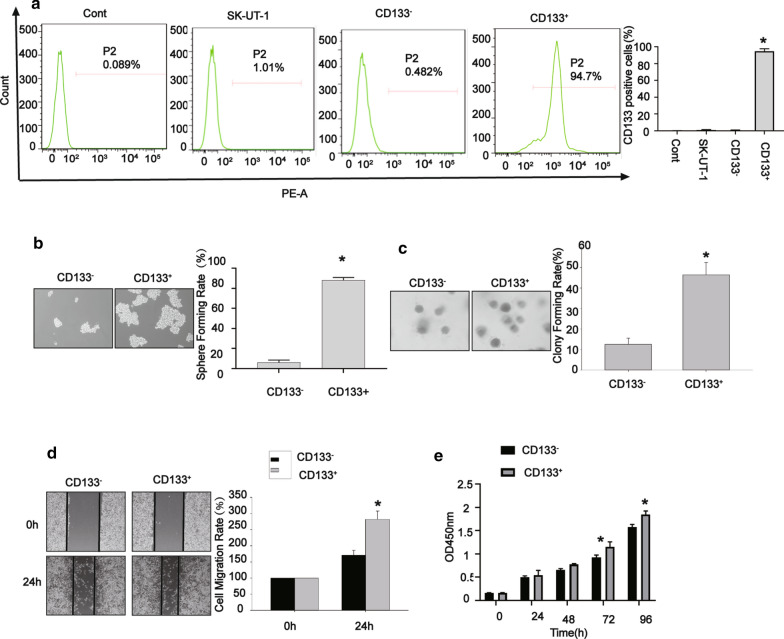
The fourth-passage spheres were defined as a CD133 cell population, which was accompanied by increase of sphere and colony forming rate, migration and invasion abilities, as well as drug-resistant properties in vitro. Moreover, the fourth-passage spheres showed a stronger tumorigenic potential in vivo. CD133 cell population sorted from SK-UT-1 line showed an increased ability in sphere and colony formation, proliferation, migration, invasion, resistance to apoptosis after treatment with doxorubicin (DXR) compared with CD133 cell population. The expression levels of CSCs-related markers (e.g., CD44, ALDH1,BMI1, and Nanog), were significantly elevated in CD133 cells compared with those in CD133 cells.
Collectively, our findings indicated that CD133 may be a significant marker for cancer stem-like cells, and it may be a potential therapeutic target for human ULMS.
子宫平滑肌肉瘤(ULMS)是一种在子宫壁平滑肌中发现的恶性肿瘤。癌症干细胞(CSCs)导致癌症转移、耐药及复发,最终致使治疗失败。然而,关于ULMS中的癌症干细胞及其相关标志物知之甚少。我们旨在对源自SK-UT-1细胞系的CD133癌症干细胞样细胞亚群进行表征和鉴定。
SK-UT-1细胞在体外进行成球培养。我们还通过免疫磁珠分选源自SK-UT-1细胞系的CD133细胞。通过流式细胞术检测CD133亚群和凋亡细胞。使用成球和集落形成试验检测自我更新和不依赖贴壁生长能力。通过小鼠异种移植模型在体内检测第四代球体和亲本SK-UT-1细胞的致瘤性。通过CCK-8试验评估细胞增殖能力和对阿霉素(DXR)的敏感性。通过伤口愈合试验或Transwell迁移和侵袭试验检测细胞迁移和侵袭。通过蛋白质印迹分析CSC相关标志物的表达。
第四代球体被定义为CD133细胞群体,其伴随着体外成球和集落形成率、迁移和侵袭能力以及耐药特性的增加。此外,第四代球体在体内显示出更强的致瘤潜力。与CD133细胞群体相比,从SK-UT-1系中分选的CD133细胞群体在成球和集落形成、增殖、迁移、侵袭、阿霉素(DXR)处理后抗凋亡能力方面有所增强。与CD133细胞相比,CD133细胞中CSCs相关标志物(如CD44、ALDH1、BMI1和Nanog)的表达水平显著升高。
总体而言,我们的研究结果表明CD133可能是癌症干细胞样细胞的重要标志物,并且可能是人类ULMS的潜在治疗靶点。