Medical Faculty, Institute of Cell Biology (Cancer Research), University of Duisburg-Essen, Essen, Germany.
Leukemia. 2021 Apr;35(4):968-981. doi: 10.1038/s41375-021-01204-6. Epub 2021 Mar 8.
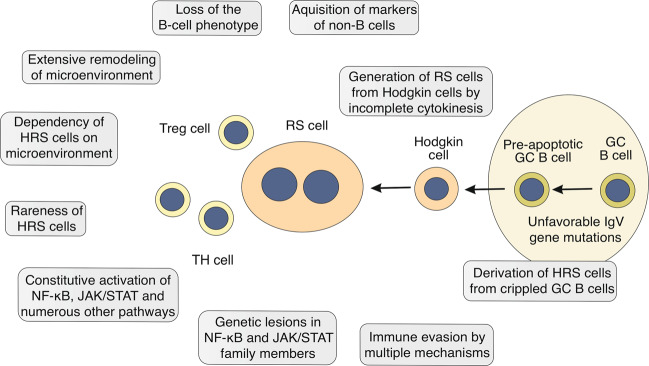
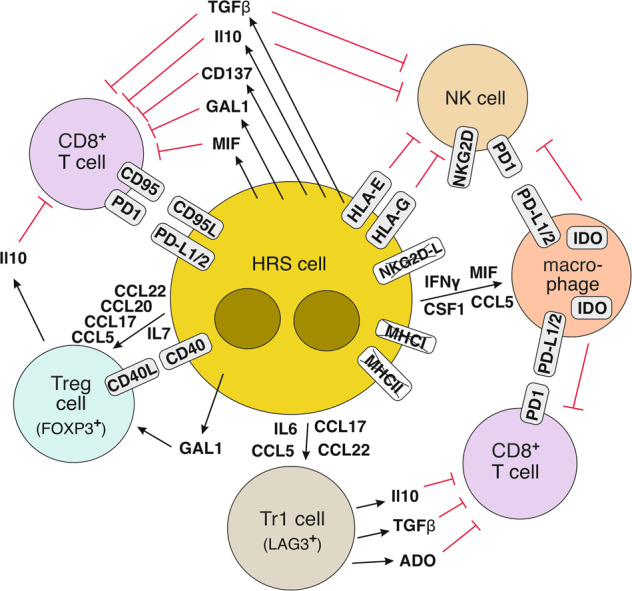
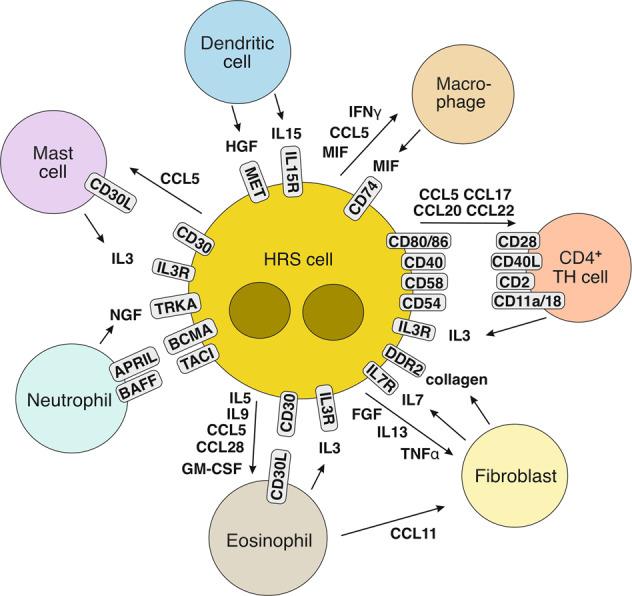
Classical Hodgkin lymphoma (cHL) is unique among lymphoid malignancies in several key biological features. (i) The Hodgkin and Reed-Sternberg (HRS) tumor cells are rare among an extensive and complex microenvironment. (ii) They derive from B cells, but have largely lost the B-cell typical gene expression program. (iii) Their specific origin appears to be pre-apoptotic germinal center (GC) B cells. (iv) They consistently develop bi- or multinucleated Reed-Sternberg cells from mononuclear Hodgkin cells. (v) They show constitutive activation of numerous signaling pathways. Recent studies have begun to uncover the basis of these specific features of cHL: HRS cells actively orchestrate their complex microenvironment and attract many distinct subsets of immune cells into the affected tissues, to support their survival and proliferation, and to create an immunosuppressive environment. Reed-Sternberg cells are generated by incomplete cytokinesis and refusion of Hodgkin cells. Epstein-Barr virus (EBV) plays a major role in the rescue of crippled GC B cells from apoptosis and hence is a main player in early steps of lymphomagenesis of EBV cHL cases. The analysis of the landscape of genetic lesions in HRS cells so far did not reveal any highly recurrent HRS cell-specific lesions, but major roles of genetic lesions in members of the NF-κB and JAK/STAT pathways and of factors of immune evasion. It is perhaps the combination of the genetic lesions and the peculiar cellular origin of HRS cells that are disease defining. A combination of such genetic lesions and multiple cellular interactions with cells in the microenvironment causes the constitutive activation of many signaling pathways, often interacting in complex fashions. In nodular lymphocyte predominant Hodgkin lymphoma, the GC B cell-derived tumor cells have largely retained their typical GC B-cell expression program and follicular microenvironment. For IgD-positive cases, bacterial antigen triggering has recently been implicated in early stages of its pathogenesis.
经典型霍奇金淋巴瘤(cHL)在多个关键生物学特征上与淋巴恶性肿瘤有所不同。(i)霍奇金和里德-斯特恩伯格(HRS)肿瘤细胞在广泛而复杂的微环境中非常罕见。(ii)它们来源于 B 细胞,但已基本丧失了 B 细胞典型的基因表达程序。(iii)它们的特定起源似乎是凋亡前的生发中心(GC)B 细胞。(iv)它们通常从单核霍奇金细胞中发育成双或多核的里德-斯特恩伯格细胞。(v)它们表现出许多信号通路的持续激活。最近的研究开始揭示 cHL 这些特定特征的基础:HRS 细胞积极协调其复杂的微环境,并吸引许多不同的免疫细胞亚群进入受影响的组织,以支持其存活和增殖,并创造一个免疫抑制环境。里德-斯特恩伯格细胞是由不完全的胞质分裂和霍奇金细胞的融合产生的。EB 病毒(EBV)在拯救凋亡的 GC B 细胞方面起着重要作用,因此是 EBV cHL 病例中淋巴瘤发生早期的主要参与者。目前对 HRS 细胞中遗传损伤的分析尚未发现任何高度反复出现的 HRS 细胞特异性损伤,但 NF-κB 和 JAK/STAT 通路成员以及免疫逃避因素的遗传损伤发挥着重要作用。也许是遗传损伤和 HRS 细胞的特殊细胞起源的结合定义了疾病。这些遗传损伤和与微环境中的细胞的多种细胞相互作用的结合导致许多信号通路的持续激活,这些信号通路通常以复杂的方式相互作用。在结节性淋巴细胞为主型霍奇金淋巴瘤中,GC B 细胞来源的肿瘤细胞在很大程度上保留了其典型的 GC B 细胞表达程序和滤泡微环境。对于 IgD 阳性病例,最近有研究表明细菌抗原触发在其发病机制的早期阶段起作用。