Shaw Crystal, Hayes-Larson Eleanor, Glymour M Maria, Dufouil Carole, Hohman Timothy J, Whitmer Rachel A, Kobayashi Lindsay C, Brookmeyer Ron, Mayeda Elizabeth Rose
Fielding School of Public Health, Department of Epidemiology, University of California, Los Angeles.
Fielding School of Public Health, Department of Biostatistics, University of California, Los Angeles.
JAMA Netw Open. 2021 Mar 1;4(3):e211001. doi: 10.1001/jamanetworkopen.2021.1001.
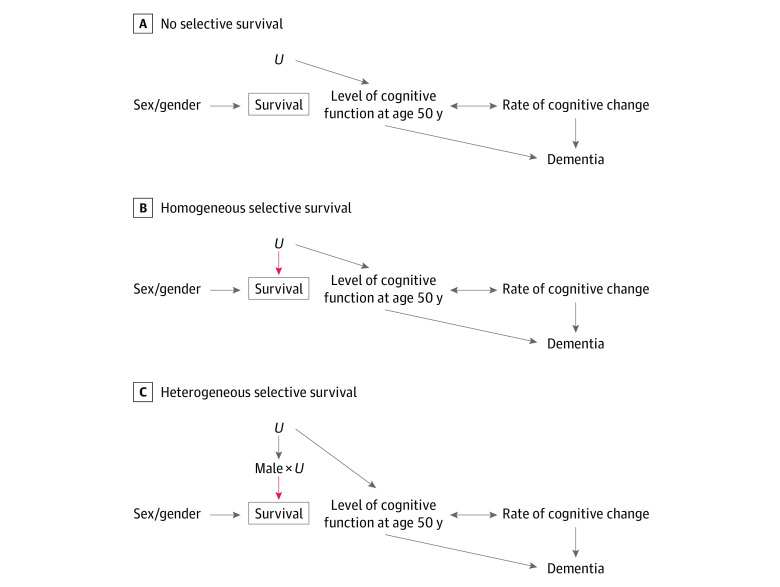
Dementia research is susceptible to bias arising from selective survival, a process that results in individuals with certain characteristics disproportionately surviving to old age. Spurious associations between risk factors and dementia may be induced when factors associated with longer survival also influence dementia incidence.
To assess the role of selective survival in explaining reported sex/gender differences in dementia incidence.
DESIGN, SETTING, AND PARTICIPANTS: This decision analytical model used a simulated cohort of US participants aged 50 years and without dementia at baseline followed up for incident dementia through age 95 years. Selective survival was induced by a selection characteristic (eg, childhood social disadvantage or Alzheimer genetic risk) that influenced both mortality and dementia incidence at varying magnitudes. Data analysis was performed from April 2018 to May 2020.
Sex/gender, conceptualized as the combination of biological sex and social consequences of gender.
Dementia incidence rate ratios (IRRs) for women compared with men. In all simulations, it was assumed that there would be no true effect of sex/gender on dementia incidence; all observed sex/gender differences were due to selective survival.
At baseline, the simulation included 100 000 participants aged 50 years (51 000 [51%] women, mirroring the 1919-1921 US birth cohort of non-Latino White individuals at age 50 years); distributions of the selection characteristic were standard normal (mean [SD], 0.0 [1.0]). Observed sex/gender differences in dementia incidence in individuals aged 85 years or older ranged from insignificant (IRR, 1.00; 95% CI, 0.91-1.11) to consistent with sex/gender differences (20% higher risk for women [IRR, 1.20; 95% CI, 1.08-1.32]) reported in an extant study. Simulations in which bias was large enough to explain prior findings required moderate to large differential effects of selective survival (eg, hazard ratio for selection characteristic on mortality at least 2.0 among men, no effect among women).
These results suggest that selective survival may contribute to observed sex/gender differences in dementia incidence but do not preclude potential contributions of sex/gender-specific mechanisms. Further research on plausibility of selection characteristics with outcomes of the magnitude required for selective survival to explain sex/gender differences in dementia incidence and sex/gender-specific mechanisms represent an opportunity to understand prevention and treatment of dementia.
痴呆症研究容易受到选择性生存所产生的偏差影响,选择性生存是一个导致具有某些特征的个体在老年时存活比例过高的过程。当与更长生存期相关的因素也影响痴呆症发病率时,可能会诱发风险因素与痴呆症之间的虚假关联。
评估选择性生存在解释所报告的痴呆症发病率中性别差异方面的作用。
设计、设置和参与者:这个决策分析模型使用了一个模拟队列,其中美国参与者年龄为50岁,基线时无痴呆症,随访至95岁时发生痴呆症。通过一个选择特征(如儿童时期的社会劣势或阿尔茨海默病遗传风险)诱发选择性生存,该特征对死亡率和痴呆症发病率有不同程度的影响。数据分析于2018年4月至2020年5月进行。
性别,概念化为生物性别和性别的社会后果的组合。
女性与男性的痴呆症发病率比(IRR)。在所有模拟中,假设性别对痴呆症发病率没有真正影响;所有观察到的性别差异都是由于选择性生存导致的。
在基线时,模拟包括100000名50岁的参与者(51000名[51%]女性,反映了1919 - 1921年美国50岁非拉丁裔白人出生队列);选择特征的分布为标准正态分布(均值[标准差],0.0[1.0])。在85岁及以上个体中观察到的痴呆症发病率的性别差异范围从无显著差异(IRR,1.00;95%置信区间,0.91 - 1.11)到与一项现有研究报告的性别差异一致(女性风险高20%[IRR,1.20;95%置信区间,1.08 - 1.32])。偏差大到足以解释先前研究结果的模拟需要选择性生存有中度到较大的差异效应(例如,选择特征对男性死亡率的风险比至少为2.0,对女性无影响)。
这些结果表明,选择性生存可能导致观察到的痴呆症发病率中的性别差异,但并不排除性别特异性机制的潜在作用。进一步研究具有足以解释痴呆症发病率性别差异所需程度结果的选择特征的合理性以及性别特异性机制,是理解痴呆症预防和治疗的一个机会。