Yamashita Tadashi, Roces Ramon Emilio Daniel, Ladines-Llave Cecilia, Reyes Tuliao Maria Teresa, Wanjira Kamau Mary, Yamada Chika, Tanaka Yuko, Shimazawa Kyoko, Iwamoto Saori, Matsuo Hiroya
Kobe City College of Nursing, Kobe, Japan.
Hospital of Muntinlupa, Muntinlupa, Philippines.
Patient Prefer Adherence. 2021 Mar 1;15:501-510. doi: 10.2147/PPA.S291939. eCollection 2021.
The World Health Organization advocates that all pregnant women in areas where anemia is prevalent receive supplements of iron and folic acid. However, owing to a myriad of factors, the uptake of iron and folic acid supplementation (IFAS) is still low in many countries. Therefore, this study was conducted to assess the prevalence of IFAS and its associated factors among pregnant women.
A cross-sectional study was conducted at a hospital in Muntinlupa, Philippines, between March and August 2019 among 280 pregnant women. A systematic random sampling technique was used to select participants. Data were collected using interviewer-administered questionnaires. Multivariable logistic regression analyses were employed to identify factors associated with the prevalence of IFAS among pregnant women.
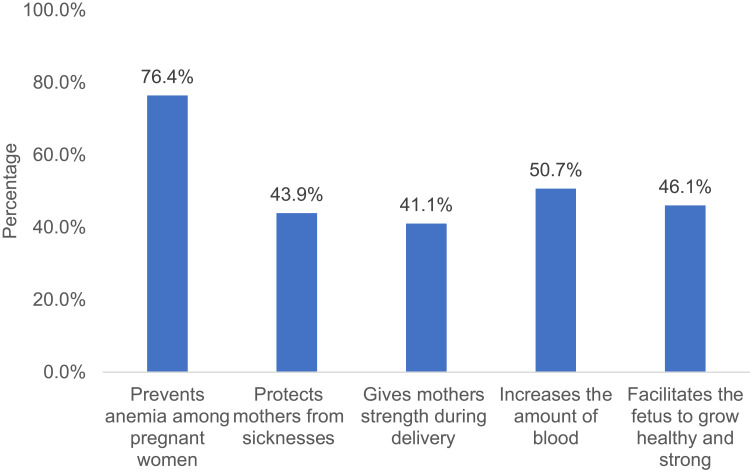
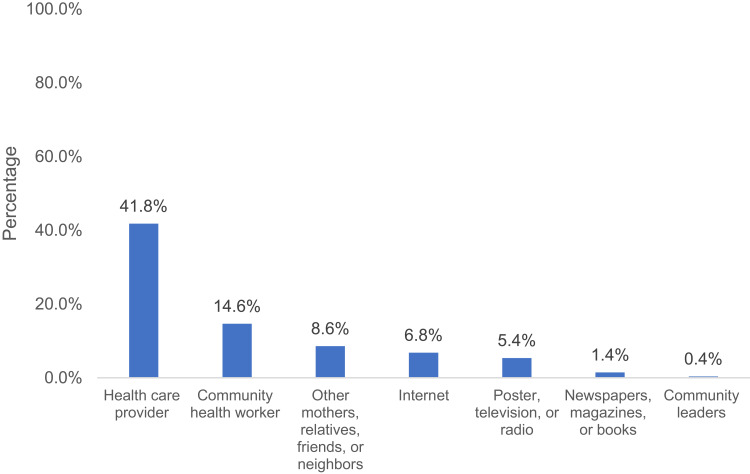
Among 280 pregnant women, a majority (85.6%, n= 238) took IFAS during pregnancy. Among the respondents, 128 (45.9%) women had knowledge about signs and symptoms of anemia, 126 (45.3%) had knowledge of the benefits associated with IFAS, and 42 (15.4%) had knowledge about side effects associated with IFAS. The main sources of information about IFAS were health care providers (41.8%), followed by community health workers (CHWs) (14.6%). Maternal knowledge concerning IFAS benefits (OR = 2.50, CI = 1.04-5.97, p=0.04) was positively associated with the prevalence of IFAS.
Maternal knowledge about the benefits of taking IFAS was significantly associated with the prevalence of IFAS among pregnant women in Muntinlupa, Philippines. There is a pressing need to improve health education on the benefits of IFAS among pregnant women to increase its prevalence. This emphasizes the necessity of increased involvement of health care providers and CHWs to increase women's knowledge of IFAS benefits and support them through pregnancy.
世界卫生组织倡导在贫血流行地区的所有孕妇补充铁和叶酸。然而,由于众多因素,许多国家铁和叶酸补充剂(IFAS)的服用率仍然很低。因此,本研究旨在评估孕妇中IFAS的服用率及其相关因素。
2019年3月至8月在菲律宾门廷卢帕市的一家医院对280名孕妇进行了一项横断面研究。采用系统随机抽样技术选择参与者。通过访谈员管理的问卷收集数据。采用多变量逻辑回归分析来确定与孕妇中IFAS服用率相关的因素。
在280名孕妇中,大多数(85.6%,n = 238)在孕期服用了IFAS。在受访者中,128名(45.9%)女性了解贫血的体征和症状,126名(45.3%)了解IFAS的益处,42名(15.4%)了解IFAS的副作用。关于IFAS的主要信息来源是医疗保健提供者(41.8%),其次是社区卫生工作者(CHWs)(14.6%)。孕妇对IFAS益处的了解(OR = 2.50,CI = 1.04 - 5.97,p = 0.04)与IFAS的服用率呈正相关。
在菲律宾门廷卢帕市,孕妇对服用IFAS益处的了解与IFAS的服用率显著相关。迫切需要加强对孕妇进行关于IFAS益处的健康教育,以提高其服用率。这强调了医疗保健提供者和社区卫生工作者增加参与度的必要性,以提高女性对IFAS益处的认识,并在整个孕期为她们提供支持。